By Joe Udo
JONGLEI (CONVERSEER) – South Sudan’s fragile healthcare system is under renewed scrutiny after a state governor reportedly travelled abroad for treatment, highlighting the deepening crisis within the country’s public health sector.
Riek Gai Kok, the governor of Jonglei State, recently flew to Nairobi in neighbouring Kenya for treatment after suffering high blood pressure. Humanitarian groups cited the trip as another example of how political elites continue to seek medical care abroad while domestic health services deteriorate.
South Sudan, which gained independence in 2011, has struggled to rebuild institutions after years of civil war. According to Transparency International, the country consistently ranks among the most corrupt in the world, a situation critics say has undermined essential public services such as healthcare.
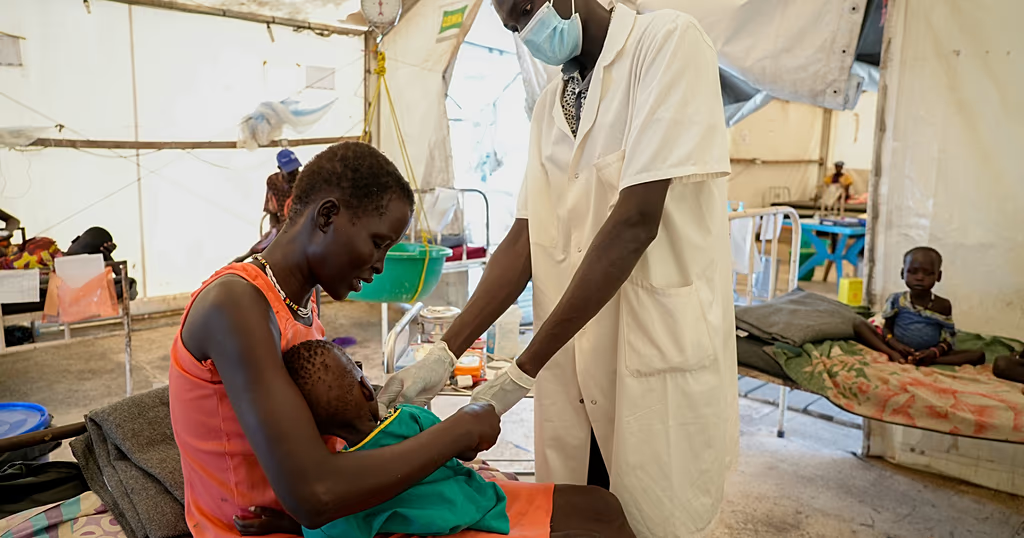
The situation has worsened as the country edges closer to renewed conflict between rival political factions. With state health services largely non-functional, more than 80 per cent of healthcare provision in the country is delivered by international humanitarian organisations.
Major medical services are currently run by groups such as the International Committee of the Red Cross and Doctors Without Borders, which operate hospitals and emergency care facilities across the country.
At a military hospital in the capital, Juba, a wounded soldier described his surprise at receiving medical evacuation after being injured in combat.
“[When] I was shot, I thought I was dead,” said 33-year-old Ajuong Deng, who sustained a gunshot wound to the leg.
He was rescued and transported to hospital by the Red Cross, not government forces. The organisation runs a surgical unit inside the Juba Military Hospital, where it also provides financial incentives to local staff to ensure the facility remains operational.
“If we don’t pay them then no one stays here,” said one humanitarian worker who requested anonymity.
Government salaries for medical staff, typically ranging from $10 to $50 per month, have reportedly not been paid for several months.
A senior humanitarian worker acknowledged the unusual arrangement, stating: “This is not what we’re supposed to be doing.”
Cycle of violence
Inside the Juba hospital, clinicians continue to treat victims of conflict as violence spreads across parts of the country.
Some patients arrive with severe injuries and limited access to immediate treatment due to poor infrastructure. South Sudan has only about 300 kilometres of paved roads, many of which become impassable during the rainy season, often causing wounds to become infected before patients reach medical facilities.
As a result, amputations are common, though survivors frequently face social stigma.
“There is a belief that amputees are not a human being anymore,” said Angeth Jervas Majok, head physiotherapist for the Red Cross facility. “A lot of patients cannot go back home.”
Majok recalled treating one patient who returned repeatedly with new injuries sustained in ongoing violence.
“I have actually had one patient who came back four times,” she said. “On the fifth time, unfortunately we lost him.”
The fighting is part of a broader cycle of violence involving clashes between government forces and opposition groups, as well as ethnic militias and cattle raiders in rural communities.
The United Nations reports that more than 5,100 civilians have been killed in recent violence, with hundreds of thousands displaced. The organisation has warned the country risks sliding into another full-scale civil war.
South Sudan’s previous conflict in the 2010s left about 400,000 people dead.
Worsening health outcomes
Despite receiving large volumes of foreign assistance, South Sudan’s health indicators remain among the worst globally.
The World Bank estimates life expectancy in the country at just 58 years, a figure that has barely improved since independence.
Maternal mortality stands at 1,223 deaths per 100,000 births, far higher than the global average of about 197. According to UNICEF, one in ten children in the country dies before reaching the age of five.
Since 2011, South Sudan has earned more than $25 billion from oil revenues, yet only one per cent of the national budget was allocated to healthcare this year. The United Nations says much of the funding intended for the sector fails to reach hospitals or local communities.
Nearly 92 per cent of the population now lives below the poverty line.
Healthcare workers also face serious risks. Facilities operated by Doctors Without Borders have been attacked 11 times in the past year alone, while the Red Cross surgical unit in Juba is equipped with blast doors and emergency supplies in case of armed sieges.
International donors are increasingly frustrated with the lack of reforms. The United States has warned it could withdraw funding unless governance improves, while some aid organisations are reducing their presence due to declining donations and security concerns.
The Red Cross confirmed it plans to gradually scale down operations in one of its facilities while attempting to strengthen local medical capacity.
Meanwhile, Ateny Wek Ateny acknowledged the government faces financial constraints but said efforts were underway to address the challenges.
“There are liquidity difficulties,” he told AFP, while rejecting claims by Transparency International that South Sudan ranks as the world’s most corrupt country.
“I don’t know what criteria they have used to rank South Sudan as the most corrupt country in the world,” he said.