How a 2010 UN promise left households facing fines, farmers facing ruin, data centres unaccountable, and taxpayers footing the bill.
THE RATIONALS

This is a companion piece to last week’s article ‘It Is a Criminal Offence to Water Your Tomatoes. It Remains Perfectly Legal to Cool a Data Centre’. It reveals that Britain told the United Nations in 2010 it recognised a human right to water — then spent the next sixteen years making sure no one could ever claim it in court. The result, households face criminal fines, farmers face ruin by administrative letter, and data centres face no questions at all.
In July 2010, the United Nations General Assembly asked itself a modest question, is access to clean water a human right? A hundred and twenty-two countries said yes. None voted no. Forty-one abstained, Britain among them, in the diplomatic equivalent of suddenly finding something fascinating to read on your phone when the bill arrives.
That vote might have stayed a footnote, except Britain is now three separate live arguments deep into what water actually means in practice, a country facing hosepipe bans most summers, a farming sector rationed by administrative letter, and a data-centre boom nobody is required to measure the thirst of. Understanding what Britain actually promised in 2010 turns out to explain all three.
Two months later, Britain filed its formal explanation for that abstention with the UN’s Human Rights Council — the sort of document nobody reads twice, which is unfortunate, because it says something rather more interesting than the abstention itself suggested.
It states plainly:
“The United Kingdom does consider that there is a right to water, which is an element of the right to an adequate standard of living in Article 11 of the International Covenant on Economic, Social and Cultural Rights.”
Almost nobody currently arguing about hosepipe bans, farm curtailments or data-centre water use appears to have read this sentence. Which is a shame, because it is the whole story.
So there it is. On paper, at the United Nations, in a document nobody has bothered to withdraw, Britain has been sitting on an acknowledged right to water for sixteen years.
But it is a right that has never been given force in a British court, never been written into domestic statute, and never once been allowed to interfere with a hosepipe ban, a farm abstraction licence, or the unmetered thirst of a data centre. It is the diplomatic equivalent of a vow made with fingers crossed behind the back — acknowledged abroad so it cannot be denied, and carefully left unenforceable at home so it cannot be used.
Here is the part that actually matters. Not all international promises count as domestic law. Britain has signed two different human-rights treaties. One of them, the European Convention on Human Rights, was formally written into UK law by the Human Rights Act 1998 — which is why a British court can actually enforce it. The other, the treaty Britain cited as the basis for its right to water, was never given that same treatment. It was signed, acknowledged, and left outside the courtroom door.
A British citizen cannot walk into a British court and invoke it. There is no statute that gives it force. Britain accepted the principle, filed the paperwork, and never once got round to building it a body to live in — an impressively durable piece of cross-party consensus.
That gap is the real story.
For the householder it means a criminal fine.
For the farmer it means a livelihood held on a licence that can be pulled without appeal.
For the taxpayer it means a £104 billion bill for a scarcity crisis nobody with a right could have forced the state to plan around properly.
And for the data-centre operator, the same gap means something entirely different, not a burden, but an exemption. No right for anyone to invoke means no duty on anyone to disclose — and the industry drawing the most water in Britain today is the one party in this piece with nothing to answer for.

Fast forward to October 2024. In a Westminster Hall debate on the water industry’s various catastrophes, an MP tells the assembled room that water is fundamentally a human right, and that everyone needs to use it at some point — a statement roughly as contestable as noting that Tuesday follows Monday. Nobody blinks. Nobody rises to add the qualification that would actually matter.
In one sense he is correct, Britain’s own government has said exactly that, in writing, since 2010. In the sense that actually counts to anyone standing in front of a magistrate over a hosepipe, he is not correct at all, because the right he is describing exists nowhere he could point a court to.
This is not really a criticism of the MP, who was almost certainly saying what every person in the room assumed to be true and legally operative. It is a criticism of everyone else — the civil servants, the special advisers, the several governments of two different parties — who have had sixteen years to notice that Britain acknowledged a right to water and then never gave it a single domestic tooth, and have simply never mentioned it.
It is rather like a company issuing a warranty on its finest letterhead and never once establishing a way to actually claim on it. The warranty is real. Do go ahead and try using it.
There is, admittedly, one place in Britain where something closer to an enforceable right to water survives in law — though it is not the place most people would guess, and not, on reflection, a comforting discovery.
The European Court of Human Rights, whose judgments bind Britain through the Human Rights Act, has repeatedly found that inadequate access to water in detention can amount to a violation of Article 3’s prohibition on inhuman or degrading treatment.
A free citizen has no equivalent claim, because the covenant Britain cited for the right to water was never given the same domestic force as the one covering prisoners. Britain guards your access to water rather more jealously once you have been convicted of a crime than while you remain innocent and merely thirsty in your own kitchen.
Governments acknowledge things at the UN constantly, often at no real cost, since covenants they haven’t domesticated cost them nothing but the ink to sign. What’s remarkable is how completely everyone downstream has assumed Britain’s acknowledgment must mean something operative.
The University of North Carolina’s School of Government, which produces widely cited policy literature on water disconnection law, holds Britain up as a model case — noting that the UK’s blanket ban on disconnecting household water supplies means, in its words, that essentially the entire population has guaranteed access to water.
True as far as it goes. But it conflates two separate things, a consumer-protection statute Parliament could repeal on a quiet Thursday afternoon, and the right Britain says it “considers” to exist under a treaty with no force in a British court. An American academic institution has mistaken a policy outcome for a legal guarantee, and nobody in Britain has thought the distinction worth correcting — possibly because that would mean admitting the guarantee doesn’t actually exist.
The industry’s financial record since privatisation is rather less flattering. Regulator-based analysis puts water companies’ cumulative dividends since 1989 somewhere between £52.7 billion, using Ofwat’s own unadjusted data, and £78 billion, using inflation-adjusted Financial Times research to 2023 — much of it flowing to overseas shareholders, and frequently raised by MPs in exactly the language of rights and violations.
But you cannot sue a water company for violating a right with no domestic legal existence. The complaint about the money is correct. The idea a citizen has a legal instrument to act on it is a fantasy.
It is worth being precise about what British law actually contains, because the gap between the promise and the statute book is where this entire article lives.
Britain acknowledged a right to water under an international covenant it never bothered to bring home. No Water Rights Bill was ever introduced. No amendment to the Water Industry Act ever created one. Not forty minutes of parliamentary time were found for the question, across three general elections and two changes of governing party.
What domestic law actually contains instead is narrower, a provision, tucked into the Water Industry Act 1999, preventing water companies from disconnecting a household’s supply over unpaid bills. That is a perfectly serviceable piece of consumer protection — and about as far from a human right as a loyalty card is from a peerage.
A right creates a standing legal claim and imposes a duty on the state to weigh it against competing interests. A disconnection ban is simply a policy Parliament made, and could unmake over a long lunch. Nothing compels the state to consider a citizen’s water security when deciding what else to permit in the same catchment, because the only right anyone ever acknowledged was filed with the United Nations — and never once invited into an actual British courtroom.
This distinction sounds academic. It is not. It is the entire explanation for everything that follows, and it is roughly the size of the gap between what a wedding speech promises and what a prenup actually enforces.
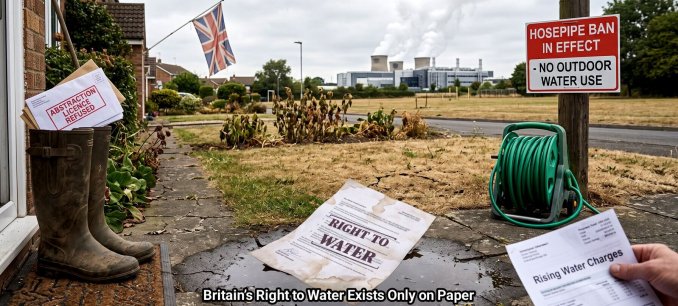
Start with the household, because it is the plainest case and the one everyone assumes is already protected. It is not. Under Section 76 of the Water Industry Act 1991 — a different Act from the one providing the disconnection ban discussed above, and considerably less sentimental about it — anyone caught using a hosepipe during a temporary use ban is guilty of a criminal offence, liable on summary conviction to a fine “not exceeding level 3 on the standard scale,” currently £1,000.
This is not hypothetical, it has existed, essentially unchanged, since 1991. What is genuinely strange is how rarely it has ever been used — most major English water companies have confirmed they have never actually fined anyone for breaching a hosepipe ban, preferring a stern word to a summons.
That is, in its own way, the more damning fact, a standing criminal offence, almost never enforced, kept on the statute book regardless, like a smoke alarm nobody has changed the battery on in thirty-five years but nobody will admit to taking down either. Nobody prosecuted, or threatened with prosecution, has ever been able to point a magistrate to a right that outweighs the restriction, because no such right exists for them to point to. They are not being denied a right. They never had one to be denied.
Consider the modern data centre — the industry the government has designated, with some fanfare, as Critical National Infrastructure. A data centre in England today faces no legal obligation whatsoever to disclose how much water it uses. Not a light-touch obligation, not a threshold to breach before anyone asks a question. None.
This is not a gap in enforcement. It is a gap in the underlying legal claim that would have compelled disclosure in the first place. Nobody has a right to know, because nobody has a right to the water being taken — which is a convenient state of affairs for an industry whose growth plans depend on nobody adding it up.
Analysis of anonymised market data, carried out by WRc for MOSL — the body running England’s non-household water retail market — and corroborated in written evidence to Parliament, found consumption is not spread evenly. Six facilities account for roughly two-thirds of measured sector water consumption, with the single largest site responsible for more than a quarter of everything analysed.
The same analysis found something worse than the raw volume, the largest sites lean on hybrid cooling systems that switch from air to water precisely once temperatures rise, meaning their thirstiest mode of operation activates in the same heatwaves that trigger hosepipe bans for everyone else.
It is true, and worth stating plainly, that a separate industry survey found more than half of England’s data centres now use waterless cooling entirely — genuine progress, and no reason to pretend the whole sector is one undifferentiated drain. But that statistic is precisely what makes the concentration finding more damning, not less, most sites have already worked out how to use little or no water, which means the handful still drawing heavily, at the worst possible moment, are choosing not to, at a scale nobody is required to disclose and nobody is required to justify.
The state has built an entire architecture of statutory protection around this industry’s electricity supply, cyber-security, and planning permissions — a dedicated Whitehall team, priority access to the National Cyber Security Centre, a fast-track regime bypassing local councils. It has built nothing equivalent around the resource the industry depends on to keep its servers cool, because there was never a right sitting underneath that resource for the architecture to protect. An industry the government is prepared to fast-track through planning has not, in the same breath, been asked to fast-track a single meter reading.
Consider the farmer, thirty miles down the same river catchment. He does not hold a right either. He holds a licence — administratively granted, administratively revocable, and increasingly revoked at short notice as droughts intensify.
A farmer who loses irrigation for a fortnight during a critical growing window risks the crop, the season’s income, and in bad years the ability to service whatever loan bought the equipment now sitting idle in his yard. That can be ruin, arrived at by administrative letter rather than bankruptcy court.
Defra’s own water White Paper, “A New Vision for Water,” published January 2026, is the flagship reform of the sector, and agriculture appears in it mainly as a pollution and permitting problem — new rules on agricultural runoff, and extended permitting from pig and poultry farms to some dairy and beef operations.
It does also commit to supporting farm reservoirs and rainwater harvesting, so the picture isn’t total neglect. But the weighting is telling, a document built around water security discusses farming considerably more as a source of the problem than as a sector whose own survival depends on the resource running out. A right would have to be weighed against that competition. A licence can simply be withdrawn.
Consider the taxpayer, currently underwriting a £104 billion, five-year investment programme to fix Britain’s water infrastructure — funded through bills and, increasingly, general taxation, which is the polite way of saying everyone pays regardless of whether they’ve ever met a data centre.
Nowhere in the legal framework does the ordinary billpayer’s interest carry a formal claim to be prioritised over any other user’s. They are being asked, politely, to fund the absence of a right — without ever being told, in the documents that decide how large the bill needs to be, how much of it exists because an entire category of large industrial user was never required to say how much water it was taking in the first place.
And consider Wales, which manages the genuinely impressive feat of being denied sovereignty over its own water twice over. Here is the mechanism, in order. Unlike Scotland and Northern Ireland, Wales has never had full legislative control over the water within its own borders. Section 48 of the Wales Act 2017 would fix that — but only if Welsh ministers formally ask the UK government to switch it on. Nobody has asked.
Worse than that, campaigners citing a Freedom of Information response say Welsh ministers actually asked for the process to be delayed — a remarkable position for a government to take on the question of governing its own rain. The practical result, billions of litres are transferred out of Wales each year, for what campaigners have called pennies, while Welsh households pay some of the highest water bills in Britain for the privilege of watching it leave.
An entire nation, inside a country that told the UN it believed water was a human right, unable to secure so much as the right to decide what happens to the water falling on its own hills.

It is worth pausing on how isolated Britain’s posture looks in comparison, not that Britain has shown much appetite lately for such comparisons. The European Parliament voted 550 to 22, with 66 abstentions, in 2022 to reaffirm access to drinking water as a human right — worth noting honestly that this vote, like Britain’s own position, was framed around the EU’s “external dimension,” not a binding domestic guarantee.
The parallel is not that Europe has solved this and Britain hasn’t. It’s that even an institution voting on the aid-facing version of the question did so by a landslide, repeatedly, while Britain has never once brought its own acknowledged right to a domestic vote at all — content, it seems, to have said the sentence once, sixteen years ago, and considered the matter closed.
Nobody sat in a room in 2010 and plotted to leave British farmers, householders and the people who live next to data centres without legal recourse for sixteen years — that would require someone to have thought about it. It is something duller and more damning: a government made a promise it had no intention of ever having to keep, because it never built the machinery that would let anyone hold it to it.
It does not need to be a conspiracy to be a failure. It only requires everyone assuming somebody else has already checked. The MP assumed the right existed in enforceable form because Britain had said, in writing, that it existed. The academics assumed a consumer-protection statute was the right in action. The water companies never volunteered the correction. Successive governments, Conservative and Labour alike, found it easier to let the assumption stand than admit the promise had always been decorative.
Britain did not fail to protect a right to water. It told the United Nations it believed in one, filed the document, and then spent sixteen years building a water system as though the promise had never been made — no disclosure duty for the industry drawing the most, no standing claim for the farmer, nothing beyond a rarely-used criminal fine for the householder, and a £104 billion bill now arriving at the taxpayer’s door to fix a shortfall the acknowledged right was, on paper, supposed to guard against.
A country that never claimed to believe in the right could at least plead consistency. Britain cannot.
Britain has a human right to water. It is simply not one that anyone can claim in court.
Somewhere in Whitehall, there is a file containing the 2010 explanation of position, its central sentence — that the United Kingdom does consider there to be a right to water — never once quoted back to the ministers who have spent the years since building policy as though it were never written.
It would take one civil servant, one afternoon, and one search of gov.uk to find it. Nobody has thought it worth the trip. Britain has a signed receipt it has never honoured.
The cost of living survey has had a decent response so far. It remains open a while longer for anyone who hasn’t yet filled it in. It takes less than three minutes. Your answers are read, not filed. If you haven’t done it yet, now would be the time. Tell us what you think. Thank you.

••••
••••
••••
••••
(UKR)