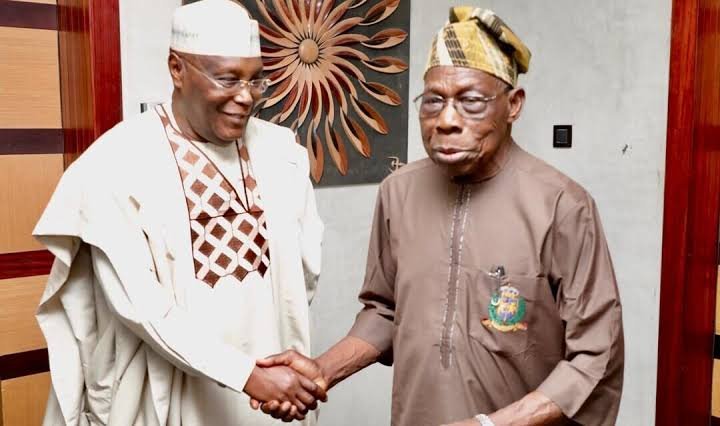
Former Vice President Atiku Abubakar has accused former President Olusegun Obasanjo of allowing personal resentment to distort the history of their eight-year administration, saying he has no regrets about opposing the former president’s bid for a third term.
Atiku, the presidential candidate of the African Democratic Congress (ADC) in the 2027 election, said his decision to oppose the controversial third-term agenda was based on his commitment to the Constitution and to Nigeria’s democracy.
He was responding to remarks by Mr Obasanjo, who on Friday described his decision to select Atiku as his running mate in the 1999 presidential election as the biggest mistake of his political career.
In a statement issued on Saturday by his Senior Special Assistant on Public Communication, Phrank Shaibu, Atiku said Mr Obasanjo’s latest comments were another attempt to rewrite the history of their political relationship and his administration.
Atiku said he watched the former president’s comments “with profound sadness, not anger,” arguing that they reflected a man whose personal grievances had overshadowed historical facts.
He said the source of Mr Obasanjo’s longstanding hostility towards him was well known, pointing to his opposition to the attempt to amend the Constitution to enable the former president to remain in office beyond the constitutionally permitted two terms.
“I am proud that I stood against the third-term agenda. I am proud that I stood by the Constitution of the Federal Republic of Nigeria. I have no apology whatsoever for frustrating every attempt to subvert our democracy for personal ambition,” he said.
Atiku said if Mr Obasanjo’s resentment towards him was rooted in his refusal to support the third-term bid, he considered the resentment a badge of honour.
“If Chief Obasanjo’s bitterness stems from my refusal to support an unconstitutional third term, then I wear that resentment as a badge of honour.
“No individual, regardless of his status or accomplishments, is bigger than the Federal Republic of Nigeria. The Constitution is supreme, and I chose Nigeria over personal loyalty,” he said.
According to him, the disagreement over the third-term agenda was not a personal battle between him and Mr Obasanjo but a struggle to preserve constitutional democracy for future generations.
“The Nigerian people won that battle. Democracy won that battle. History has already delivered its verdict,” he said.
Atiku said it was therefore ironic that the same person whose ambition he claimed to have opposed on constitutional grounds was now criticising those who resisted the move.
Atiku also rejected any attempt to diminish his contribution to the economic policies of the Obasanjo administration.
He drew attention to comments by the Director-General of the World Trade Organisation (WTO), Ngozi Okonjo-Iweala, who, according to the statement, had praised the economic management team he led as vice president.
Atiku said the remarks came less than 24 hours before Mr Obasanjo’s latest comments.
“Whether or not the timing is merely coincidental is for Nigerians to judge. What is beyond dispute, however, is that while distinguished Nigerians who served at the highest levels continue to acknowledge my contributions to one of Nigeria’s most successful periods of economic management, Chief Obasanjo appears determined to diminish them,” he said.
He said Mr Obasanjo was free to disregard his contribution to the administration, but that the historical record would ultimately speak for itself.
“Chief Obasanjo may choose not to appreciate my role in building one of Nigeria’s most prosperous economic eras, but history has been far kinder. The record speaks for itself, and so do the testimonies of those who worked closely with that administration,” he said.
Atiku also recalled his relationship with Mr Obasanjo before the latter became president, saying he had supported the former military ruler during his imprisonment and later helped him politically.
Mr Obasanjo was imprisoned by the military government of the late General Sani Abacha in 1995 after being convicted of involvement in an alleged coup plot. He was released in June 1998 following Abacha’s death and the subsequent transition towards civilian rule.
Atiku said he supported Mr Obasanjo’s family while he was in prison and worked with others to secure his release.
“History records that while Chief Obasanjo was in prison, I stood firmly by him. I supported his family, worked tirelessly with other patriots for his release and never wavered in my belief that he deserved his freedom,” he said.
He further claimed that after Mr Obasanjo’s release, he provided personal and political assistance to him.
“When he eventually regained his freedom, he had little to his name. I received him, clothed him, ensured he was properly cared for and extended every support necessary to help him regain his footing.
“Beyond that, I mobilised political structures, built alliances and made enormous personal and political sacrifices that culminated in his emergence as president of the Federal Republic of Nigeria,” he said.
Atiku said he did not regret supporting Mr Obasanjo, stressing that he did not expect personal repayment for the assistance.
“Do I regret helping Chief Obasanjo? Absolutely not. When God gives you the opportunity to lift another human being, you do so without expecting repayment. Acts of kindness are matters of conscience, not commercial transactions,” he said.
He nevertheless accused Mr Obasanjo of failing to acknowledge the role he played in his political journey.
“If the true history of Chief Obasanjo’s political journey is ever written—free from selective recollection and personal bitterness—Atiku Abubakar will feature prominently as one of those whom God used to change the course of his life and political career,” he said.
Atiku also criticised Mr Obasanjo for revisiting old political disputes at a time he said Nigerians were grappling with serious economic and security challenges.
He cited economic hardship, unemployment, insecurity and widespread despair as issues that should command the attention of political leaders ahead of the 2027 election.
“The 2027 election should be about rebuilding Nigeria, restoring security, reviving the economy and giving hope to the next generation—not reopening old political wounds,” he said.
Atiku said he had deliberately refrained from responding to Mr Obasanjo’s previous criticisms because of his respect for the office of president and the relationship they once shared.
He, however, warned that his restraint should not be interpreted as an inability or unwillingness to respond.
“That restraint should never be mistaken for weakness or docility,” he said.
“There comes a point when silence in the face of repeated distortions of history ceases to be a virtue. While I have no desire to engage in a public quarrel with a man I once stood beside in his most difficult moments, neither will I permit falsehoods, half-truths and calculated attempts to rewrite history to go unanswered.”
Atiku said Mr Obasanjo was entitled to his personal opinions and grievances but should not present disputed claims as facts.
“Chief Obasanjo is entitled to his opinions. He is entitled to his personal grievances. What he is not entitled to are his own facts,” he said.
Messrs Obasanjo and Atiku were elected president and vice president respectively on the platform of the Peoples Democratic Party (PDP) in 1999 and were re-elected in 2003.
Their relationship, however, deteriorated during their second term, particularly over the controversy surrounding attempts to amend the Constitution to permit Mr Obasanjo to seek a third term.
Atiku opposed the move and the disagreement contributed to the collapse of their political relationship.
The former vice president later left the PDP for the Action Congress and contested the 2007 presidential election against the PDP’s candidate, Umaru Yar’Adua.
The dispute also resulted in a constitutional battle after Mr Obasanjo declared Atiku’s office vacant following his defection from the PDP.
The Supreme Court subsequently ruled that the president lacked the constitutional authority to remove an elected vice president from office.
Mr Obasanjo has repeatedly criticised Atiku since their time in office, while the latter has also defended his role in the administration and his opposition to the former president’s third-term bid.
(Premium Times)