•How APC, PDP, ADC, NDC plot to garner votes of Nigeria’s largest region
By Fred Itua, Abuja; Noah Ebije, Sola Ojo, Kaduna; Olanrewaju Lawal, Birnin Kebbi
As political calculations for the 2027 general elections gather momentum, Nigeria’s North West is once again shaping up as the country’s most strategic electoral battleground.
Comprising seven states, Kaduna, Kano, Katsina, Jigawa, Kebbi, Sokoto and Zamfara, the region remains the nation’s most vote-rich geopolitical zone and has historically served as the electoral backbone of the All Progressives Congress (APC).
Remarkably, following Zamfara Governor Dauda Lawal’s defection from the Peoples Democratic Party (PDP) in March 2026 and Kano Governor Abba Kabir Yusuf’s earlier move from the New Nigeria Peoples Party (NNPP) in January 2026, the APC now controls the governorship in all seven North West states, a dominance unmatched anywhere else in the federation.
Yet, political dominance of this scale does not automatically translate into electoral invincibility. Worsening insecurity, economic hardship, succession battles, godfather rivalries and the fragmentation of the opposition into competing platforms, the APC, the PDP, the African Democratic Congress (ADC) and the newly formed Nigeria Democratic Congress (NDC), could still reshape the electoral landscape ahead of the polls.
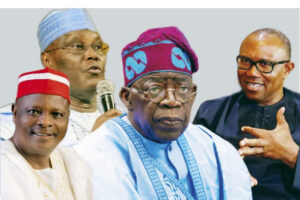
Each of these four parties now carries a distinct national character. The APC is the party of incumbency and federal patronage. The PDP, though diminished by the departure of Atiku Abubakar, retains legacy structures in states such as Bauchi and Oyo and residual loyalty in the North West. The ADC, built in 2025 around Atiku, David Mark and Nasir El Rufai, positions itself as the primary northern opposition vehicle. The NDC, the newest entrant, carries Peter Obi and Rabiu Kwankwaso and is still establishing itself legally and in organisation.
This analysis examines the political dynamics likely to define one of Nigeria’s most closely watched electoral contests, state by state, before placing President Bola Ahmed Tinubu side by side with Kwankwaso to assess where each man truly stands in the region.
Kaduna: Battle without godfather
As Nigeria gradually enters the build up to the 2027 general elections, Kaduna State is once again emerging as one of the country’s most consequential political battlegrounds. Home to one of the largest voting populations in Nigeria, and often regarded as a microcosm of the country’s religious, ethnic and political diversity, Kaduna will likely play a significant role in shaping the national electoral landscape.
The dominant issues remain insecurity and the cost of living. Despite government efforts to improve security, banditry and kidnapping continue to affect several rural local government areas, including Birnin Gwari, Giwa, Chikun, Kajuru, Igabi and parts of Kachia. Attacks on farming communities have disrupted production and supply chains, contributing to rising food prices alongside broader national inflationary pressures. With about 4.3 million registered voters, even modest shifts in rural turnout could significantly influence the outcome.
The APC holds a clear edge, built on the incumbency of Governor Uba Sani, who is seeking a second term without the backing of a single dominant godfather, having steadily built a political identity distinct from that of his predecessor, Nasir Ahmad El-Rufai. Sani was affirmed unopposed by APC delegates with 459,393 votes, and benefits from federal alignment through the Speaker of the House of Representatives, Tajudeen Abbas.
However, Kaduna promises one of the most spectacular fights in the entire region. Isa Ashiru, a two time former PDP governorship candidate who polled more than 719,000 votes against Sani in 2023, has emerged as the ADC’s governorship candidate after winning the party’s primary with 86,113 votes. Ashiru’s candidacy is strengthened considerably by his alliance with El Rufai, described by observers as the soul of opposition politics in Kaduna.
The PDP has fielded Shehu Usman Bawa, though the party’s traditional base in the state has visibly declined. Political figures to watch include Sani, Ashiru, El Rufai and Wamakko style grassroots mobilisers within the APC structure. Whether Ashiru can convert the sympathy generated by his narrow 2023 defeat into a winning coalition, and whether El Rufai’s loyalists remain within the APC fold or chart an independent course, are likely to determine whether Sani secures a comfortable second term or faces the toughest battle of his career.
Kano: The great political swap
Kano’s 2027 contest has become the most volatile in the entire North West, defined by a dramatic swap of political camps. Governor Abba Kabir Yusuf, who rode the Kwankwasiyya movement to victory under the NNPP in 2023, defected to the APC on 26 January 2026, a move that triggered the resignation of his own deputy governor, Aminu Abdulsalam Gwarzo, in protest.
The dominant issue in Kano is not insecurity in the conventional sense but the fracture of a once formidable political movement, alongside the perennial concerns of youth unemployment and the state’s commercial economy. The APC currently holds the structural edge, having absorbed Yusuf’s entire government, 22 members of the State House of Assembly and eight federal lawmakers, while former APC National Chairman Abdullahi Ganduje declared Yusuf the party’s sole governorship candidate for 2027.
Yet, the APC’s advantage is contested fiercely. Kwankwaso, having left the NNPP and briefly the ADC, now leads the NDC in Kano, where his loyalist Aminu Abdulsalam Gwarzo has emerged as governorship candidate, with the 2023 APC candidate Nasiru Gawuna also defecting to the NDC to contest the Kano Central senatorial seat. The NDC itself remains a young and legally contested platform, having been founded only recently and facing court challenges over its registration with the Independent National Electoral Commission, an uncertainty that opposition figures in Kano privately admit could complicate its ability to field candidates smoothly should the litigation drag into the election year.
Analysts describe Kano North as APC leaning, Kano Central as tilting toward the opposition bloc, and Kano South as the genuine swing zone that both camps are scrambling to control. Major figures include Yusuf, Ganduje, Kwankwaso, Gwarzo and Gawuna, whose overlapping rivalries and alliances make Kano arguably the most unpredictable state in Nigeria. Whether the Kwankwasiyya base stays loyal to its founder or follows the sitting governor into the APC will decide the contest, and given Kano’s status as the North West’s most populous state after Kaduna, the outcome will carry outsized weight in the national presidential tally as well.
Katsina: A stronghold meets a restless electorate
Katsina remains one of the APC’s strongest strongholds nationally, yet the contest is increasingly shaped by governance rather than party loyalty alone. Banditry has become the defining issue across many rural communities, disrupting farming, displacing villages and making travel dangerous, while the security crisis has evolved into an economic one as agricultural production has declined in affected areas.
The APC enjoys a clear edge here. Governor Dikko Umaru Radda is eligible for, and expected to secure, a second term, which removes the succession battles weakening ruling parties elsewhere. This is also the home state of late President Muhammadu Buhari. Despite the APC’s dominance, identity politics, religious networks, traditional institutions and Hausa Fulani solidarity, remains a powerful mobilising force, though these factors are increasingly complemented rather than replaced by voter expectations on security and livelihoods.
Voters, analysts note, no longer separate the cost of living from insecurity in their own minds; the two have become, in effect, a single grievance. With more than 3.5 million registered voters, Katsina’s outcome could meaningfully influence the national presidential contest
Kebbi: Succession battle behind strong development record
In Kebbi, Governor Nasir Idris has, by most accounts, delivered strongly on infrastructure, welfare and support for traditional and religious institutions, and enters 2027 with the advantages of incumbency and firm backing from President Tinubu’s federal structure. The dominant issue shaping the contest is less insecurity, though banditry along the Nigeria Niger Republic border remains a concern in places such as Zuru Emirate, and more a battle over political succession within the APC’s own ranks.
The APC holds the clear edge, but the party must first navigate hurdles from within before facing the opposition. Former Attorney General of the Federation Abubakar Chika Malami is positioning for the ADC governorship ticket, while Senator Bala Ibn Na’Allah, once tipped as Malami’s running mate, remains a formidable if unresolved factor.
Senator Garba Musa Maidoki’s defection from the APC to the ADC has also unsettled Kebbi South Senatorial District, though APC stakeholders argue that Idris’s development record, particularly the roughly sixty four billion naira road project linking Koko and Dabai in Zuru Emirate, has endeared the electorate to his administration.
The APC’s four emirates, Gwandu, Argungu, Yauri and Zuru, have historically split their loyalties, and it is this internal balancing act, as much as any opposition threat, that will occupy the governor’s attention most between now and the polls. Major figures include Idris, Malami, Na’Allah and Maidoki, whose rivalries will determine whether Kebbi South, historically the most contested of the state’s senatorial districts, tilts toward APC or ADC.
Jigawa: Calm on security, fractured opposition
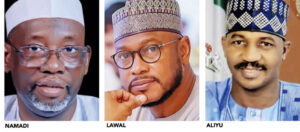
Jigawa stands out as comparatively stable in security terms, meaning campaigns there focus more on governance, agriculture and economic development than on banditry. Governor Umar Namadi has secured APC’s consensus nomination for a second term with what party officials describe as roughly ninety five per cent internal agreement, backed by former governors Ali Sa’ad Birnin Kudu and Ibrahim Saminu Turaki.
The APC retains a commanding edge, reinforced by its entrenched grassroots dominance across the populous Hadejia, Dutse, Gumel and Ringim emirates, and by the recent defection of federal lawmaker Shitu Galambi from the NNPP. However, the party is not without internal strain. Former Speaker Idris Gwaram defected to the PDP after losing his APC ticket, and the opposition, though fragmented, is showing signs of life.
The PDP has settled on Mustapha Sule Lamido, son of former governor Sule Lamido, as its consensus candidate, while the ADC’s Sabo Muhammad Nakudu, a former two term senator who defected from the APC, has emerged as a potential outlet for aggrieved APC members and protest votes; tellingly, Nakudu’s own local government area, Birnin Kudu, is also Lamido’s base, setting up a direct local contest between the two opposition figures even before either can turn attention to the APC.
The NDC remains, by most accounts, virtually absent in Jigawa. Major figures to watch are Namadi, Mustapha Sule Lamido and Nakudu, though observers broadly agree that fragmented opposition currently gives Namadi’s APC the upper hand.
Sokoto: Godfather politics and a caliphate’s influence
Sokoto is shaping into a key arena where incumbency, godfather politics and religious identity intersect. Governor Ahmed Aliyu has been affirmed as APC’s candidate for a second term, and his position is reinforced by the enduring patronage of Senator Aliyu Magatakarda Wamakko, the state’s dominant political godfather, whose structure recaptured Sokoto from the PDP in 2023.
As the seat of the Sokoto Caliphate, religion and traditional institutions play an outsized role in political mobilisation here, and candidates are expected to combine identity based appeals with policy proposals on security, education and youth employment. The APC enjoys the clearest edge of any North West state, owing to the Aliyu Wamakko partnership and a historic infrastructure budget exceeding seven hundred and fifty billion naira. The PDP, meanwhile, remains fractured into rival factions, one aligned with FCT Minister Nyesom Wike and another with Bello Aliyu Goronyo and former minister Kabiru Tanimu Turaki, and has yet to settle on a unifying governorship aspirant.
The ADC has stepped up grassroots mobilisation, attracting figures such as former Minister of Transport Yusuf Suleiman, former Deputy Governor Manir Muhammad Dan Iya and former commissioner Faruku Malami Yabo, while former governor Aminu Waziri Tambuwal remains an influential, if now more nationally focused, factor; critics argue his own tenure left too little visible infrastructure to serve as a rallying point for a fresh opposition bid, even as his loyal supporters insist his national profile could still be converted into local votes if he chooses to re-engage directly.
Given the 2023 result of roughly 52 per cent to 47 per cent between APC and PDP, Sokoto has traditionally been a tight, two-party battleground, and the APC enters 2027 as the clear favourite chiefly because the opposition remains too divided to consolidate that latent competitiveness.
Zamfara: Defection can’t paper over old rivalries
Zamfara has for years been the most insecurity-ravaged state in the North West, with banditry disrupting farming, displacing communities and shaping every election since 2007. Governor Dauda Lawal, elected in 2023 on the PDP platform partly on a promise to end the state’s cycle of violence, defected to the APC in March 2026 after concluding that Zamfara was being starved of federal intervention funds available to APC controlled states.
The APC now holds a nominal edge through Lawal’s defection, formalised in a grand reception led by Vice President Kashim Shettima and attended by ten sister governors. Yet the party inherits deep, unresolved factional fault lines dating back to the 2023 defeat of then governor Bello Matawalle, whose rivalry with former governor Abdulaziz Yari undermined APC unity at the time. Both men remain influential within the party, alongside Senator Kabiru Marafa, whose own political journey, from APC to ADC to NDC within the space of weeks, illustrates the sheer instability of Zamfara’s political alignments.
The PDP, though it has lost its governor, retains surprising residual strength; party stalwarts continue purchasing nomination forms, and possible candidates such as Ibrahim Shehu Bakauye keep the party competitive, backed by former National Security Adviser Aliyu Muhammad, popularly known as Ali Gusau. The dominant issue remains, unambiguously, security, and whichever party voters trust most to end banditry, rather than party loyalty itself, is likely to decide the outcome.
Since the return of democracy in 1999, Zamfara’s opposition has defeated two sitting governors, in 2007 and again in 2023, a track record that makes any claim of permanent APC dominance here more fragile than the governor’s defection alone might suggest. Major figures include Lawal, Matawalle, Yari and Marafa, whose competing loyalties make Zamfara’s APC the most fragile of the seven North West chapters despite its formal dominance.
Tinubu and Kwankwaso: Where the two men stand
No comparison captures the shifting balance of power in the North West quite like placing President Tinubu side by side with Kwankwaso.
Tinubu enters 2027 with the institutional weight of incumbency behind him across the entire region. Every APC governor in the North West, Sani in Kaduna, Yusuf in Kano, Radda in Katsina, Idris in Kebbi, Namadi in Jigawa, Aliyu in Sokoto and now Lawal in Zamfara, has publicly endorsed his second term bid, and the North West APC Zone formally passed a vote of confidence in him at a stakeholders’ meeting in Kaduna, declaring, in the words of Deputy Senate President Barau Jibrin, that there is no vacancy in Aso Rock.
Tinubu’s camp also points to 12 ministers, top National Assembly positions and senior security appointments drawn from the zone as evidence of inclusiveness, alongside the establishment of the North West Development Commission and improved security along previously impassable routes such as the Abuja to Kaduna road. His most consistent argument, advanced by former APC National Chairman Abdullahi Ganduje, is structural, that with every governorship in the zone now in APC hands, the party’s mobilisation machinery across the North West’s roughly twenty million registered voters is simply unmatched.
Kwankwaso’s standing is narrower but, within its radius, arguably deeper. His authority rests almost entirely on the Kwankwasiyya movement, a personal political following built over two decades and two terms as Kano governor, rather than on any state level incumbency. Having left the NNPP, briefly passed through the ADC, and settled in the newly formed NDC alongside Peter Obi, Kwankwaso no longer commands a sitting government house anywhere in Nigeria, a fact Governor Yusuf himself has used to question his continued relevance.
Yet Kwankwaso’s loyalists, Gwarzo in Kano’s governorship race and Gawuna in the Kano Central senatorial contest, suggest his movement retains genuine grassroots pull even without executive power. Atiku Abubakar has publicly argued that Kwankwaso’s influence is confined to Kano State and further diluted there by Yusuf’s own following, a claim Kwankwaso has pointedly declined to contest directly, preferring instead to note that the two men may yet cooperate before 2027 despite their parties’ current separation.
Tinubu’s position in the North West is broad but institutional, resting on governors, federal appointments and party structure that could shift again if incumbents falter or defect once more, as the region’s recent history of realignment amply demonstrates. Kwankwaso’s position is narrow but personal, confined chiefly to Kano and its Kwankwasiyya diaspora, yet resilient precisely because it does not depend on controlling a government house.
Should the NDC and ADC eventually reunite, as Kwankwaso himself has suggested remains possible, the combined weight of Atiku’s northern networks, Obi’s southern and urban support, and Kwankwaso’s Kano stronghold could pose the most serious regional challenge Tinubu has faced since taking office. Until then, however, the APC’s structural capture of all seven North West governorships gives Tinubu a commanding, if not unassailable, advantage in the zone that will decide, more than any other, the shape of Nigeria’s 2027 general election.
Beyond party structures and personalities, one factor threads through every state examined here; the size and behaviour of the electorate itself. As Nigeria’s largest voting bloc, the North West is expected to play a decisive role in determining the outcome of the 2027 presidential election, and political parties across all four platforms are therefore paying unusually close attention to voter registration, Permanent Voter Card collection and turnout across the region.
In a zone where insecurity has repeatedly kept rural voters from polling units, and where party loyalty has shown itself capable of shifting almost overnight, the party that succeeds in converting registered voters into actual ballots, rather than the party with the loudest endorsement or the most defectors, may ultimately prove the decisive force in 2027.
(The Sun)