
Jason Arday Should Never Have Been Allowed High Enough to Fall as He Did
JEFFREY BLEHAR
Former Cambridge University professor Jason Arday – who was revealed over the past two weeks to have largely fabricated his life story while plagiarizing other scholars almost constantly throughout his career — is dead, apparently by his own hand. (Details are as yet unclear, but he is reported to have been found dead in his flat by London police under circumstances that are officially described as “unexpected, but not suspicious,” a delicate way of stating the obvious.) Before all else, I sincerely ask you to pray for the man’s soul. Suicide is indescribably sad, and his was a needless death. It is impossible not to feel melancholy about the outcome.
I hesitate, however, to call it a “tragedy,” as I see others have done. I reserve that term for the innocent victims of events on the order of force majeure. (As for school shootings and terrorist attacks, these are not tragedies; they are atrocities.) I have no doubt that Arday’s sense of despair was acute indeed; the act of self-abnegation speaks for itself.
Yet I will not pretend he is innocent in his own doom. For one thing, suicide is a choice, and I don’t have to respect the decision of a man to end his life out of shame, even as I pity it intensely. That becomes even more difficult to do when I remember the positively malicious acts Arday committed against other innocents when he was still trying to conceal his wrongdoing.
Those who noticed that Jason Arday was an academic fraud are not to blame for his death. Those who insisted Cambridge live up to its scholarly standards and investigate the legitimacy of Arday’s work are not the ones who should feel shame. The most obvious person to blame for Jason Arday’s suicide is Jason Arday himself — and yet he is no longer around to account for this sin, or any other.
But I can think of some people who are.
I think, for example, that Arday’s professional colleagues — the men and women who passed him up through the scholarly ranks at warp speed — ought to account for putting him in the position to fail, despite such obvious lack of merit and so many strange red flags. We don’t have to speculate about whether they doubted his credentials, scholarship, or intellectual capacities: In The Guardian, Afua Hirsch reveals that black studies academics in the U.K. had quietly pegged him as a fraud long ago:
The fact is that many of Arday’s black peers in academic sociology have been voicing concerns about him for a while. He seemed, to them, to have come out of nowhere. His performance at high-profile academic events did not match the credentials that were being touted. I have had various conversations with sociology professors in which this has been the main topic of conversation, and their questions began to mount into a list. They did not voice them publicly because we all know that whatever the truth or the outcome, he would be unlikely to be treated fairly and we would all be damaged in the process.
What a damning confession — and published in a national newspaper, no less. Did any of Arday’s “black peers” ever think to quietly go to their department heads for a frank discussion? Maybe if one of Arday’s “peers” had taken him aside, man-to-man, and called BS on his impossible tales (“no way did you run 600 miles in six days, friend”) he wouldn’t have felt emboldened to make up so many spectacular lies about his life — and put them in a memoir, no less. After all, he’d gotten away with the entire grand fable until then! Arday wouldn’t have been able to bring such a truly catastrophic amount of shame crashing down upon his head had he not been coddled, excused, and even encouraged at times.
What did these people’s reflexive tribalism get them? A man whose obvious lies about himself, whose track record of grievous academic misconduct, and whose frank inability to actually do the work on any level found himself promoted, on a fast-moving conveyor belt, to the place where his many lies could no longer be concealed. His peers claim they knew all this — and they stayed quiet even as white administrators promoted him into a position where he was destined to flame out.
A responsible scholarly culture would have immediately red-flagged Arday as unfit for academia — perhaps around the time he submitted a graduate thesis transparently plagiarized from other scholars. Instead his university “cleared” his work, and a string of higher educational institutions lined up to fast-track a fraud to the top of academia, where his impostures finally became too ridiculous and repellent to avoid notice from skeptics.
Make no mistake: Whether or not you believe Jason Arday to have been a stunningly naïve autistic plagiarist or a cynically smooth-talking fabulist, he was the primary author of his own downfall. But let us not simply close the book on this private calamity without pointing a finger directly at the entire institutional complex that allowed Jason Arday to destroy himself. They let him down even as they were letting themselves and their students down. Humpty Dumpty made his own decision to sit on the wall; but who led him there, and invited him to get comfortable? On this sad day, focus your true contempt on them.
Jeffrey Blehar is a National Review staff writer living in Chicago. He is also the co-host of National Review’s Political Beatspodcast, which explores the great music of the modern era with guests from the political world happy to find something non-political to talk about. @EsotericCD
See Related Article Below
Jason Arday: A Black and White Case
FRANK HAVILAND
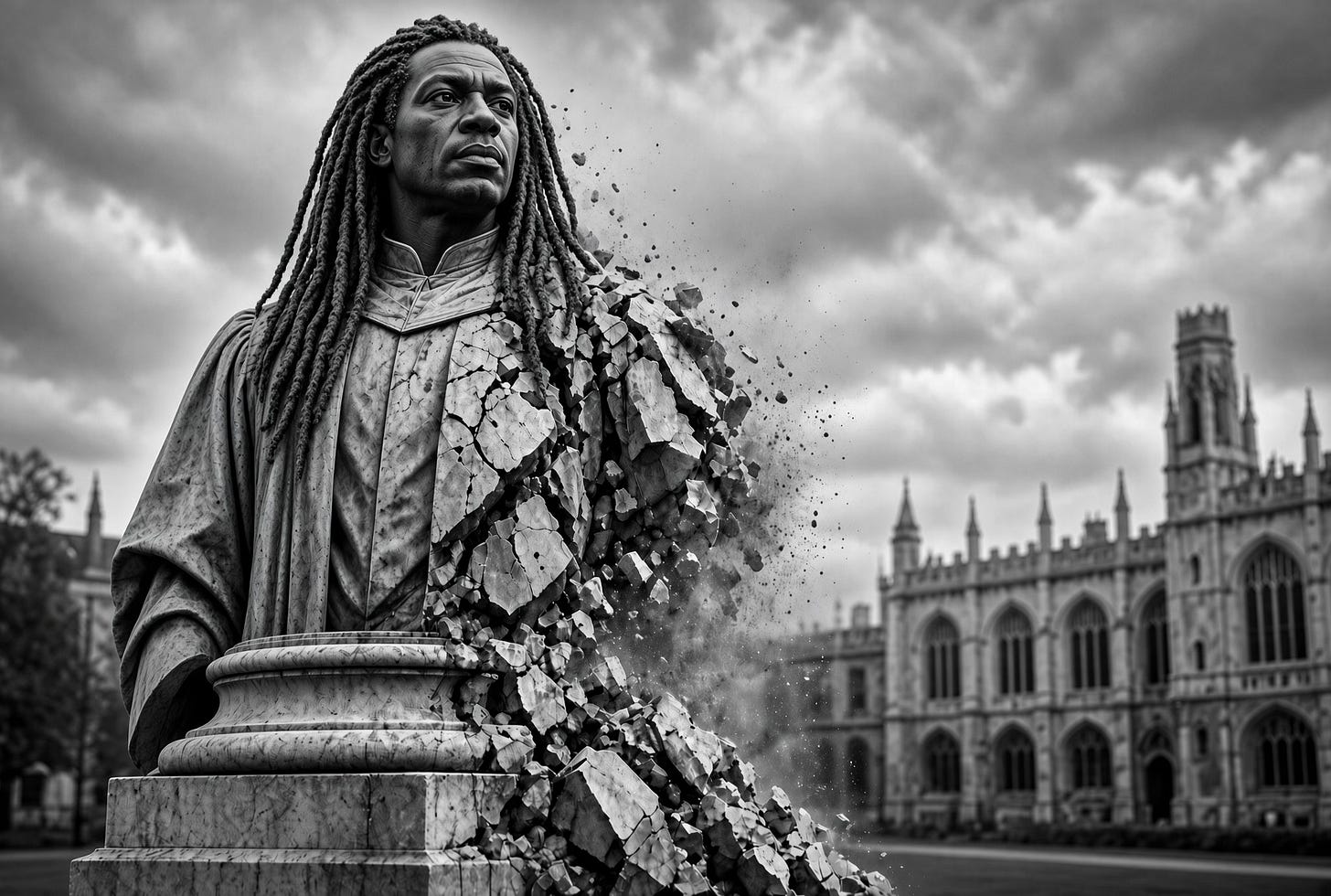
The tragic end of Jason Arday’s life was entirely predictable. Found dead on Friday afternoon, in what appears to have been a suicide, Arday leaves behind a wife and two children. Across the political spectrum, both supporters and critics had already begun warning that the public pressure would prove intolerable. They were right. Even Arday himself, in his memoir Great and Unfortunate Things, appears to have prophesied this possible outcome: “What if I have completely overestimated my capabilities? What if my story ends up being a cautionary tale like Icarus about flying too close to the sun?” In the 24/7 world of social media and the internet pile-on, few among us could be confident of withstanding such scrutiny. That fact, however, does not require us to lionise Arday, nor to forget how this charade came to pass.
Arday’s meteoric rise (and subsequent fall) is a black and white case – but not in the racial sense his supporters have repeatedly claimed. Rather than a hindrance, it was Arday’s blackness specifically which smoothed his path at every turn. It helped quash the initial Times Higher Education investigation that was met with legal threats. It undoubtedly mediated the unanimous decision of Cambridge’s Board of Electors, in the face of a strikingly thin scholarly record. It drew the fawning sycophancy of faculty head Hilary Cremin, that he was “the best in the world” at what he did. It garnered credibility to specious claims that no one else could have gotten away with. And it generated countless signatures to an open letter in his defence, long after the irrefutable evidence against him had become public knowledge.
The flip-side of this story has played out many times, yet most people neither know nor care. Ray Honeyford, the Bradford headmaster driven from his post in the 1980s after criticising multiculturalism, received no such martyrdom. Mike Adams, the outspoken conservative North Carolina professor, was forced into early retirement in the wake of controversial statements, and subsequently took his own life. His death prompted more celebration than solidarity on the Left. Michael Shively, a longstanding and highly-respected anatomy professor at Utah Valley University died by suicide, after a prolonged internal investigation into his teaching methods. His death remains barely a footnote in academia.
Contrary to the Arday case, all three of these men told the truth (at least, as they saw it), and were hounded because of it. All three were the supposed beneficiaries of “white privilege”, although it failed to function as a shield when called upon. All three were not defended by the institutions they served, irrespective of their dutiful service. And all three failed to generate a mass media campaign to leave them alone, on the grounds of their identity. White victimhood, unlike black victimhood, is far more difficult to commercialise.
I hate to say it, but Jason Arday is now odds-on to become the next George Floyd – an insult both to him and to martyrdom in general. Arday was no petty criminal. A fantasist, a liar, a fraud no doubt – but he does not deserve any association with Floyd. And those lining up to exploit his death in pursuit of their own particular brand of grievance, ought to be thoroughly ashamed of themselves.
Of course, they won’t be. The facts of Jason Arday’s life, to all intents and purposes, are now irrelevant here. Having ignored the utter fabrication of his scholastic achievements and dismissing his critics as “racist”, Arday’s death is going to become the next blank cheque for the pre-existing narrative of black victimhood. Already, the vultures are circling:
White supremacy killed Jason Arday. Murdered him.
— Nels Abbey (@nelsabbey) August 14, 2026
This is a public execution. You hounded Jason Arday to death. You murdered him. You killed him. I warned you. I knew this is exactly what you all wanted with your ‘racism’ masked as accountability. Your white supremacist blood thirsty lust to destroy DEI masked as public… pic.twitter.com/BAk8fBUYr3
— Dr Shola Mos-Shogbamimu (@SholaMos1) August 14, 2026
If Jason Arday were a white middle-class academic, he would not have been hounded by the British press in the way he was.
My thoughts are with his loved ones. May he rest in peace.
— Zarah Sultana MP (@zarahsultana) August 14, 2026
Sending love to Jason Arday’s family and friends.
He was subject of sustained and malicious media attacks which were no doubt more vicious because he was Black.
We must now reflect on the impact of a trial by some of the media and online on someone under extreme pressure.
— Zack Polanski (@ZackPolanski) August 14, 2026
I’m devastated for the family and friends of Jason Arday.
He faced an unacceptable public hounding and campaign of abuse. I know many Londoners will be angry and upset this evening.
Jason Arday was the victim of a pernicious public shaming that other people in his position…
— Sadiq Khan (@SadiqKhan) August 14, 2026
While some of this is predictable fodder, the Khan tweet is particularly reprehensible. “I know many Londoners will be angry and upset this evening,” he wrote, after framing the scrutiny of Arday as an “unacceptable public hounding” and “pernicious public shaming.” As Mayor of London, Khan is not averse to accusing others of inflammatory speech. He has previously insisted that “no one has the right to incite hatred, cause division, or sow the seeds for discord in our city.” The selective application of that principle is revealing.
Those who wish to portray Arday as a victim are free to do so. But they ought at least to be honest in their portrayal. Arday was a victim of course: a victim of his own narcissism, and more broadly the liberal charlatans at Cambridge who saw him as little more than a pawn to bolster their DEI credentials. That should exact from them a sustained period of profound reflection, at the very least.
There are other victims in this story, ones that no one else is concerned about. What about Paula Zwozdiak-Myers, whose thesis Arday plagiarised to within an inch of its life? What about the other candidates who never got the job at Cambridge because they didn’t tick enough diversity boxes? What about the THE journalist Jack Grove, who was hounded for raising concerns, investigated by the police, and threatened by Carter Ruck – whose very ‘SLAPP’ letter contained glaring inaccuracies? What about Cambridge students cheated out of an education, because their professor wasn’t up to the task? What about the student downgraded by Arday, who was subsequently accused of racism? What about Nathan Cofnas, the man ironically fired by Cambridge for telling the truth about race, who did the majority of the legwork exposing Arday, and who even now is likely to come under fire in the wake of his death? What if any of these people, with more legitimate grievances had committed suicide? Who would have cared? Who could have weaponised it? Who would have even dared try?
The argument that those in positions of authority should not face scrutiny in case they take own life when exposed, is at once both facile and childish. Does that mean we should stop demanding high standards, dismiss fraud as innocuous, or simply empty the prisons? Those who dramatically embellish their CVs may not be criminal in the strict sense of the word, but their lies have real-world consequences for others – potentially fatal ones when the over-promoted are doctors, pilots, engineers or anyone else whose competence actually matters.
Arday’s death is a personal tragedy. I feel genuinely sorry for him, his family, and especially the two children he leaves fatherless. But it should not be used to excuse what he did, and more widely what Cambridge did. In choosing to take his own life (assuming that is what happened, and however understandably), Arday once again sidesteps accountability for his own choice of action.
The picture painted at his initial investigation however (and now enhanced after his death), that Arday was attacked because he was black, is a despicable slur which warrants zero credibility. Arday wasn’t criticised because he was black; he was criticised because he was a fraud. These are accusations that Thomas Sowell, Neil deGrasse Tyson and Ben Carson would have laughed off – because they, unlike he, got there on merit. And in the end, and certainly in academia, merit is the only criteria which ought to matter.
This sorry episode should serve as a grave warning to the DEI fanatics who put Arday in post, and demand accountability from them in future. But it won’t. It will only encourage them to go further. And next time, even fewer people will be prepared to challenge them.
Frank Haviland is the Editor of The New Conservative, and the author of Banalysis: The Lie Destroying the West.

••••
••••
••••
••••
(UKR)