…Production Gap Widens To 3.5 Million Tonnes
…Over 60% Of Rice Mills Idle
…Porous Borders, Community Resistance Hampering Anti-Smuggling Efforts—Customs
In the early hours of the morning along Idiroko Road in Ota, Ogun State, one is likely to encounter a stream of vehicles with raised boots. At first glance, these vehicles appear to be carrying ordinary cargo. A closer look, however, reveals bags of rice stacked inside. In some cases, the contents are concealed beneath black waterproof covers.
Some of the vehicles appear rickety and worn out, yet they are fitted with powerful engines. THE WHISTLER correspondent who visited the area observed that the vehicles are specially modified for smuggling goods across Nigeria’s borders in Ogun area, particularly rice.
Some rice traders who spoke with THE WHISTLER confirmed that a significant portion of the rice sold in local markets enters the country through land borders.
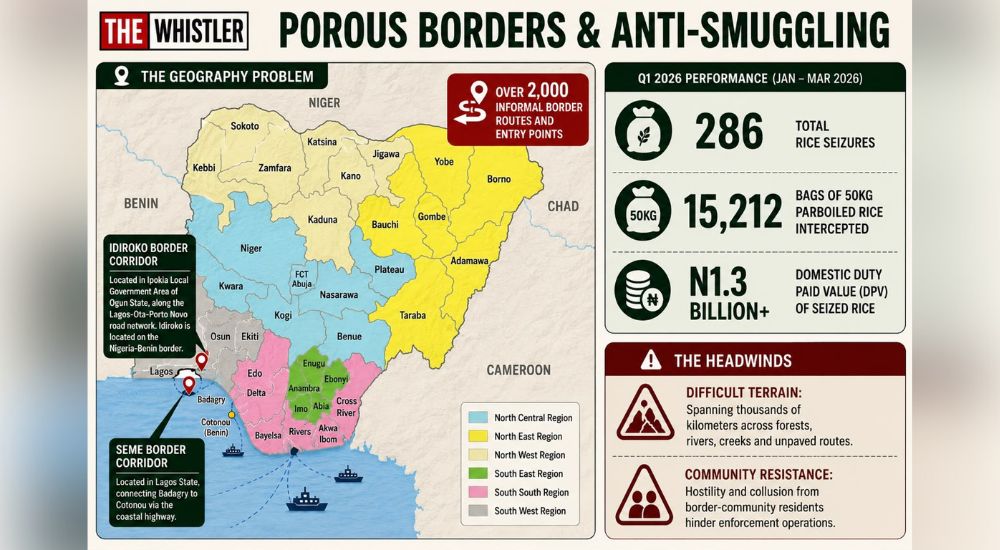
Nigeria’s borders remain highly porous. Estimates suggest that there are more than 2,000 border routes and entry points across the country, many of which are difficult to monitor effectively.
Data from the Nigeria Customs Service (NCS) underscore the scale of the challenge. According to the agency, in 2025, the Nigeria Customs Service (NCS) executed over 2,500 seizures of prohibited and harmful goods, with a combined value exceeding N59bn. These anti-smuggling operations included the interception of firearms, expired pharmaceuticals, foreign parboiled rice, and illegal narcotics.
The persistent influx of smuggled rice comes despite longstanding restrictions imposed by the federal government.
In March 2016, the NCS reintroduced restrictions on rice importation through Nigeria’s land borders. The decision reversed an earlier policy introduced five months before, which had permitted rice imports through land routes provided the appropriate duties and charges were paid.
Explaining the reversal at the time, the Service said revenue generated from rice imports through land borders was far below expectations and did not correspond with the volume of rice arriving at ports in neighbouring countries. Reports from border commands also indicated a sharp increase in rice smuggling activities.
Nearly a decade later, the policy remains in place. During a routine inspection of Apapa Port in Lagos in August 2024, the Comptroller-General of Customs, Adewale Adeniyi, reiterated that the ban on rice importation through land borders remained in force.
The restriction was introduced to curb smuggling, ensure proper collection of import duties, and encourage local rice production. Yet, despite these objectives, smuggled rice continues to find its way into Nigerian markets, often competing directly with locally produced varieties and undermining efforts to achieve self-sufficiency in rice production.
However, smuggling is not the only factor shaping the rice market. Recent policy decisions by the administration of President Bola Tinubu have also altered the dynamics of rice importation and pricing.
One of such measures was the decision by the Central Bank of Nigeria (CBN) to lift foreign exchange restrictions on rice importers and 42 other items. The restrictions had been introduced in 2016 as part of broader efforts to conserve foreign exchange and boost domestic production. Around the same period, the apex bank launched the Anchor Borrowers’ Programme, an initiative aimed at transforming Nigeria’s agricultural sector and increasing local rice output.
In announcing the removal of the restrictions, the CBN stated that the move would improve liquidity in the foreign exchange market and support more efficient market operations. The bank added that its interventions in the market would gradually reduce as liquidity conditions improved.
The federal government has also revised import tariffs across several sectors as part of its 2026 fiscal policy framework.
Under the new policy, the import duty on rice imported in bulk or in quantities exceeding five kilograms was reduced to 47.5 per cent from 70 per cent. The tariff on broken rice was also cut to 30 per cent from 70 per cent.
The changes, contained in a fiscal policy circular that took effect on April 1, 2026, replaced the 2023 fiscal guidelines.
According to the government, the revisions form part of Nigeria’s efforts to align with the ECOWAS Common External Tariff regime and are intended to promote growth in critical sectors of the economy. However, analysts say the lower tariffs, combined with continued smuggling through porous borders, could further intensify competition for local rice producers already grappling with high production costs and other operational challenges.
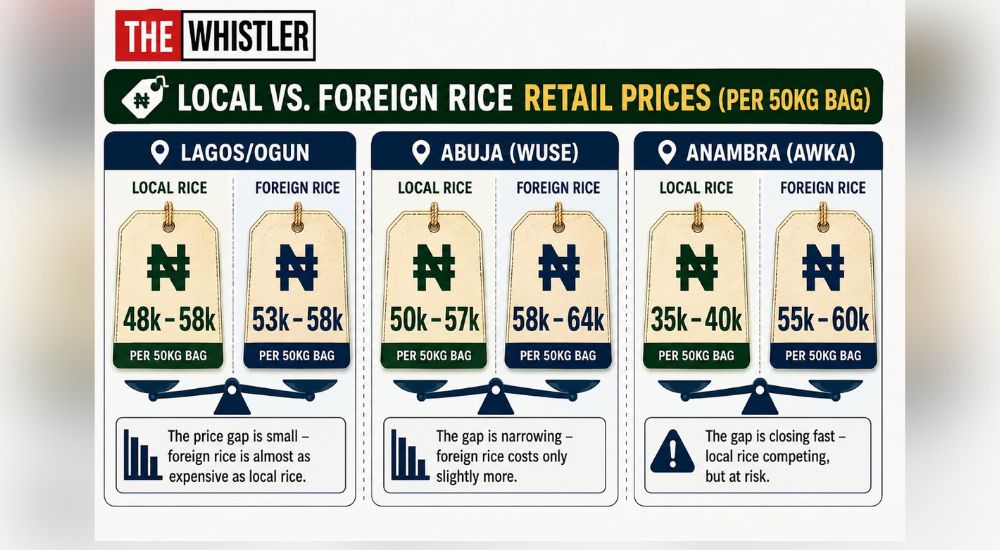
A market survey by THE WHISTLER found that a 50kg bag of local rice sells for N48,000–N58,000 in Lagos and Ogun, while foreign rice costs N53,000–N58,000. In Wuse Market, Abuja, local rice goes for N50,000–N57,000 and foreign rice for N58,000–N64,000. In Anambra, local rice sells for N35,000–N40,000, while foreign rice goes for N55,000–N60,000 at Eke Awka.
The narrowing price gap between local and imported rice is expected to heighten concerns among farmers and millers, who fear that cheaper imports could erode the competitiveness of locally produced rice.
Commenting on the reduction in import duty, a rice miller recently told S&P Global that the tariff cut comes at a difficult time for the industry, which is still recovering from a major market disruption and contending with prices at multi-year lows.
“The government will have to give better options to farmers on seeds, agrochemicals, and fertilisers to lower paddy prices; otherwise, local production of rice in Nigeria will die,” the miller said.
The miller added that while the new fiscal policy promises support for local industries through reduced tariffs on machinery imports, the measure offers no immediate benefit to existing rice mills.
Efforts to reach the President of the Rice Farmers Association of Nigeria (RIFAN), Aminu Goronyo, for comments were unsuccessful.
However, a rice farmer, James Peter, said rice importation and smuggling was affecting local production, adding that chemicals, fertilisers and other farming inputs had become increasingly expensive, making it challenging for local farmers to compete.
“I have reduced my production output from 500 bags to 300 bags to minimise risk,” he said.
Another farmer, Peter Hassan, acknowledged that local production is currently insufficient to meet national demand and called on the government to provide farmers with critical inputs such as fertiliser, chemicals and other farming implements. According to him, such support would help Nigeria achieve self-sufficiency in rice production.
He noted that rice remains a staple food for millions of Nigerians and argued that increased local production would generate significant economic benefits, particularly for farming communities.
“For now, the government should not ban rice importation. However, there should be a one- to two-year timeline during which local farmers are adequately supported to achieve self-sufficiency. Once that goal is attained, rice importation can then be banned,” Hassan told THE WHISTLER.
“Producing rice locally is better than importing it.”
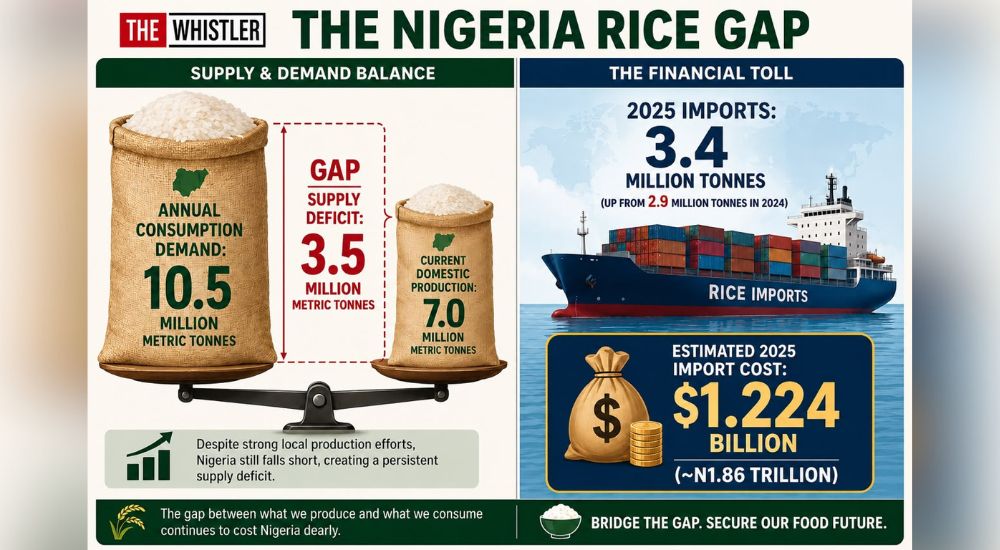
A recent report by the Observatory of International Rice Statistics (OSIRIZ) estimated Nigeria’s rice imports at 3.4 million tonnes in 2025, up from 2.9 million tonnes in 2024.
Published in mid-January, the annual outlook projected a significant increase in rice import volumes across Sub-Saharan Africa in 2025, highlighting persistent structural challenges in domestic production.
At a price of $360 per tonne for Indian parboiled rice, Thai and Pakistani white rice, THE WHISTLER estimates that importing 3.4 million tonnes would cost approximately $1.224bn, excluding freight, insurance, port charges, and other transaction costs. Using the CBN/NFEM annual average of N1,520/US$1 in 2025, the import bill would amount to about N1.86tn.
In a communiqué issued after the Second Cycle Meeting of the National Agribusiness Policy Mechanism (NAPM) held in Abuja in December 2025, stakeholders recommended the formal closure of existing rice import windows. The recommendation was based on falling food inflation and evidence suggesting that Nigeria’s apparent rice surplus is being driven largely by high import volumes rather than increased domestic production.
The NAPM is a comprehensive, data-driven framework established by the Federal Government to harmonise agricultural policies, stabilise food prices, and strengthen national food sovereignty. Coordinated by the Presidential Food Systems Coordination Unit (PFSCU), it seeks to align policies across the three tiers of government while integrating market, climate, and agricultural data.
Meanwhile, data published by the CBN under its Commodity Development Initiative (CDI) – Rice programme indicate that Nigeria currently produces about 7.0 million metric tonnes of rice annually, against a consumption demand of 10.5 million metric tonnes, leaving a supply deficit of 3.5 million metric tonnes.
“Nigeria is one of Africa’s largest producers of rice grains but also the continent’s largest importer of milled rice. The current production of rice in Nigeria stands at 7.0 million metric tonnes with a consumption demand of 10.5 million metric tonnes which creates a deficit gap of 3.5 million metric tonnes,” the apex bank stated.
The production outlook remains under pressure. The United States Department of Agriculture (USDA) Foreign Agricultural Service projects Nigeria’s rice production for marketing year (MY) 2026/27 at 8.3 million metric tonnes (MMT), down 6 per cent from the 8.8 MMT projected for MY 2025/26.
The decline is attributed to reduced planted area, insecurity in some producing regions, and rising input costs, which industry sources say have doubled over the past two marketing years. Consequently, harvested area is forecast at 4.2 million hectares, about 7 per cent below the 4.5 million hectares projected for MY 2025/26.
“The area of my land planted with rice used to be between 200-300 hectares when I started farming a decade ago. From 2024 until now, I have only been able to cultivate 100 hectares because I am not breaking even. My last harvest only generated enough revenue to cover operational costs, with no profit remaining,” the report quoted a rice farmer as saying.
According to the report, low rice prices continue to discourage production despite rising demand. Industry contacts said lower-priced milled and semi-milled rice from India and Thailand enters the market through informal channels, keeping domestic paddy prices low.
Many farmers are reportedly selling paddy below production costs, while some struggle to find buyers. About 60 per cent of rice mills nationwide are currently idle due to paddy shortages, the report stated, with many unable to compete with prevailing market prices and operating at a loss or shutting down.
The report noted that some farmers are diversifying into sesame, soybean and black cumin (Nigella sativa), citing lower input costs and export potential.
Rice consumption is forecast to reach 9.0 MMT in MY 2026/27, up 6 per cent from 8.5 MMT a year earlier, driven by lower domestic prices and improved consumer purchasing power.
Imports are projected at 3.5 MMT, a 9 per cent increase from 3.2 MMT in MY 2025/26, supported by lower global rice prices, particularly from South Asian exporters, as well as rising consumption and declining domestic output.
While rice imports through land borders remain prohibited and sea-borne imports attract relatively high tariffs, the report noted that lower duties in neighbouring countries continue to facilitate informal rice inflows into Nigeria.
Beyond formal import channels, smuggling remains a major structural challenge.
The Chief Executive Officer of the Centre for the Promotion of Private Enterprise (CPPE), Dr. Muda Yusuf, described smuggling as a greater threat to Nigeria’s rice industry than the Federal Government’s recent reduction in import duty on bulk rice imports.
He said the revised tariff of 47.5 per cent still provides reasonable protection if properly enforced.
According to him, the more pressing challenge is the influx of rice through Nigeria’s porous borders, which allows smugglers to evade import duties entirely.
“The challenge of smuggling. That is even a bigger problem, if you ask me, than this tariff, because the borders are so porous,” he said
Yusuf argued that the revised tariff remains high enough to provide a reasonable level of protection for local farmers and processors.
“(At) 47.5 per cent, (the) tariff is still good enough protection, if it will be enforced. And if local farmers can also be supported with fertiliser, with inputs and all of that, they will still have an edge,” he added.
The economist noted that Nigeria’s tariff decisions are also shaped by commitments under the Economic Community of West African States (ECOWAS), the World Trade Organisation (WTO), and the African Continental Free Trade Area (AfCFTA), which encourage gradual trade liberalisation.
However, the Chief Economist and Partner at SPM Professionals, Dr. Paul Alaje, warned that the reduction in import duty could hurt local producers and lead to job losses.
While acknowledging that the policy may lower rice prices, he argued that the biggest beneficiaries would be rice-exporting countries rather than Nigerian farmers and millers.
“Mills will suffer. Farmers will suffer. It will create local unemployment,” Alaje told THE WHISTLER.
He noted that cheaper imported rice could improve availability but would negatively affect local investments and jobs in the rice value chain.
“There will be rice availability in Nigeria at a relatively lower price, because taxes have been reduced. But what that means is that jobs that have been created in that sector will be badly affected,” Alaje added.
Customs Intensifies Anti-Smuggling Operations
The NCS recorded 286 rice seizures involving 15,212 bags of 50kg parboiled rice with a DPV exceeding N1.3bn in the first quarter of 2026.
Speaking with THE WHISTLER, the National Public Relations Officer, Deputy Comptroller Abdullahi Maiwada, outlined the Service’s anti-smuggling operations and ongoing efforts to protect local rice production.
Maiwada said the NCS assesses effectiveness through market intelligence, seizure volumes, and the rising cost of smuggling operations, noting that evolving smuggling tactics reflect strengthened border enforcement.
He said the Service is intensifying intelligence-led operations, deploying non-intrusive scanners, using geospatial intelligence to monitor illegal routes, and strengthening community relations through CSR initiatives.
According to him, the NCS has dismantled major syndicates along the Seme, Idiroko and northern corridors, with several suspects arrested and facing prosecution.
He also highlighted successes by the Western Marine Command, which intercepted multi-million-naira shipments of rice and other prohibited goods moved through waterways using locally made boats.
Maiwada, however, acknowledged persistent challenges, including Nigeria’s porous land borders and resistance from some border communities, where elements sometimes collude with smugglers or obstruct enforcement operations.
“Enforcement is hampered by a few persistent bottlenecks. Chief among them is the highly porous nature of our land borders, spanning thousands of kilometers across difficult terrains.
“Furthermore, we face the challenge of hostility from some border-community residents, who sometimes collude with smugglers or actively resist law enforcement officers during lawful seizures,” he told THE WHISTLER.
(The Whistler)