
•Decrepit facilities dot communities like sore fingers
From Stanley Uzoaru (Owerri); Femi Folaranmi (Yenagoa); Obinna Odogwu (Awka); Ighomuaye Lucky (Benin), and Laide Raheem (Abeokuta)
Nigeria’s primary healthcare centres (PHCs), which are supposed to be the bedrock of the country’s health system, are generally not in a good state of health. The PHCs were established to provide accessible, preventive, and basic curative care at the grassroots level. The first part of the evolution of the healthcare system began in the colonial period and ran up to the post-independence era, ending in 1975, during which the early health infrastructure prioritised curative medicine over preventive care, largely serving colonial administrators, military personnel, and urban residents. Then came the five-year period from 1975 to 1980, when the global shift towards basic health services, propelled the country to initiate the National Basic Health Services Scheme (NBHSS). This period was the first attempt to build a system that would be centred on primary healthcare. However, it failed because the implementation process was plagued by challenges and a lack of community-focused strategies.

Then came the Prof Olikoye Ransome-Kuti era that lasted eight years (1985 to 1993), following his appointment as the Minister of Health. Ransome-Kuti drew on the 1978 Alma-Ata Declaration, and drove the effort of the country to adopt the model of primary healthcare prescribed under the declaration. It was first tried out in 52 local government areas (LGAs). The success of that initial step led to expansion of the programme to all the local governments in the country from 1986 to 1990. In essence, delivery of primary healthcare services was delegated exclusively to the local governments. Under the PHC programme, the country achieved over 80 per cent universal child immunisation.
To sustain progress, the Ibrahim Babangida military regime promulgated Decree 29 in 1992 under which the National Primary Health Care Development Agency (NPHCDA) was established. Unfortunately, after the exit of Ransome-Kuti in 1993, institutional decline began to set in as the system suffered from neglect, political instability, and a loss of community confidence. The system continued to operate at the sub-optimal level until 2017 when a revitalisation initiative was commenced to reposition the PHCs, boost their capacity and the capability of the personnel to render more value-added services including some degree of medical investigations. Supported by the World Bank and other foreign donor agencies, the federal and state government set about tackling infrastructural decay and epileptic supply of medications and necessary consumables. For this purpose, the federal government established the Basic Health Care Provision Fund, built several new facilities, upgraded several PHCs, provided solar-powered cold chain storage facilities for vaccines. As with everything in Nigeria, changes of administrations and differing commitment to governance standards have once again affected the PHCs.
Correspondents in states present situation reports.
Imo: New buildings, old problems
In village squares across Imo, the blue-and-white signboards of Primary Health Care Centres, PHCs, are becoming more visible. Under Governor Hope Uzodimma, the state approved the construction of 55 new PHCs spread across all 27 local government areas. The idea is simple: bring care closer to the people.
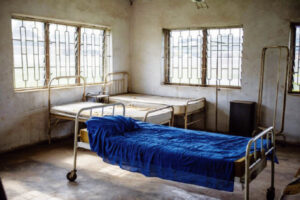
The list stretches from Enyiogwugwu and Ibeku in Aboh Mbaise to Nnarambia and Ihenweorie in Ahiazu Mbaise. In Owerri West alone, new centres are planned for Ndegwu, Amakohia-Ubi, Irete and Orogwe. Government officials say each facility will be fully equipped, staffed, and run 24/7, with a focus on maternal and child health, prevention, and emergencies. They are meant to complement existing PHCs that the administration says have been “renovated, equipped, and functional.”
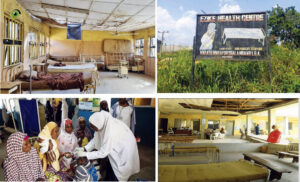
For many rural families, that promise matters. But on the ground, a different picture is emerging. In several communities, newly announced PHCs sit beside older ones that are still falling apart. Residents describe collapsed ceilings, wall cracks, no perimeter fencing, and buildings they are structurally unsafe. Yet they keep coming, because it is the only facility within walking distance.
Staffing is another gap. Most of the centres do not have enough trained personnel. And despite the policy of free primary care on paper, patients and nursing mothers say they are charged for treatment and vaccination.
Mrs. Patient Ajuluchi, a nursing mother in Owerri West, said she paid ₦30,000 for delivery at a local PHC. Vaccinations cost between ₦1,500 and ₦2,000 per dose. She also pointed to a solar power system that has not worked since installation. “They use rechargeable lanterns at night,” she noted, adding that her biggest frustration is staffing hours. “The most annoying thing is that they don’t sleep at the PHC themselves. They leave us to come back the next day. My experience there is always horrifying.”
Delivery fees vary widely. Saturday Sun learnt that women pay between ₦20,000 and ₦40,000 for delivery.
Isiala Mbano is a miniature of Imo’s PHC story. Not all facilities there are “dilapidated” anymore, but progress is uneven. The Umuduru Health Centre is one of the success stories. Revitalised with support from the Federal Government through NPHCDA and community contributions, it now has fresh paint, working solar panels, functional delivery rooms, immunisation, maternal care, medical laboratory and treatment for minor ailments. Residents say access has improved.
Step outside Umuduru, however, and the challenges return. An assessment of 10 PHCs in Isiala Mbano found many with severely cracked walls, leaking roofs with torn nets on doors and windows, dirty or broken toilets, no clean water, and reliance on rainwater. Most fell below NPHCDA standards.
“Beneath the renewed hope lies deeper structural problems,” noted a local assessment by a group. However, the state government announced three more PHCs for Isiala Mbano in 2025, to be located in Obollo, Ibeme, and Anara. Whether they would avoid the same pitfalls is blowing in the wind.
Physical access is one area with modest gains. A survey in Isiala Mbano found 72 per cent of residents describing the access road to PHCs as good; 19 per cent as “very good,” three per cent “bad,” and six per cent as “very bad.” The conclusion: “Physical accessibility to HCFs defined by the road network in Isiala-Mbano is generally good.” Most routes remain as narrow village or feeder roads, not highways, but they are passable.
Staffing and supplies are harder to fix. Umuduru’s upgrade came “despite lingering challenges relating to staffing, water supply and accommodation.” Health workers describe exhaustion, delayed funding, and weak infrastructure.
A recent study found utilisation was “generally very low due to lack of qualified personnel and valid drugs.” Residents also cited the “protracted absence of doctors” and “poor workers’ attitude” as barriers to care.
Imo’s plan for 55 new, 24/7 PHCs is ambitious and needed. For residents in communities that currently trek long distances, proximity alone can save lives, especially for mothers and children.
But the experience in Owerri West and Isiala Mbano shows that new buildings without staff, drugs, water, power, and accountability risk becoming empty shells. Charging for services that should be free, absent night staff, and non-functional solar systems erode the trust PHCs need to function. As one resident put it, the centres are used because they are the only nearby option. The real test for Imo’s PHC reform will be whether the next 55 centres are not just closer, but safer, staffed, equipped, and truly open when a woman goes into labour at midnight.
Until then, for many families across the state, hope is under construction, but care is still a struggle. Another patient from Ohaji/Egbema, Mrs Janeth Uzoma, also said that most PHCs in Ohaji/Egbema are not in a good state, lack good roads, amenities and power supply.
“The primary healthcare centre in Ohaji/Egbema, presently deserves good attention. Some in various communities are not good for human usage,” he said.
Bayelsa: Doctors scarce as drones deliver supplies to riverine PHCs
As at the time Senator Douye Diri assumed office as governor in February 2020, Bayelsa State’s health was not in great shape. Worst hit by the crisis in the health sector were the primary healthcare centres (PHCs) located in very remote communities in the state. The difficult terrain did not help the situation in several coastal communities.
As of January 2023, the situation report at some of the PHCs in the state was depressing. Any first time visitor to the PHC at Kpansia community in Yenagoa Local Government Area would wonder why the doors were firmly locked. Investigations revealed that the doctor, the medical officer attached to the PHC, came at 9 am to attend to patients, but by noon, once the queue of patients seated in the waiting areas had thinned out, he would lock the door and leave due to lack of residential quarters for him to stay.
An emergency case in such a situation would be taken to a private hospital. This trend was replicated across the eight local government areas in the state. Shortage of manpower, corruption, lack of electricity, absence of security, lack of water, low staff morale, nepotism, political considerations, lack of capacity, and poor facilities have been identified as some of the problems militating against the optimal efficiency of PHCs in Bayelsa State.
However, the story changed when Diri was sworn in for a second term in 2024, and he appointed a Professor of Family Medicine, Professor Seyifa Brisibe, as the Commissioner for Health. Immediately he resumed office, Prof Brisibe initiated efforts to upgrade the facilities in PHCs across the state through expansion of the health insurance scheme, and improved the data systems. He also introduced the Local Government Areas Primary Healthcare (PHC) challenge in the state, to recognise and reward local government areas that demonstrated exceptional commitment and performance in the delivery of essential primary healthcare services to communities.
Aside from upgrading health facilities, with some PHCs becoming cottage hospitals, the state government has adopted the deployment of drones to take drugs to remote areas in the state. The use of the drones deployed by Zipline Drone has enabled medical supplies to get to swampy and riverine communities, which had previously found it difficult to access. In partnership with GAVI and UNICEF, the state government wants to improve primary healthcare through disease prevention and routine immunisation in riverine communities. This partnership has also been able to ensure the recruitment of 500 skilled personnel for the PHCs.
But it is not yet Uhuru. Shortage of manpower persists while absenteeism is still a big deal. In the Imiringi community, there is no functional PHC. The building that used to be the PHC has been donated to the Catholic Church to be used as the Catholic Hospital, while the staff of the PHC work for the hospital. According to Joseph, while this has been helpful for the community, it would be good if the state government could still consider having a PHC to make healthcare delivery accessible to more people.
At Okordia, the PHC, though accessible by road, is not functional. Saturday Sun learnt from Raymond, a resident that the staff of PHC hardly come to work. He said the people of Okordia now access medical care through the upgraded cottage hospital at Tein Biseni. The story is not different in Akassa, Brass Local Government Area. The sorry state of the PHC in Akassa has been brought to the notice of the Speaker of the House of Assembly, Rt Hon Abraham Ngobere.
In Oluasiri, Nembe Local Government Area, Madam Mabinto stated that medical personnel are not available at the PHC. Most of the medical personnel posted to the area usually influenced their posting back to places accessible by road, leaving the PHC at Oluasiri, Okoroma, and other far flung communities in Nembe without adequate healthcare.
Anambra: some good, some crying for attention
In Anambra State some primary healthcare centres are in good shape and functional, while several others are not. They do not only lack adequate personnel, they have dilapidated structures with limited drugs available.
The PHC in Awba-Ofemmili community in Awka North Local Government Area, for example, has received very little attention from the government. The last time the reporter visited the healthcare centre, the structure was already dilapidated with parts of its roof and ceilings falling off. Not even several reports on the horrible state of the PHC moved the government to fix the clinic and make it functional.
The hospital structure was built by Governor Peter Obi towards the end of his two-term tenure which lasted from 2006 to 2014. His successor, Chief Willie Obiano whose own two-year tenure lasted from 2014 to 2022, did almost nothing to equip the hospital and make it functional despite the vast financial resources at his disposal at the time. Even the road to the community was horribly dilapidated.
Fortunately, however, the current governor, Prof. Chukwuma Soludo, has fixed the road, tarring it from Amansea to the community. The new road passes through the PHC.
Residents of the community are hopeful that the Soludo-led government would also fix the hospital and make it functional in no distant time. Contrast that with the situation in Umuomaku community, Orumba South LGA of the state, and you’ll see that the story is different. Residents of the community said their PHC is very functional; and that it has health officers working there. A youth leader, Maduakor King Nwabueze, told the reporter that all was well with the primary healthcare centre.
“The Soludo government, through the Executive Secretary of the Primary Healthcare Development Agency provided a solar system for the facility, a borehole also powered by solar too”, he said.
“The PHC has a matron and two nurses, making them three personnel. In fact, it functions. It is functional at the moment. What we are asking them to do is the flooring of the compound to stop the bushes growing there.”
In the Umuzu community, Ogbaru LGA, the PHC is in bad shape. In fact, the health centre is not functioning. Former President-General of the community, Mr. Chukwudum Ndedigwe, told the reporter that the hospital was horribly dilapidated.
“The health centre had one building until Senator Stella Odua built another one which was demarcated with a fence. The first building was erected under the MDG programme. So, the main health centre is the one built by Senator Odua. The hospital is not working. There’s nobody there. It doesn’t have health personnel,” Ndedigwe lamented.
Edo: Benin gets light, villages get darkness
In Edo State, the previous administration under Mr. Godwin Obaseki concentrated more of his time in bringing healthcare delivery closer to the people of the state by investing heavily in primary healthcare. Every local government area had a functional primary healthcare facility.
Interestingly, the present Monday Okpebholo administration has been consolidating on what it met on ground.
A visit to one of the facilities in Ogbeson in Ikpoba Okha Local Government Area of the state revealed that patients were trooping in and out of the health centre.
Mr. Chris Akhabue, who took his child there for medical attention, expressed satisfaction with the services rendered to his child.
He said: “I live in Benin on the Agbor Road axis and I have accessed the healthcare service at Ogbeson and the building is very okay. My child was sick and I took him there and he got prompt medical attention.
“The one at Amufi is also up to standard. The staff are up and doing too. There is a good road network to the facility and luckily for them too, the state government has tarred all the roads linking to the health centre. And I must commend the Edo State Government for taking such a good initiative to revamp the healthcare facilities in the state.” He also revealed that he was not charged exorbitant fees for the service. At the primary healthcare facility at Ikpema in Oredo Local Government Area, renovation work is ongoing while the workers in the facility have been relocated to temporary buildings within the locality.
Medical Officer of Health for Oredo Local Government Area, Dr. Amenze Ohenhen told Saturday Sun that the facilities of Oredo LGA meet or exceed national standards. He added that the facilities are accessible, well-built, and equipped with multiple power sources (solar, grid, and generators).
Ohenhen maintained that the Edo State Primary Health Care Development Agency centrally procures drugs and equipment to ensure fixed, affordable pricing. He noted that while staffing is improving with the presence of doctors, the system still requires more personnel to meet growing demand. However, it was revealed that while the Edo South senatorial district has adequate staff and every other thing working out for them, it is not completely so in the rural areas.
It was discovered that some of those in the rural areas are under staffed and short of some of the essential commodities.
Ogun: COVID forced PHC’s rehabilitation, citizens seek maintenance
When Governor Dapo Abiodun assumed office in 2019, rehabilitation and revamping of the healthcare sector was among the top priorities of his administration, which promised to overhaul the healthcare system right from the primary to secondary and tertiary health institutions.
The first tangible step taken by the administration to walk its talk was the comprehensive rehabilitation of primary healthcare centres during the COVID-19 pandemic. Then, all the PHCs across the state were not only rehabilitated, they were equipped with basic medical facilities and drugs. Amenities such as water and electricity were put in place. This upgrade was not unconnected with the outbreak of the pandemic as Ogun was the first state to record the index case of COVID-19 in Nigeria.
After the pandemic, people have continued to visit the PHCs as a result of the renovation and availability of medical facilities necessitated by COVID-19. Since then, pressure had eased on the general hospitals as health centres began to offer treatment for some non-life threatening ailments. Laboratories became fully functional as medical tests such as malaria, typhoid, genotype, diabetes and others are being carried out. Child and mother mortality rate equally improved further. When our correspondent visited the Obada-Oko Primary Health Centre in Ewekoro Local Government Area of the state, it was observed that the facility was still operational. Nurses and health workers were sighted carrying out their duties, while the laboratory was in active mode.
Meanwhile, a solar power system has been installed to provide alternative electricity supply to the health centre. A resident of the community, Ademola Okunneye, noted that the health centre has continued to provide the healthcare needed for the people of Obada-Oko and its environs. He, however, appealed to the state government to construct Obada Health Centre-Iwokun-Railway Line Road, in order for people in the remote communities to have access to the medical facility.
Okunneye further called for more medical personnel to be posted to the health centre in order to be able to offer 24-hour medical services to the people.
At the Abeokuta South LG Primary Health Centre located in the Oke-Ilewo area of Abeokuta, antenatal and postnatal services are notable. When our correspondent visited the facility, pregnant women were attending an ante-natal programme. Health personnel were administering immunisation to newly born babies.
A cursory look around the facility showed that it is still maintained in its pristine condition and visitation is high, perhaps due to its location in the heart of Abeokuta metropolis.
A nursing mother, Mrs Omolara Sanusi, who brought her newborn baby for immunisation, commended the state government for maintaining standard and quality of the health centre. She also lauded the Abeokuta South LG for ensuring the smooth running and posting of personnel who carry out clinical services with diligence.
•To be continued tomorrow
(The Sun)