
by
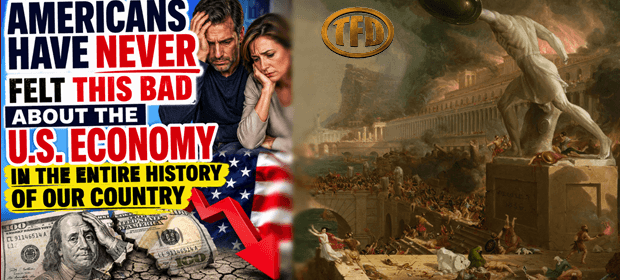
For much of the nation, it feels like we are in a permanent economic crisis with no end in sight. I have been documenting our long-term economic decline for years, and now we have reached a point where Americans have literally never felt this bad about the state of the U.S. economy. Considering everything that we have been through over the last several decades, that is saying a lot. So how will the American people be feeling if economic conditions continue to deteriorate? We might want to be thinking about that, because all of the long-term trends are taking us in the wrong direction very rapidly.
The University of Michigan has been tracking consumer sentiment for more than 70 years.
On Friday, we learned that the University of Michigan’s index of consumer sentiment has fallen to the lowest level ever recorded…
American attitudes just hit a milestone of sorts. On Friday, the University of Michigan reported that its index of consumer sentiment fell to the lowest level ever recorded in 70-odd years of surveys.
Sentiment was already low at the start of this year, but it fell sharply after the Iran war began at the end of February and sent gas prices sharply higher.
Until this year, the previous lowest level was in June 2022, when inflation was running at the highest level in decades. Friday’s sentiment reading was 10% below even that number.
“Prices remain extremely high, labor markets have unambiguously weakened in the last four years, and now we’re in the middle of a war,” said Joanne Hsu, director of consumer surveys for the University of Michigan. “I don’t think the fact that we’re lower than June 2022 should come as a surprise to anyone.”
At this stage, nobody can deny what is happening.
Those at the very top of the economic pyramid are still thriving, but just about everyone else is really hurting.
Since the 1970s, there have been many periods of great economic turmoil, but even during those times Americans felt better about the economy than they do right now…
Indeed, households are feeling worse about their personal finances and the broader state of the economy than they did during the Great Inflation of the 1970s, when the cost of groceries doubled and the government was forced to ration gasoline; the Volcker shock, from 1979 to 1982, when the average interest rate on 30-year mortgages hit 18.6 percent and the country went into devastating back-to-back recessions; the early months of the coronavirus pandemic, when 200,000 firms collapsed, the unemployment rate flirted with 15 percent, and essentials such as infant formula became impossible to find; and the Great Recession, when the stock market lost half its value, the banking system teetered on the brink of implosion, and lenders foreclosed on 6 million homes.
Read that paragraph again and let it really sink in.
Even during our darkest economic moments, Americans always had hope that things would eventually turn around.
Unfortunately, that is no longer true.
According to one financial expert, consumers are now “entrenched in financial stress”…
Americans “are entrenched in financial stress,” Bruce McClary, senior vice president of membership and media relations at NFCC says — the result of elevated prices on top of near-historic highs of consumer debt on credit cards and auto loans.
The nonprofit organization, which provides education and solutions for individuals struggling with their finances, especially debt management, reported a “significant surge” in consumers reaching out for credit counseling, which could be a warning sign for the broader economy, NFCC says. While it’s encouraging to see individuals seeking help before they have run out of options and can’t pay their bills at all, the widespread struggle could be evidence of the overall consumer economy’s health declining, the organization says.
Financial stress has become a permanent part of most of our lives.
Our seemingly endless cost of living crisis is getting even worse, and consumers are drowning in an ocean of debt.
As prices go up and up, our standard of living is steadily going down.
One recent survey asked Americans if they have reduced spending in certain areas or not, and the results were absolutely shocking…
- dining out: 54 percent say yes, while 44 percent say no;
- entertainment or leisure activities like going to movies, shows, or sporting events: 49 percent say yes, while 47 percent say no;
- vacation plans: 48 percent say yes, while 49 percent say no;
- grocery shopping: 43 percent say yes, while 56 percent say no;
- driving: 36 percent say yes, while 60 percent say no.
When close to half the country is reducing spending in multiple areas, that is really bad news for the economy.
In the past, when the economy has started to waver our politicians in Washington have intervened by borrowing and spending more money.
Borrowing and spending money that we do not have provides a short-term economic boost, but it also creates a long-term economic problem.
Now we are trapped in a nightmarish debt spiral, and so any short-term help that our politicians in Washington will be able to provide moving forward will be very limited…
The national debt held by the public, about $31 trillion, is now the size of the U.S. economy, up from 39 percent of the economy in 2008 and 79 percent in 2019. For most of the country’s history, the fact that the economy’s growth rate surpassed the interest rate on the debt enabled us to keep paying our bills.
But as my colleagues and I show in a policy brief for the Stanford Institute of Economic Policy Research, the fiscal outlook today is much more challenging. We concluded that the combination of higher deficits and climbing interest rates raises the risk that borrowing will become more expensive and will push government debt levels to climb relentlessly. This is a debt spiral.
The math is simple and unforgiving. Say both your annual income and your debt equal $100. Suppose you face a 2 percent interest rate but you get a 4 percent raise. You’ll have no problem paying your creditor their $2 in interest from your $4 in added income. But if you swap those rates around, every year puts you further in the hole.
It took decades of incredibly bad decisions to get us into this hole.
Sadly, there is no easy way out.
What this means is that a tremendous amount of pain is ahead.
If you think that economic conditions are bad now, just wait until you see what is coming.
We tried to defy the laws of economics for a long time, but now economic reality is catching up with us in a major way.
Michael’s new book entitled “10 Prophetic Events That Are Coming Next” is available in paperback and for the Kindle on Amazon.com, and you can subscribe to his Substack newsletter at michaeltsnyder.substack.com.
••••
Published to The Liberty Beacon from The Falling Darkness


••••
••••
••••
••••
(TLB)