…South-South Insecurity Incidents
Dropped By 20.9% In Three Years
…North-West Emerges Hotspot Of Hostilities, North-East, Valley Of Death
Despite the escalating security across the country, tension in the Niger-Delta region has been on the decline, investigation has shown.
A survey carried out by THE WHISTLER also shows that majority of the respondents attribute the de-escalation of security incidents in the Niger-Delta region to the pipeline surveillance operations being executed by Tantita Security Services Nigeria Limited (TSSNL).
The Armed Conflict Location and Event Data project (ACLED) data show that violent events declined by 20.9 per cent in the South-South geopolitical region between 2023 and 2025.
The rate of fatalities arising from such violent events in the oil rich region declined by 8.3 per cent within the same period of time.
Although the rate of similar conflicts declined by a higher margin of 26.9 per cent in the South-East region, the rate of fatalities resulting from such events increased within the region by 8.3 per cent.
The violent events tracked by ACLED within the period under review include violence against civilians, battles between the authorities and armed groups, protests, strategic developments, riots, and explosions/remote violence.
The South-West recorded a decline of 14.1 per cent in the total number of incidents between 2023 and 2025. However, the fatality rate increased by 12.21 per cent.
The picture takes a different look in the three geopolitical regions of Northern Nigeria.
According to the database, North-West incidents increased by 127.9 per cent between 2023 and 2025 and in the process, recorded an increase of 99.1 per cent in fatality rate.
The North-East witnessed a rise of 19.5 per cent in the number of events and an increase in fatality rate of 26. 4 per cent within the period under review.
On the other hand, the number of incidents in the North-Central region increased by 74.1 per cent while the number of fatality rate increased by 38.3 per cent between 2023 and 2025.
ACLED tracked a total of 4,701 incidents in all the regions in 2023. The number increased to 5,815 in 2024 and 6,570 in 2025. These give a total of 17,086 incidents within a period of three years.
Regional distribution of conflicts showed that the North-West recorded a total of 1,076 events in 2023; 1,727 in 2024, and 2,452 in 2025. These give a total of 5,255 incidents for the years under review.
The North-East recorded 923 events in 2023; 985 in 2024, and 1,103 in 2025. These give a total of 3,011 for the three-year period.
Similarly, the North-Central recorded 918 incidences in 2023; 1,140 in 2024 and 1,598 in 2025. These give a total of 3,656 for the three-year period.
For the South-South, a total of 651 conflicts occurred in 2023; 720 incidents in 2024, and 515 incidents in 2025. These sum up to a total of 1,886 for the period of review.
The South-West recorded a total of 573 incidents in 2023; 654 in 2024, and 492 incidents in 2025. These give a regional total of 1,719 events for the three-year period covered by this period.
On the other hand, the South-East recorded 560 events in 2023; 589 events in 2024, and 410 in 2025. These sum up to a total of 1,559 events for the years, 2023 to 2035.
In terms of fatalities, the national figure increased from 8,847 in 2023 to 9,862 in 2024. By 2025, it increased to 12,858. These give a total of 31,567 deaths for the period of three years.
Regional fatalities showed that the North-East recorded 3,469 deaths in 2023; 2,530 in 2024; and 4,486 in 2025. These come to a total of 10,485 in the three-year period.
The North-West recorded 2,351 deaths in 2023; 3,952 in 2024; and 4,680 in 2025. These sum up to a total of 10,983 within a period of three years.
The North-Central region recorded 1,921 fatalities in 2023; 2,038 in 2024; and 2,657 in 2025. These come to a total of 6,616 within the three years under review.
Turning down south, the South-East recorded 471 deaths in 2023; 598 in 2024; and 510 in 2025. These sum up to 1,579 in the three-year period.
In the South-South, regional fatalities rose from 399 in 2023 to 438, but declined significantly to 366 in 2025. These add up to 1,203 within a period of three years, 2023 to 2025.
The South-West recorded 231 deaths in 2023; 306 in 2024; and 259 in 2025. These come to a regional fatality of 796 within the three-year period under review.
For the first five months of this year ending on May 23, 2026, the ACLED data showed a total of 3,477 incidents occurring in the regions in the following order: North-West, 1,318; North-East, 910; North-Central, 781; South-South, 158; South-West, 206; and South-East, 104.
In the first five months of the present year ending on May 23, 2026, the casualty figure stood at 7,061. The casualty figure is shared among the six geopolitical zones in the following order: North-East, 3,303; North-West, 2,153; North-Central, 1,335; South-East, 56; South-South, 124, and South-West, 90.
The ACLED statistics show that Nigeria’s security environment deteriorated significantly between 2023 and 2025, with both conflict events and fatalities rising sharply.
Within the period under review, the North-West became Nigeria’s primary conflict hotspot, recording the highest number of violent events.
The North-East remained the deadliest region, reflecting the continued impact of insurgency-related violence.
The North-Central zone experienced sustained escalation, suggesting a widening geography of insecurity, according to experts.
The southern zones generally recorded lower levels of violence. The South-East, however, experienced elevated insecurity in 2023–2024 before the declining in 2025.
The trends show that Nigeria’s security challenge is increasingly becoming a North-West–North-Central corridor, while the North-East remains the country’s most lethal conflict theatre.
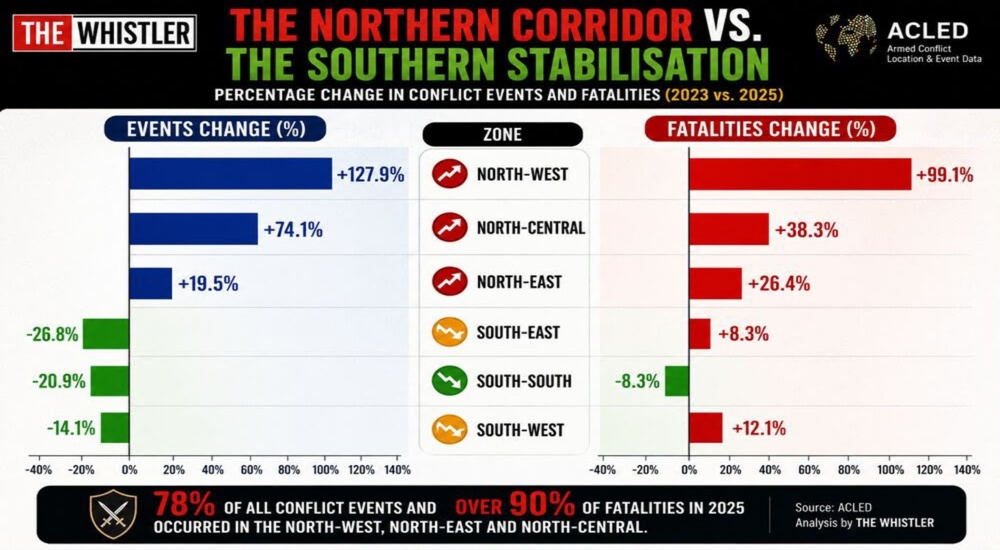
Together, these three zones accounted for approximately 78 per cent of all conflict events and over 90 per cent of all fatalities in 2025, making them the decisive drivers of Nigeria’s national security outlook.
The South-South’s conflict profile is fundamentally different from northern Nigeria. The region’s insecurity is driven less by insurgency and more by criminality, cult violence, communal tensions, and localised armed confrontations.
The overall decline in most categories between 2024 and 2025 suggests a modest improvement in the security environment, although the persistence of civilian-targeted violence and the increasing lethality of riots remain areas of concern.
Unlike northern Nigeria, where attacks on civilians increased sharply, the South-South experienced a gradual decline. These incidents include cult-related killings, community clashes, criminal attacks, kidnappings, and localised armed violence.
The relatively stable fatality figures suggest that although incidents remain common, they have not become significantly more lethal.
Apart from the data provided by ACED, an online survey conducted by THE WHISTLER between Friday, June 5 and Sunday, June 7 on regional security perception validated some of the findings presented through the statistical report.
A total of 1,110 persons responded to the survey which employed random sampling methodology. The study assessed perceptions of violence, peacefulness, and the relative contribution of various armed groups to insecurity.
Key findings indicate that the North-East is overwhelmingly perceived as the most violent region, with 582 citations. The South-South and South-East were seen as the most peaceful, accounting for over 81 per cent of the respondents.
Bandits and Boko Haram were rated as the most significant contributors to insecurity, while Oduduwa agitators received the lowest threat rating.
Respondents were asked to identify which of Nigeria’s six geopolitical regions records the highest occurrence of violence. An overwhelming majority cited the North-East (582 respondents), driven by the long-running Boko Haram insurgency.
The North-Central (210) and North-West (204) followed closely, reflecting bandit and herder-farmer conflict concerns. Southern regions recorded significantly fewer citations.
When asked which region is the most peaceful, respondents overwhelmingly picked the South-South (540 respondents, 48.6 per cent) and South-East (366, 33 per cent). The South-West followed with 156 citations (14.1 per cent).
This variation from the statistical report may have been influenced by recent security breaches, which seem to suggest that the profile of the South-West region has been rising in insecurity ratings.
The survey was conducted when the media were awash with the mass kidnaping of 39 children and seven teachers from three schools in the Oriire Local Government Area of Oyo State as well as the high-profile kidnap of the sister of a former Minister of Power, Chief Adebayo Adelabu, and her twin sons.
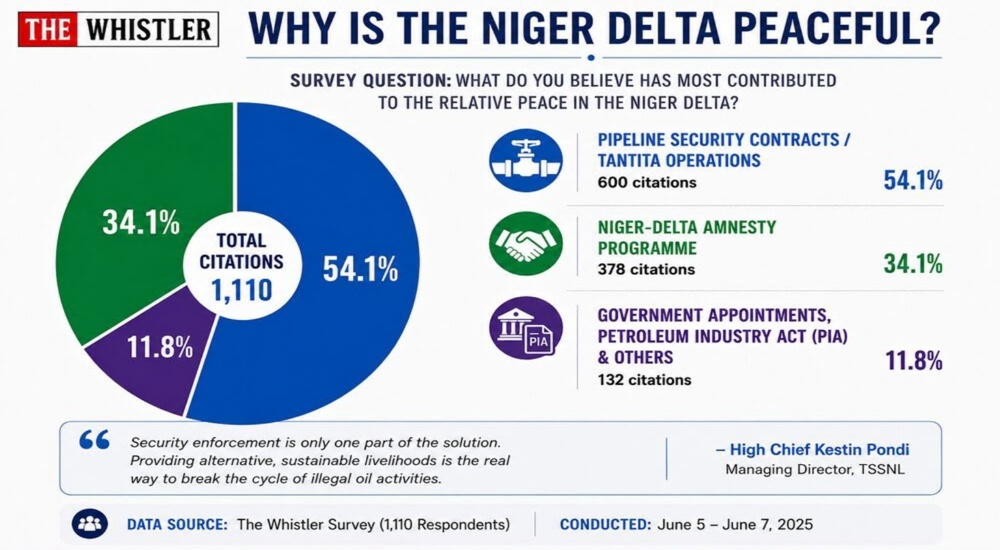
Despite decades of resource-control agitation, the Niger-Delta was perceived as relatively peaceful today. Respondents attributed this to pipeline security contracts (600 citations, 54.1 per cent), followed by the Niger-Delta Amnesty Programme (378, 34.1 per cent). A small minority credited government appointments or the Petroleum Industry Act.
The Nigerian National Petroleum Company Limited had in August 2022 awarded the pipeline surveillance contract to Tantita Security Services Limited (TSSL), a company linked to High Chief Government Ekpemupolo, for a sum of N48bn per annum.
A total of 54.1 per cent of respondents believe that the deployment of thousands of former militants in the execution of this contract must have contributed to the relative peace in the region which used to be the hotbed of insecurity in the country.
Several stakeholders including the Minister of State for Petroleum Resources, Heineken Lokpobiri, credit this contract for the restoration of peace in the oil producing region.
While there had been calls for the splitting of the contract, traditional rulers and other stakeholders had in a recent forum asserted that such action could destabilise the peace being enjoyed in the region.
THE WHISTLER learnt that the Tantila employs both kinetic and non-kinetic approaches to achieve lasting peace in the region in the bid to protect the nation’s pipeline infrastructure.
While it has employed about 136,000 persons involved directly in pipeline activities, it has offered indirect employment to more than 300,000 in its strategy to ensure peace and stability in the oil region directly responsible for the wealth of the nation.
One of the non-kinetic approaches of the company aimed at ensuring peace and tranquillity in the Niger Delta region is its partnership with Stakeholders Development Network (SDN) and Ecosus Pro Nigeria Limited to launch the Tantita Sustainable Rice Farming Initiative.
The company said on its portal that this initiative aimed to transition communities previously engaged in illicit oil-related activities into structured, large-scale rice farming that would not only provide them employment opportunities, but also feed communities beyond the region.
Managing Director of TSSNL, High Chief Kestin Pondi, underscored the strategy at the launch of the programme in 2025 when he said, “We recognise that security enforcement is only one part of the solution. Providing alternative, sustainable livelihoods is the real way to break the cycle of illegal oil activities.”
A Thisday report asserted that the activities of the company resulted in the rise of the country’s crude oil production from 1.2 million barrels per day to 1.7 million barrels per day.
Similarly, a report by The Guardian quoted, quoted the President General of the Ughelli Descendants Union, Mr. Sam Akpemegi, praising the commencement of the company since it started the execution of the pipeline surveillance contract.
Akpemegi had said, “They have done very well and improved security since they began operations.”
The same report quoted Civil Society Organisations backing the security services of the company in a forum convened by the Centre for Social Justice, Equity and Transparency.
In a communiqué issued by Dr. Opialu Fabian, the forum said the fragmentation of the contract could weaken operational efficiency, reduce accountability, and create openings for criminal networks.
Fabian said, “Pipeline protection is not a routine contractual engagement but a sensitive national security function requiring discipline, trust, intelligence coordination, and a clear chain of command.”
(The Whistler)