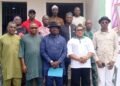
Renowned human rights lawyer, Femi Falana, SAN, alongside members of the #EndBadGovernance, and other civil society activists, on Friday took to the streets of Lagos to protest worsening insecurity, economic hardship and what they described as the failure of government to address the plight of ordinary Nigerians.

The protesters gathered at the Ikeja Underbridge area of Lagos as part of activities marking Nigeria’s Democracy Day, carrying placards with inscriptions demanding urgent action to tackle insecurity, kidnapping and the country’s worsening economic crisis.
Among the messages displayed on the placards were: “No Democracy Without Security,” “End Insecurity and Kidnapping,” “End Bad Governance,” and “Free All Abducted Children, Teachers, Farmers,” among others.
The demonstrators, including members of Committee for the Defence of Human Rights (CDHR) marched through parts of the state while calling on the Federal Government to take decisive measures to address rising cases of violent attacks, kidnappings and the deteriorating living conditions faced by millions of Nigerians.

Falana, a longtime advocate for democratic governance and human rights, joined the protesters in demanding greater accountability from elected leaders, arguing that democracy should translate into improved welfare and security for citizens.
The protest comes amid growing public frustration over the country’s security challenges, including mass kidnappings, bandit attacks, insurgency and violent crimes that have affected several parts of Nigeria in recent years.
Citizens have also continued to grapple with soaring food prices, inflation, rising transportation costs and declining purchasing power following a series of economic reforms introduced by the administration of President Bola Tinubu.
Friday’s demonstration was organised under the banner of the #EndBadGovernance movement, which gained national attention in 2024 after mobilising protests across several states against economic hardship, hunger and governance failures.
Participants at the Lagos rally, according to reports argued that while Nigeria was celebrating 26 years of uninterrupted democratic rule and the 33rd anniversary of the June 12, 1993 presidential election, many citizens had little to celebrate due to worsening socio-economic conditions.
The June 12 election, widely regarded as the freest and fairest in Nigeria’s history, was believed to have been won by the late Chief Moshood Kashimawo Olawale (MKO) Abiola before it was annulled by the military regime of former Head of State Ibrahim Babangida.
The annulment sparked widespread protests and a prolonged pro-democracy struggle that eventually contributed to Nigeria’s return to civilian rule in 1999.
In recent years, however, activists, labour groups and civil society organisations have argued that the democratic gains secured through the June 12 struggle remain incomplete, citing persistent insecurity, corruption, unemployment, poverty and alleged human rights abuses.
(SaharaReporters)