JOHN WYCLIFFE
‘Bliss was it at that dawn to be alive, but to be young was very heaven!’ (William Wordsworth on the French Revolution).
I WAS certainly not young on that morning on June 24, 2016, but as my whisky-fogged brain and sleep-deprived body walked along Whitehall on the way back from Parliament Square that Friday morning I did feel a sense of exhilaration.
Although I had campaigned for Leave and helped finance Martin Durkin’s Brexit the Movie, I did not expect we would win, especially after the terrible murder of MP Jo Cox during the final days of the campaign. Even so, I couldn’t resist staying up to watch the result with a bottle of the hard stuff to drown my sorrows. As the results from first Newcastle and then Sunderland came in, it was clear that Leave was in with a chance, and I dared to hope. Once the result was announced, I immediately wrote an article for TCW that matched the mood of what the MP, Gisele Stuart, would subsequently call that ‘unfrozen moment’ when anything seemed possible but is painful to revisit now.
Bunking off work, I went down to Parliament Square where the atmosphere was euphoric as the day was historic. We had done it! Two builders cheered and waved a Union Jack from the back of a flat-bed trunk rushing towards Millbank: the little people had beaten the elites – or so we thought. On the way back, I remember seeing the Australian flag flying from a building and thinking of the new, potentially Anglospheric future my children would be blessed to live in: the rebirth of Britain as an ancient free-trading nation that could combine its deep sense of history and traditions with modernity, rebinding itself to its kindred throughout the world.
This blog is written in the first-person singular style because Brexit and its aftermath was deeply personal to me, as I imagine it to many of you: I had always hated the EU from my teens due to my revulsion at the Common Agricultural Policy, and long before Maastricht it was obvious for those who cared to look that the direction of travel was inevitably towards an anti-democratic European super-state. Since joining TCW I had written much on the subject and in the months following the referendum, as it was plain that Brexit was being betrayed, wrote a great deal more. As Remain turned first into Remoan and then to an ever more self-confident move to Rejoin, a sense of outrage and increasing desperation grew among Brexiteers. Like many on the Leave side, I was so angry and aghast at the betrayal that it was causing me sleepless nights. People even started to talk openly of civil war.
I must admit that initially I was no fan of the idea of a referendum, being rather cynical about the capacity of people to take an interest and judging that almost always on such occasions people tended to be scared into sticking with the status quo, as indeed they had done in the previous referendum in what was then the Common Market in 1975. What a hypocrite I was – hating the EU’s imperial ambitions but not really trusting the people to make the right decision. That said, not long after the campaign got under way, I revised my thinking. All through the campaign Remain looked as if they were going to win, but I was deeply humbled and impressed by the way that ordinary people diligently went about their solemn democratic duty. Brexit was truly being discussed everywhere – in pubs, at work, on public transport, at home and online. It impressed upon me that people will really rise to the challenge if they feel they are genuinely empowered to do so and are only apathetic if they feel disenfranchised, which makes the subsequent betrayal by the elites even more disgusting.
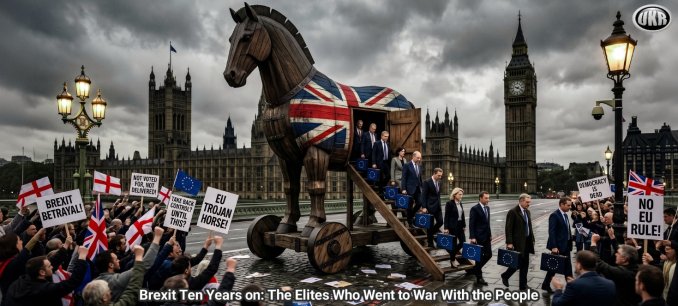
The second thing Brexit taught me – indeed taught us all – was that our elites and political class are truly rotten: venal, arrogant, cynical, contemptuous and profoundly anti-democratic. Very few realised just how deep the rot had gone, and in the first few days following the vote we naïvely expected our representatives to honour the democratic mandate of the people. Within a very short time we were to be disabused: Leave voters were castigated as ‘bigots’, ‘racists’, ‘thick’ and ‘low information’ by people leading gilded lives, who had plainly never lost before and weren’t going to take it lying down. Moreover, the problem wasn’t simply a domestic one: those of us who thought that talk about the globalist ‘New World Order’ was best left to those wearing tin foil hats were forced to concede otherwise as their supposedly mad conspiracy theories crystallised into fact before our eyes. British MPs, elected as guardians of our democracy, instead saw it as their job to conspire openly against their own country, travelling to Brussels to encourage the EU to take as hard a line as possible in what can only be called acts of treason. The elites were in open revolt against the people: Brexit lifted a stone and shone sunlight on a deeply morally corrupt political class, and if it achieved nothing else, we should be thankful for it achieving that. From that moment onwards, it became apparent to me that the way the world was architected, with its exceptionally powerful global networks of influence and governance, meant that the purely representative model of democracy had had its day, and only a Swiss-style system of direct democracy could hope to adequately represent the people – a belief I hold to this day.
Thirdly, Brexit taught me that great events, far from being determined by the great tides and flux of history – a man’s ‘swarm life’, as Tolstoy wrote in War and Peace – can at critical points turn on extremely individual and chance occurrences. In 2019, during the great drama of the third meaningful vote on Theresa May’s doomed withdrawal agreement, the leaders of the European Research Group (ERG), Jacob Rees-Mogg and Steve Baker, faced an impossible moral dilemma: accept the terms and trap Britain in the EU’s orbit with no escape, or vote down the Bill and Brexit may not happen at all. Both Baker and Rees-Mogg agreed with deep reluctance to advise the ERG to accept the terms and vote for the Bill. However, quite by accident Baker then met his fellow Brexiteer spartan Suella Braverman, who inquired about what he was going to advise. Her look of disgust so quailed Baker that he did a volte-face and advised the ERG to stick to its guns, leaving Rees-Mogg politically stranded. The ERG followed Baker’s line and voted down the Bill.
Much similar drama centred around Boris Johnson, who famously drafted two Daily Telegraph articles the night prior to the beginning of the referendum campaign – one for Remain and one for Leave. Had the highly articulate and charismatic Boris plumped for Remain, it is very doubtful that Leave would have won. However, had he not become infatuated with the then Carrie Symonds – later dubbed ‘Carrie Antoinette’ due to her regal sense of entitlement to influence her by then husband on government policy – Johnson may have made a far better success of Brexit. Instead, we got the biggest Brexit betrayal of them all – the post-covid ‘Boris Wave’ of truly unimaginable and nightmarish migration inflows.
So, was it all worth it? Despite all the drama, pain and passion of the Brexit years, it seems a dead, grey thing now. As Brexit has receded into the distance, it has been eclipsed by the even greater betrayals and horrors of a still intransigent political class that continues to govern in defiance of its people, changing the country out of all recognition through mass immigration and committing ever more authoritarian outrages against them. In the process it has severely crippled the Conservative Party and almost certainly the Labour Party. In their wake new political forces have risen, but despite increasing civil unrest the often-predicted civil war has so far failed to break out. After all the dashed hopes of that last decade, the public seemed instead gripped by a grim fatalism and resignation that the country is passing, or has already passed, the point of no return.
But yes, it was all worth it: ultimately, the lesson of Brexit was that, as flawed and painful as it was, by sheer persistence and bloody-mindedness we did at least leave the EU in the end, which is now in an even worse state than we are, cold comfort though that may be. As dismal and fated as things may seem presently, Brexit teaches us the lesson to ‘keep buggering on’, as Churchill put it. Who knows how the wheel may spin again in the years to come, allowing us another chance to free the country we love from the tyrannical grip of the elites and to resurrect the courage, vision and hope that defined the best spirit of the Brexit years.
’Til Brexit rises again!
See Related Article Below
Ten Years Today – We Are Leaving! But We Didn’t, Not Really
The UK and Global Establishment’s Campaign Against Brexit and the Subsequent Sabotage of Sovereignty
TOM WILSON

.
.Yet this victory for Leave was achieved despite an unprecedented mobilisation of the UK and global establishment against it. The Remain campaign, backed to the hilt by the government of David Cameron, major political parties, the Bank of England, most of the mainstream media led by the BBC, big business, and international figures, ran a ferocious “Project Fear” in a sustained effort of economic scaremongering designed to frighten voters into supporting the status quo.
From the outset, the establishment framed Brexit as an act of reckless self-harm. Chancellor George Osborne warned of an immediate “punishment Budget” with tax rises and spending cuts. The Treasury produced reports predicting a sharp recession, falling house prices, and long-term damage to GDP. The Bank of England, under Mark Carney, suggested financial instability and higher unemployment. International voices amplified the message: Barack Obama urged Britain to remain, warning of the country going to “the back of the queue” for trade deals, while IMF Managing Director Christine Lagarde and others echoed dire economic forecasts.
This was not neutral analysis but coordinated and highly mendacious advocacy. Studies of campaign speeches later confirmed the heavy reliance on fear-based appeals by prominent Remain figures, including Cameron, Osborne, and others across parties. Warnings ranged from economic Armageddon to the breakup of the United Kingdom itself. Scotland’s Nicola Sturgeon and others suggested Brexit would trigger Scottish independence. The campaign portrayed Leave voters as economically illiterate or driven by base instincts like xenophobia, rather than legitimate concerns over sovereignty, immigration control, and democratic accountability.
Project Fear drew on the precedent of the 2014 Scottish independence referendum, where similar tactics had succeeded. Yet in 2016, despite the barrage including claims of immediate job losses, supply chain collapse, and even war in Europe, the public proved resilient. Immigration emerged as a stronger concern than the economy in the final weeks, reflecting deeper frustrations with EU free movement and ‘elite’ disconnection. Leave’s simpler messages of “Take Back Control” resonated because they addressed real issues of borders, laws, and global independence that Remain’s hyperbolic warnings ignored.
The establishment’s efforts extended beyond domestic politics. Global financial interests, multinational corporations benefiting from regulatory harmonisation, and supranational bodies viewed Brexit as a threat to the post-war globalist order. The EU itself, naturally invested in preserving its membership, lent implicit and explicit support to Remain. The narrow victory for Leave was thus a triumph of popular will over institutional power, media consensus, and elite opinion.
Tragically, the story did not end with the referendum result. Successive UK governments, both Conservative and Labour, have failed not only to seize the opportunities of Brexit but have actively worked to undermine it, often through delay, dilution, and deference to Brussels.
Theresa May’s premiership was defined by negotiation failures and internal party divisions. Her withdrawal agreement, particularly the Northern Ireland Protocol, created a de facto border in the Irish Sea, fragmenting UK territorial integrity and subjecting Northern Ireland to EU rules. The repeated inability to pass her deal led to her resignation. Boris Johnson secured a revised but still vapid agreement and a general election victory in 2019 on “Get Brexit Done,” delivering the formal exit on 31 January 2020.
Yet implementation of even this weak, EU-favouring deal proved tortuous. Trade frictions emerged, especially for businesses dealing with new customs and regulatory barriers. Critics on the Leave side argued that opportunities for deregulation, independent trade deals, and agile policymaking were squandered amid the Covid-19 pandemic and subsequent economic challenges. And of course, in a moment of supreme spite, they opened the floodgates to a huge increase in immigration in the infamous Boris spike.
The Retained EU Law Bill saw any hope for rapid divergence scaled back, with many EU regulations retained due to Whitehall’s covert plan to keep us in the EU’s pernicious orbit. Promises of scrapping thousands of EU-derived rules were, at best, diluted. Labour’s victory in 2024 shifted rhetoric towards a “reset” with the EU. While Starmer ruled out rejoining the Single Market, Customs Union, or full membership immediately, actions suggest closer alignment. Summits and deals on security, trade, and standards have been framed as pragmatic but indicated incremental re-integration. In other words, rejoin by stealth.
Across administrations, the pattern is one of minimal divergence. Regulatory alignment in areas like product standards, state aid, and environmental rules persists. Trade deals with non-EU partners have been slower and less transformative than hoped. Immigration, a key Leave driver, remains excessive. Establishment economic analyses routinely blame Brexit for any and all economic bad news and setbacks, no matter how preposterous the claim, rarely pointing to global factors, domestic policy failures, energy costs, and the self-fulfilling effects of prolonged uncertainty and sabotage. What is clear is that no government has pursued a bold, coherent vision of Global Britain with enthusiasm.
The UK Establishment – encompassing much of the civil service, judiciary, academia, media, and corporate sector – has never accepted Brexit. Reports and commentary frequently highlight efforts to align regulations “by stealth,” such as through metrology and product acts that facilitate EU standards adoption. The “reset” under Labour emphasises cooperation in foreign policy, defence, and youth mobility schemes that echo pre-Brexit arrangements.
This abasement also manifests in refusal to exploit regulatory freedoms (e.g., in gene editing, fintech, or agriculture), preference for EU-style rules in negotiations, and cultural nostalgia for the “European project.” The machinery of state often defaults to harmonisation, viewing independence as administratively burdensome and, in many cases, immoral, even illegal and against spurious international law.
Re-joining the EU, whether overtly or by stealthy convergence leading to accession, would come at a very steep price. It would require accepting the acquis communautaire in full: free movement (undermining border control), contributions to the EU budget (without the previous rebate), jurisdiction of the European Court of Justice, and loss of independent trade policy and probably the Euro.
Economically, however, the EU faces sluggish growth (projections around 1% for the euro area), productivity failures, fragmented capital markets, energy vulnerabilities, and demographic decline. High debt in several members, disputes over fiscal transfers, and regulatory burdens hinder dynamism. Geopolitically, reliance on the US for defence (highlighted by shifting American priorities) and exposure to coercion from powers like China expose weaknesses. Enlargement fatigue, rule-of-law conflicts with members like Hungary, and populist challenges from within test cohesion.
Politically, the EU trends towards greater centralisation – more qualified majority voting, supranational authority over budgets, migration, and foreign policy – which critics describe as increasingly technocratic and distant from citizens. This “ever closer union” risks democratic deficits, as seen in responses to crises where national preferences are overridden. For the UK, re-joining would mean surrendering sovereignty for uncertain influence in a bloc whose economic model is faltering and whose governance is becoming more top-down and less accountable.
Brexit was sabotaged. Yet the referendum affirmed the principle that the British people, not distant elites, should decide their governance. Persistent efforts to reverse or hollow out that decision betray democratic trust. True success requires commitment to making independence work: radical regulatory reform, global trade ambition, controlled immigration, and cultural confidence. Clinging to a declining, centralising EU by stealth offers false security at the cost of agency. The establishment’s resistance reveals more about its priorities than the people’s 2016 verdict. Britain must now choose sovereignty and adaptation over managed decline within a troubled union.
(UKR)