
Captured Market
A rundown of what’s really in the leaked Reset press release
CATHERINE MCBRIDE
The statement to be published on 20th November has already been leaked to the UK press, but unfortunately most of them have missed the important parts. The Remainer/Rejoiner press have neglected to mention the worst bits of the document because they are, like the Prime Minister, desperate to rejoin the EU, and they want to take Fido with them, so they are emphasising the Pet Passports and overlooking the items that involve massive costs and upheavals to British businesses and UK taxpayers.
Let’s start with the bits the press forgot to mention or didn’t understand:
The document that I am reading on November 5th, Guy Faulks Day as it happens, is dated November 20th and is written in the past tense. Everything in this document has already been agreed. There will be no negotiation about the Reset on November 20th. Andy Burnham is obviously just a patsy who was parachuted into a safe Labour constituency to put the UK under EU control. Starmer probably didn’t have the bottle to do this, or, being a lawyer, understood the implications, although it started under his watch when Nick Thomas-Symonds (Who he? Ed.) agreed to the Common Understanding in May 2025 and gave the EU a blank cheque. UK government ministries have obviously been working on this document since then without mentioning it to the UK population, or offering them a vote on its contents.
Speaking of blank cheques, any costs in the Reset are UNFUNDED. The press release obviously doesn’t want to remind people that nothing the EU does is free, so the document doesn’t mention any costs. However, rest assured, the costs and payments to the EU will have been agreed, as this is the main reason the EU is doing this. But UK politicians won’t want to mention the cost so close to last week’s budget statement because it didn’t set aside any amount to pay for the Reset: that means paying the EU for its ‘policy work’, paying for the cost of running the EU’s electricity market, and paying into the EU’s ‘Cohesion Funds’.
Laughably, Point 24 claims the UK and the EU want to ‘reinforce cooperation on democratic resilience’. Think about that. A group of unelected bureaucrats in the EU and an unelected Prime Minister in the UK are claiming they want to support democracy by signing an agreement the British public has not seen and did not vote for. The current UK Prime Minister represents a Labour Party elected on a platform promising to NOT re-join the EU, the Single Market, or the Customs Union, but here he is, signing an agreement written by the EU that hands them control over our trade, our energy, and our money.
Burnham only believes in democracy if it’s OK to lie about your beliefs to get elected and do the exact opposite once in power. Meanwhile, the EU only believes in democracy if people vote for more EU. If not, election results have been cancelled, such as in Austria in 2016 and Romania in 2024; referendum results are ignored, such as referendums on the Maastricht and Lisbon treaties in Ireland, France and the Netherlands; or it will withhold funding if it doesn’t like your policies, as it did to Hungary until it elected a new Prime Minister.
As a punchline to the document’s little democratic joke, Point 26 will enable the UK to participate in EU Election Observation Missions – I assume they mean elections outside of the EU or the UK.
To add insult to injury, the document acknowledges in Point 8 that the UK-EU Trade and Cooperation Agreement is the most ambitious trade agreement of its kind, and that it ‘functions effectively’. This proves that the government knew that the dodgy economists who claim Brexit has reduced the UK economy by 4%, 6%, or 8% were lying. And that the politicians and central bank governors who claim that UK trade with the EU has dropped by 15%, 20%, or 26% because of Brexit are also lying. So why are we doing this Reset at all? I suspect the EU needs that blank cheque more than it wants to admit to its own bond market investors.
The agreement also welcomes in Point 29 the signing of an MoU on health security, but it’s undated. No doubt this will be signed in the photo op. This MoU will establish another quango, the Specialist Committee on Health Security, within the Trade and Cooperation Agreement. This is despite Point 43, which welcomes the conclusion of negotiations about the common Sanitary and Phytosanitary Area between the UK and the EU. This will allow health certificate-free movement between the UK and the EU of plants, animals, and plant or animal products, even though the EU is currently a cesspit of diseases, from Foot and Mouth and African Swine Fever to Citrus Green Disease (HLB), Xylella fastidiosa in olives and rosemary, and Potato Psyllid. All of these diseases will soon be available in British garden centres and on British farms. (Don’t complain that you never get anything from the EU.)
Toward the end of the document, which is meant to be about resetting the UK-EU Trade and Cooperation Agreement, we finally get to Supply Chains. Or actually, EU supply Chains. In Point 64, the EU claims that it wants to cooperate on ‘export controls to counter technology leakage in critical sectors’ and on ‘resilient supply chains’, including ‘critical raw materials’. Yes, I am not joking; the document actually says this.
Apart from ASML, which has a near monopoly on advanced semiconductor manufacturing tools, the EU does not control any critical digital or industrial technologies. The EU relies on non-EU providers for over 80% of key digital products, services, infrastructure and intellectual property, while US companies control over 70% of the EU cloud market. So why would we let the EU control the UK’s technology sector? The UK is still home to ARM Holdings, as well as other designers of compound semiconductors and photonics. The UK has significant quantum technology research and investment. The UK has Europe’s largest AI sector with substantial private investment, as well as advanced engineering, biology, advanced connectivity and cybersecurity. The UK has its own national Semiconductor Strategy, AI Hardware Plan and Quantum Programs; why would it take orders from the Luddite EU that is trying to block technology at every opportunity?
So what Critical raw materials does the EU have? Not many either: some copper, helium, and coking coal, but for most of the 34 critical raw materials the EU identified in Regulation 2024/1252, the EU relies on China to either supply and/or process them, including rare earths, gallium, graphite and EV battery materials. Again, like technology, the UK is slightly better endowed in critical minerals, with the largest lithium deposits in Europe, significant tungsten, Europe’s largest nickel refinery, and the only Western source of some rare earth alloys used in magnets. Still, UK domestic production meets only about 6% of its critical mineral needs. But the sector does contribute about £1.8 billion to the economy and supports about 50,000 jobs.
Like technology, the UK has its own Critical Minerals Strategy and aims to supply 10% of its annual demand by 2035 and produce 50,000 tonnes of lithium by 2035. So again, why would the UK let the EU make its rules for these minerals? Does the EU just want to gain control over British Lithium and Tungsten?
But still in Point 65, the UK has agreed to be bound to ‘ensure that in its policies and national legal order the same outcomes as regards other international partners as the relevant EU measures in order to ensure that the supply chain in question is protected in a consistent way across the EU and UK markets.’ (Only an EU apparatchik could write such unintelligible rubbish and think that they are writing in English). This gobbledygook is then slightly clarified in the next sentence, which mentions the need for resilient steel, electric vehicle, and critical technologies supply chains.
What I think they are trying to say is that the UK has agreed that its policies and laws must produce the same results as EU policies and laws to consistently protect supply chains across Europe. This has been agreed without the EU requiring the UK to sign up to dynamic alignment with EU trade regulations.
The UK has committed to applying the same export controls on sensitive technologies (even though it has more sensitive technologies than the EU), applying investment screening to eliminate high-risk investors (?), and restricting high-risk suppliers in critical infrastructure (China or Russia?). So why has the EU insisted on UK dynamic alignment in food and agricultural trade, but it is content to accept a commitment to achieve similar outcomes in the larger and more important strategic, industrial, and defence industries? Is this because EU SPS dynamic alignment is designed to prevent the UK from buying food and agricultural goods from non-EU countries?
Point 65 is probably referring to the EU’s restrictions on Chinese investment and components in its strategic machinery, although China is not named in the document. Although restricting Chinese involvement in strategic machinery may sound sensible, remember that the EU still relies on Russian oil and gas; the oil is now mainly refined in India, so the EU can pretend it is using Indian petrol, diesel, and chemicals. But without Russian Crude, this supply chain stops working.
Point 65 probably also wants the UK to impose the same tariffs on Chinese EVs as the EU, so that the EU can recapture the UK as a market for German vehicles. The only problem is that German EVs are also made in China; at least the BMW and VW ones are. If the EU wants to save their car industry, both it and the UK should drop their EV mandates.
Point 65 may also cover the much-mentioned ‘Made in Europe’ supply chain rules, although this nickname for the program isn’t directly mentioned.
The following Point 66 gets to the EU’s main aim in its protectionist policies: the EU wants the UK to help protect the EU’s steel industries with a quota system under the WTO GATT process. This ‘reciprocal’ arrangement has two massive holes.
- The UK hardly makes any steel any more. It is down to just 2 blast furnaces, and they are only still operating because of massive government subsidies, while the EU has 47 blast furnaces and hundreds of Electric Arc Furnace steelworks run on much cheaper industrial electricity than the UK’s. So agreeing to Point 66 would simply result in the final death of UK steelmaking.
- The EU has defied the WTO CODEX rules and has ignored a myriad of complaints to the WTO after the EU lowered its pesticide Maximum Residue Levels, and its banning of certain food ingredients and packaging materials without any scientific evidence to back up its changes.
The EU is happy to cherry-pick which WTO rules it wants to obey and which it wants to ignore, but now it wants to use the WTO to block Chinese EV and steel imports while it is defying the WTO and blocking imports of fruit, vegetables, and cereals from other countries. I should point out that if the UK is silly enough to let the EU make its SPS rules, the UK will also be defying WTO CODEX rules.
However, the UK would still have a steel industry and would not fear being undercut by Chinese steel if it had encouraged investment in new steel plant and equipment rather than making steel production uneconomic through short-sighted carbon taxes, bans on coking coal extraction, and high industrial electricity prices making EAFs uneconomic in the UK.
Point 38 will make labour voters in Grimsby and Aberdeen choke: The EU ‘welcomes the decision (Who decided this?) on full reciprocal (yes, reciprocal) access to fishing waters until 30 June 2038 AND on the extension of energy cooperation on a continuous basis.’ Energy and fish were tied together in the original Brexit negotiations to ensure the UK had continued access to EU electricity and that the EU had continued access to UK fishing waters, but that link was severed when Keir Starmer allowed EU fishing rights in UK waters to be extended until 2038, so why are they still tied together?
In Point 39, the document complains about the drop in fishing catches in the Celtic Sea; apparently, this is impacting ‘coastal communities’ in the UK and the EU. However, it is unclear whether they mean British and Irish coastal communities or the massive French, Danish, and Dutch trawlers, which presumably also come from coastal communities and have been granted unlimited access to UK fishing waters until 2038. These boats may also be causing the problems noted in Point 40 about shortages of North East Atlantic mackerel, blue whiting, and herrings. But the EU fishing industry has strongly opposed the UK’s restriction on bottom-towed fishing gear in British Marine Protected Areas. So the EU may be able to address low fish stocks by restricting its own fishing industry rather than also destroying the UK’s fishing waters.
Point 41 vaguely references the Energy Title of the Trade and Cooperation Agreement and its extension until March 2028, but doesn’t explain what it is or that it was meant to cease applying in June 2026.
The Energy Title of the TCA is meant to facilitate trade and investment in energy and raw materials, increase energy security, promote environmental sustainability, and ensure fair competition through non-discriminatory access to energy networks and non-discriminatory rules and fees for the production, generation, transmission, distribution, and supply of electricity and natural gas. So if all of this is included in the Trade and Cooperation Agreement’s Energy Title, and this has been extended for another 2 years, why is the UK agreeing to pay to join the EU’s Internal Energy Market (IEM)? We let EU nations Belgium, Ireland and the Netherlands buy our gas and use the UK gas interconnectors as a land bridge to access Norwegian gas and US LNG, so why do we have to pay the EU’s electricity system costs to be allowed to buy and transport EU electricity?
Point 47 explains how electricity trading would be different as a member of the IEM rather than simply continueing to rely on the TCA’s Enery Title: besides the slight saving for UK energy companies as they will be able to buy interconnector capacity simultaneously with their electricity purchases, but the main changes are:
1. The UK would be required to apply the same EU electricity market rules and EU renewable rules known as RED III simultaneously when they are applied in the EU;
2. The ECJ would be the exclusive arbitrator of any disputes regarding energy purchases or the other dynamically aligned regulations; and
3. Most importantly for the EU, the EU has linked participation in their Internal Electricity Market with payment to the EU’s Cohesion Fund. This is the main difference between the TCA’s Energy Title and joining the EU IEM – payments to the EU.
According to Montel Analytics, joining the IEM could possibly save electricity companies 0.25% to 0.7% of wholesale electricity prices, but the EU Cohesion Fund was about £6 billion a year in the 2021-27 EU budget. If the UK has to pay 16% of this, and we import the same amount of electricity as we did in 2025, then the Cohesion Fund would be equivalent to adding 2% to the wholesale costs of large industrial electricity users.
Only a government would think it makes sense for UK taxpayers to pay the EU the equivalent of 2% of our electricity costs so private electricity companies can save at most 0.7% of their costs on transporting the 10% of electricity we import from the EU. Although the EU could ask for much more than this, as it has more than one cohesion fund and so far we have been ‘invited’ to join a second one.
The EU has several cohesion-style funds the UK may be asked to contribute to, including:
- The European Regional Development Fund, which aims to reduce financial disparities between EU regions (it gets about €214 to €226 billion in the EU’s 2021 to 2027 budget)
- The European Social Fund+, meant to reduce disparities in employment, education, training, and skills (pity the UK’s 1 million NEETs won’t be eligible for this). (€95 billion in the 2021-27 EU budget)
- The Cohesion Fund is designed to pay for infrastructure projects in EU countries with a Gross National Income below 90% of the EU average. This is the fund the UK will be paying into if/when we join the EU’s Internal Electricity Market. (€48 billion in the 2021-27 EU budget)
- The Just Transition Fund is tasked with helping EU regions affected by the EU’s Green agenda transition away from firm power produced by hydrocarbons and replace it with intermittent wind and solar power. I suspect wealthy countries like Germany wouldn’t be eligible for this financial assistance, so they will keep burning lignite. Meanwhile, Poland’s economic miracle might be over if it is forced to give up its coal-fired power and instead get handouts from the ‘Just Transition Fund’. (€20 billion)
- Finally, the European Territorial Cooperation fund (Interreg), which funds infrastructure projects between different EU countries. (€10 billion). In Point 36, the EU is also generously going to allow the UK to also ‘participate’ (that means pay, not receive) in its ‘Interreg programmes’. I wonder how much the UK will be expected to pay for its participation?
Together, these funds cost about €370 to €390 billion in EU funding over the 2021to 2027 EU budget period. The next budget from 2028 to 2035 is expected to be much larger. No wonder the EU wants the UK’s money.
Despite the EU’s enthusiasm in point 47 for decreasing the dependency on hydrocarbons, in Point 46, the EU welcomes ‘ongoing cooperation on security of energy supply especially in times of critical geopolitical uncertainty’. I have to assume they are talking about the UK’s oil and gas resources here, overlooking the irony that one of its cohesion funds subsidises EU members’ transition from reliable hydrocarbons to intermittent wind energy. Meanwhile, the UK’s Energy Independence Bill was introduced into the House of Commons yesterday and is designed to stop new oil and gas development in the UK. I wonder whether anyone has told the EU, or whether the EU will force our Ministers to tear up the Energy Independence Bill, as well as the Sentencing Act.
Point 44 of the Document welcomes the concluded negotiations on linking the EU’s and UK’s Emission Trading Schemes (ETS), which will apparently allow for ‘mutual recognition of UK and EU emission allowances’, despite the much lower prices in the UK. So, will EU firms be able to buy UK lower-priced certificates and use them to pay EU carbon taxes? Will the EU mind that the money raised from UK emission allowances does not go into EU coffers or even into EU green initiatives? Do our politicians even know that the two ETS markets are different?
The document also claims that the EU and UK will exempt each other’s goods from their respective Carbon tariffs, known as the Carbon Border Adjustment Mechanism (CBAM) ‘subject to respective laws and procedures that we plan to launch without delay’. Without delay? Let’s hope so, because the UK’s HMRC is still planning to start its own CBAM in two months, with a threshold based on the imported value of the CBAM goods, while the EU CBAM is applied after a certain weight of the good is imported. The UK CBAM system uses a single default value for each good at the HS 6-digit level, rather than the EU’s much more complex 120-country default system. Do UK negotiators understand the differences in the two schemes?
Will HMRC’s efforts be put in the bin once the EU runs the UK again? Will the time and effort HMRC has put into their system be wasted, along with money spent on the ports and customs authorities the UK has installed in the Irish Sea and in Kent? And what about the UK companies that have paid to implement systems that comply with the UK’s CBAM scheme; will they be compensated for their wasted expense?
Joining the EU’s CBAM is not a benefit for the UK, as the UK has very limited capacity to make, let alone export, the six commodities covered by the EU’s CBAM: aluminium, steel, cement, fertiliser, hydrogen and electricity. For almost all goods covered by the EU’s CBAM, the UK imports far more from the EU than it exports to the EU. But because the EU’s ETS price is higher than the UK’s, importers of EU goods would not have to pay anything under the proposed UK CBAM. So why are we joining the EU’s System?
The UK steel exports dropped dramatically after the closure of Redcar and Port Talbot steelworks. UK aluminium production has fallen to just 5% of its previous highs after the closure of Lynemouth and the Holyhead smelters. UK fertiliser production ceased in 2022 due to the UK’s high gas prices and carbon taxes. The UK produces very little hydrogen but imports much more from the EU. The UK’s wind- and gas-produced electricity is mixed in the grid, but again we predominantly import electricity from the EU, which supplied 10% of the UK’s electricity in 2025. Finally, the UK still makes and exports cement, but our largest cement export to the EU, kaolinic clay, is produced very efficiently, and the EU CBAM default applied to UK Kaolinic clay is lower than the EU’s benchmark, so UK exports would not be subject to the EU’s CBAM.
Additionally, the UK, along with South Korea and South Africa, is currently being reviewed by the EU for a reduction in the total CBAM costs under Article 9 of Regulation (EU) 2023/956, which allows an authorised CBAM declarant to claim a reduction in the EU’s CBAM if a carbon price has been effectively paid in a third country. So why is the UK even thinking about joining the EU’s CBAM?
In Point 31, the agreement welcomes the UK’s participation in Erasmus+ in 2027, even though this was announced last year, as was Point 35, which covers joining the Erasmus+ scheme from 2028 to 2035 for an annual fee of £810 million. If the EU is now claiming this hasn’t been agreed, then we should expect them to try to increase the price we have to pay for this dubious ‘benefit’.
However, according to Point 32, negotiations have been concluded on the Youth Experience Scheme, which will allow “young” people from the EU to live in the UK for up to 3 years to work, study, volunteer, or travel. The document doesn’t mention an age limit (apparently you’re young until you’re 30), and it doesn’t mention any limit on how many under-30s can come, which implies that there isn’t a limit. This is effectively free movement for under-30-year-olds in the EU.
More comedy gold appears in Point 33, where the EU claims a shared strength in Higher Education (where are they hiding their world-class universities?), but then, in the next point, mentions a supplementary agreement that will allow unlimited EU students to study in UK universities at the same capped fee paid by UK students. And in this point, it includes the word UNLIMITED. This will cost billions of pounds; but who will pay for this? Will UK lecturers, Vice-Chancellors, and College Provosts take a pay cut? Will non-EU foreign students see their fees increased to subsidise EU students? Or will UK taxpayers be expected to stump up the extra money? And why does the EU want to make this part of the Trade and Cooperation Agreement? Is this a way to threaten the UK that if they resent paying for EU students, they may lose their trade agreement with the EU? If so, the UK should call the EU’s bluff – we buy a lot more from the EU than they buy from us. But instead, the EU’s poodle, Andy Burnham, will agree to this and sign it within 6 months, to meet the EU’s current timetable. Perhaps one of the EU bureaucrats’ children is applying to Oxbridge.
The section on defence and security doesn’t mention the unrest and riots across EU cities; instead, the document starts in Points 11 to 13 with the usual EU arrogance fluff about concern for Ukraine, the Western Balkans (Huh?), Gaza, the West Bank, Iran, Yemen, Africa, the Indo-Pacific, and even the Arctic. No mention of Paris, Marseille, or Berlin. Obviously, there is nothing to see there. Yet in Point 21, the UK has apparently agreed to participate in EU civilian Common Security and Defence Policy (CSDP) missions to tackle shared threats and challenges, ‘with a particular focus on European security’. So maybe we will be able to watch UK police operating French water cannons against the rioters and anarchists.
The document also pledges its commitment to the International Criminal Court in Point 15, but the EU is not so interested in the UK sending EU criminals back to the EU, as we see later in the document in Point 51. The UK has had to agree to disobey its own Sentencing Act 2026 by not deporting EU criminals, even though the point of the Sentencing Act was to reduce the pressure on UK prison capacity. So, the Act will only apply to criminals from non-EU countries. EU criminals will still take up UK prison places, and UK taxpayers will still be paying for their incarceration, while new criminals will be given noncustodial sentences because we don’t have enough prison places, but that’s OK because we can’t possibly upset the EU.
Point 22 commits to upholding the United Nations Convention on the Law of the Sea and freedom of navigation, and yet the EU hasn’t sent its massive navy to the Persian Gulf to force Iran to reopen the international waterway known as the Straits of Hormuz. This is because the EU doesn’t have a navy, as defence is still a national competence, and about a third of EU countries are either landlocked or neutral. There is no EU fleet, no EU flagship, nor an integrated EU naval command equivalent to a national navy. So why is the UK signing an agreement with the EU about protecting the Laws of the Sea? Surely we should be talking directly to Italy, Spain, Greece, and France.
Points 23, 25, and 27 are about countering cyber threats, space threats, and violent extremism. All well and good, except they plan to do this by aligning their ‘restrictive measures’. Although they don’t explain what these are. Do they mean restrictions on technology, or on free speech, or on political opinions?
Point 52 claims that the UK and EU have already agreed to formalise their cooperation in tackling drug trafficking. I thought this would happen without a formal international agreement.
Point 53 claims that the EU might possibly allow the UK to join the Prüm International Initiative on law enforcement cooperation and the exchange of DNA, fingerprints, and vehicle registration data. Given that the UK opted out of Prüm in 2014, when we were EU members, I’m not sure why they would want to join now that the EU has taken over what was once an initiative between 8 EU countries.
Point 60 is more comedy gold. Apparently we adopted the European Commission’s Channel Action Plan in June 2026, which is apparently providing ‘a structured EU-level framework for cooperation to tackle irregular migration and the criminal networks facilitating it, as well as to strengthen border management.’
The EU claims that its Action Plan is ‘coordinating action against migrant smuggling’. However, anyone who has watched footage of French Police standing on Calais beaches while enormous rubber dinghies are loaded with illegal migrants, which the French navy then escorts to the UK’s maritime border, may not have realised that this is a coordinated action against migrant smuggling.
Point 60 also explains that the UK is ‘making a financial contribution’ to the EU’s ‘coordinated action’ to reflect our ‘shared responsibility for addressing these challenges’. Again, the Document doesn’t mention how large this financial contribution is, but we can see from the daily dinghy arrivals in the UK that the EU is either totally inept or it is actually coordinating the movement of illegal migrants into the UK, rather than trying to stop it. Or the EU is simply pocketing the money and letting the French Police do what they like. Also a possibility.
The document finishes at point 66. Some parts of this document have already been signed and agreed; it will be interesting to see if the UK government ever admits to the cost of this foolishness. However, any money we pay to the EU is money that should have been used to increase the UK’s defence spending, or to counter cyber threats to the UK; instead, it will be wasted on EU Cohesion funds and payments to the EU for its policy work on the Agri-food, ETS and CBAM, and the running of its internal energy market, despite the fact that the UK already has departments full of public servants developing our own agricultural and food regulations, our own emissions trading markets, carbon border payments, and energy regulations.
See Related Article Below
Burnham’s Brussels surrender has been written before he even gets on the plane
GAWAIN TOWLER
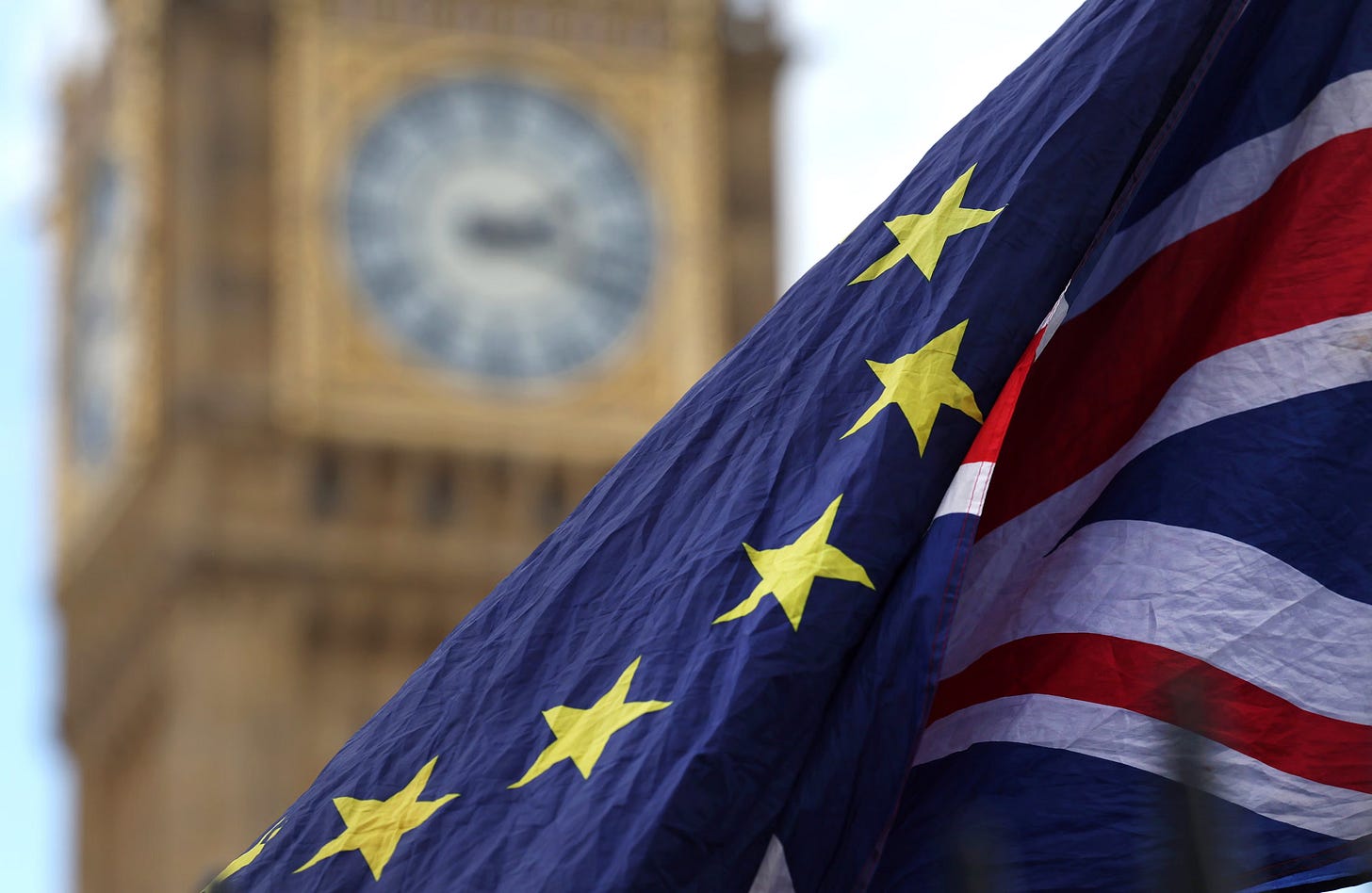
The communiqué for Andy Burnham’s Brussels summit has leaked. It is dated 20 November. It was written in October.
Eleven pages, 66 paragraphs, and the blanks are still showing. One line welcomes “the signing/conclusion of negotiations [TBD]“. Another welcomes a memorandum signed “on XX 2026”. The leaders of Europe and Britain “concluded the following“, we are told, before any of them had sat down. The word “welcome“ appears 26 times. “Made in Europe“, the procurement access Burnham promised MPs on 12 October, does not appear once.
Most of it was trailed. The food deal that hands British farm rules to Brussels. A carbon price set by the EU’s auction. A “youth experience scheme“ that is three years’ residence to work, study or “simply travel“, which is not an experience, it is a visa. Erasmus. Home fees for EU students, with the Treasury reportedly bailing out universities by £450 million a year to cover it. Fishing rights to 2038, “welcomed“ as if we had received a gift rather than given one. Two cheques to Brussels of unspecified size, one for the right to trade electricity through cables we already use, one to help the EU police its own beaches.
And a clause in which “the UK recognises the concerns of the EU“ about deporting European criminals and “commits not to proceed“. Brussels has drafted the British government’s recantation for it, and the Home Office had to leak the thing to get the paragraph noticed.
Three parts of this document deserve a closer look, because almost nobody has given them one.
The AI law that arrives through the back door
Paragraph 49 is the best joke in the document, told with a straight face. Britain and the EU will launch a “Digital Partnership“ on artificial intelligence, “while safeguarding our regulatory autonomy“. The very next sentence adds the EU’s Artificial Intelligence Act to the list of Brussels laws that apply directly in Northern Ireland.
So a 144-article European statute, which half the countries that passed it now want paused, becomes the law of part of the United Kingdom by a line in a press release. On 4 November, the afternoon the leak broke, a Cabinet Office minister quietly confirmed it. From 10 November, any smart speaker, connected watch or AI toy sold in Belfast meets EU rules or is not sold there. A tech firm in Belfast is now at a disadvantage to one in Brighton. Again. The Stormont brake, which exists for exactly this, will not be pulled, because London has already said yes.
The clause nobody has read
Paragraph 65 is the real surrender, and it has had no coverage at all. It is written in the sort of English designed not to be read. So I have.
Britain “would be bound to ensure in its policies and national legal order the same outcomes as regards other international partners as the relevant EU measures“ on steel, electric cars and “critical technologies“. Bound. In British law. The same outcomes. Against other countries.
In plain words, when Brussels slaps a tariff on Chinese cars, Britain must legislate to match it. When Brussels cuts a steel quota, so must we. When Brussels decides a new industry is “critical“, the obligation grows to fit. No British minister, regulator or court need find any harm to any British firm. The decision is taken in the Commission and we are bound to copy it.
Six weeks ago Britain refused exactly this. On 28 September the Business Secretary, Jonathan Reynolds, told Brussels we would not match its 35% duties on Chinese electric cars, that trade policy would be decided in British interests, and that no Chinese maker was building cars here to sneak them across the Channel anyway. Brussels had demanded the tariffs as the price of “Made in Europe“ access. Paragraph 65 writes Reynolds’ refusal out of history. The toll has gone into the text and the bridge it was meant to pay for has been removed.
Think what that means on a forecourt in Wigan. The cheapest electric car in Britain today carries a 10% tariff. Under this clause it rises by a third overnight, not because anyone in Britain wanted it, but because an official in Brussels was worried about Stellantis.
Now think about Washington. “Other international partners“ includes the United States. When the EU retaliates against American steel tariffs, we are bound to “the same outcomes“. Britain’s own deal with Washington bought our steel an exemption precisely because we were not in Europe’s trade war. This paragraph conscripts us back into it, with no vote on the targets.
And it is built to be unbreakable. Every strand of the reset is tied to every other, so a future government that tears up paragraph 65 loses the food deal, the carbon deal and the electricity cable in one go. That is the design. Reform will tear it up anyway, and should say so now.
Nought point four
And for all this, what does Britain get? Burnham gave the number to the cameras. “It’s estimated up to 0.4% extra on GDP.” Up from 0.3% a few weeks earlier. Not doing it would be a “dereliction of duty“.
Look at the number. It is a long-run estimate, which in Treasury language means 15 years. The whole reset, every cheque and every clause, is claimed to leave the economy 0.4% bigger in about 2040. Annual growth of 0.03%. The Office for National Statistics revises a single quarter by more than that most months. The Treasury has not published its workings, and the Adam Smith Institute notes the figure has changed several times during the talks. A number chosen to be quoted, not to be nailed down.
The economist Catherine McBride told the Lords that Britain’s entire food and live animal exports to the EU in 2025 were £12 billion. That is 0.4% of GDP. The headline deal is being sold on a gain equal to the whole of the trade it is meant to help. You would have to double every sausage and every lamb sent across the Channel. Her costing of the other side of the ledger is £17.6 billion a year by 2027. Halve it if you like. It is still a bill of £9 billion a year against a hoped-for £15 billion, once, in 2040.
The Prime Minister’s word for not signing was dereliction. The dereliction is signing eleven pages that bind British law to Brussels’ trade policy, put a foreign statute on the books in Belfast and write two blank cheques, on the strength of a number he refuses to show anyone.
He will fly to Brussels on the 20th, sign a document finished before he arrived, and come home to tell us the public are the boss. The public were the boss once. Paragraph 51 remembers it. It calls the result a concern.

••••
••••
••••
••••
(UKR)