By Jörn Petring and Johannes Neudecker, dpa
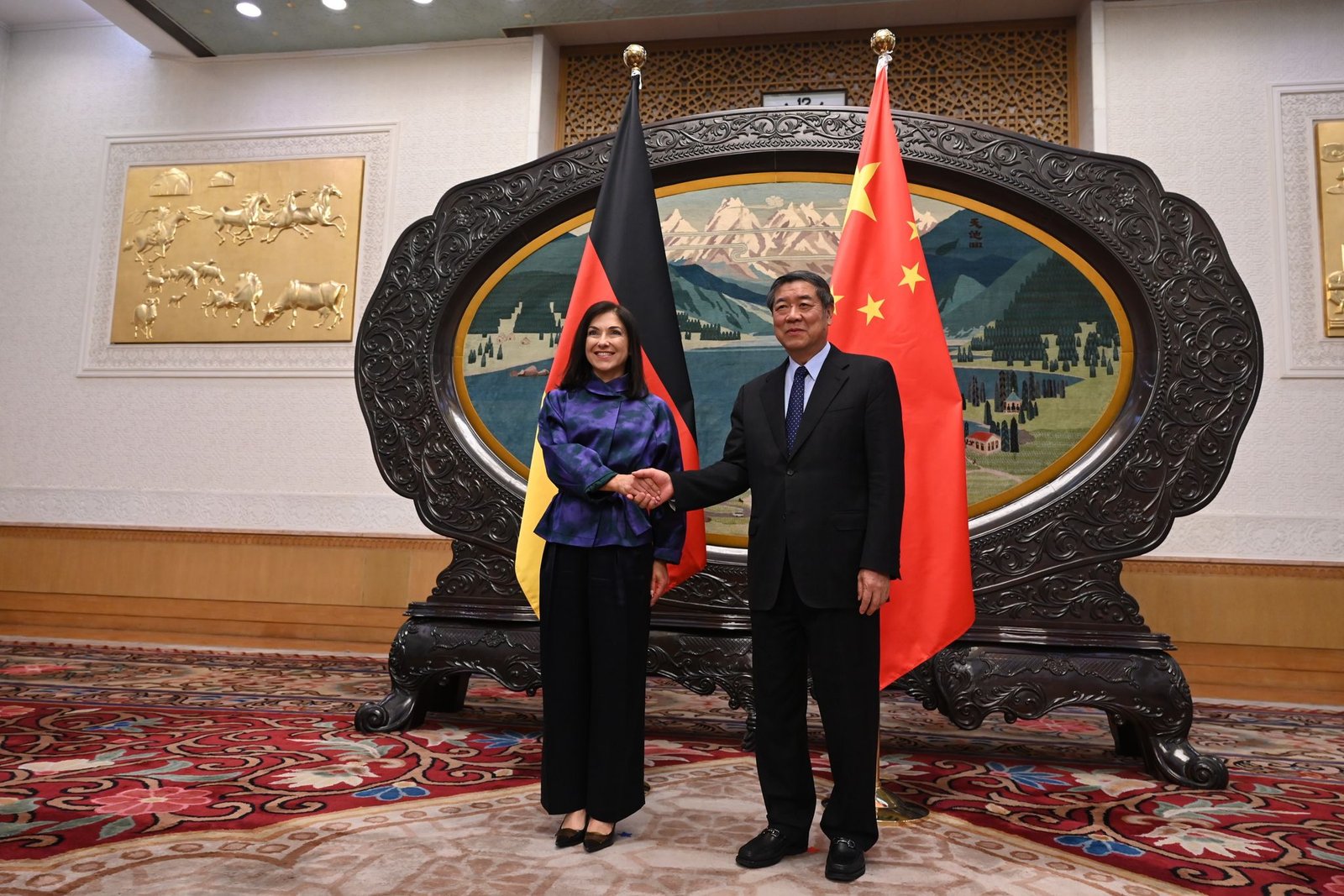
Reiche’s two-day visit comes in the wake of Chancellor Friedrich Merz’s inaugural trip to Beijing in February, as part of a bid by Berlin to revive economic dialogue as the German-Chinese trade imbalance remains heavily strained in China’s favour.
Berlin has also long complained of unfair competition, amid a wider debate within the European Union over tougher protective measures to safeguard domestic industries against a surge in Chinese imports.
Economy Minister Reiche acknowledged that China had developed into one of the world’s most important hubs for industry, technology and innovation with “impressive momentum.”
China is a global leader in fields such as robotics, artificial intelligence, renewable energy, and batteries, Reiche said after talks with Zhou Haibing, vice minister at China’s powerful National Development and Reform Commission.
The minister stressed that “candid and open exchange” was “very, very important” to her, addressing a number of controversial issues in Beijing.
Reiche, who also held talks with Commerce Minister Wang Wentao, said the discussions had involved exploring ways to “create channels [for the supply of critical resources] that our companies can rely on.”
German companies need access to critical minerals and rare earth elements, “because the modern world and modern technologies would be inconceivable without these raw materials,” Reiche said.
As a result of a trade dispute with the United States, China introduced export licences for seven rare earth elements and magnets made from them.
This has caused a major headache for European companies, many of which heavily rely on China to supply the resources.
Reiche also found clear words on the subject of competition. “Our companies do not shy away from competition,” she stressed, adding that German firms are accustomed to succeeding under tough conditions.
Competition ensures that both sides improve together, the minister said, but stressed that competition must be structured and organized in such a way that it also benefits both sides.
China remains Germany’s largest trading partner. According to Germany’s Federal Statistical Office, bilateral trade volume exceeded €250 billion ($291 billion) last year. Imports from China rose 8.8% to €170.6 billion, while German exports to China fell 9.7% to €81.3 billion.
A damning report released last week by the Centre for European Reform dubbed “China shock 2.0: The cost of Germany’s complacency” identified the massive surge in Chinese exports as the main reason behind Europe’s biggest economy’s struggles.
The think tank accused Berlin of being too “hesitant” in the face of China’s massive trade surplus, “even as China has already eaten much of German industry’s lunch and is preparing to start on dinner.”
The key issue facing the German economy is “export demand, chopped off by China’s profound pressure on Germany’s industrial base,” the report stated.
Reiche said that while Chinese investment was welcome in Germany, it must bring innovation, vertical integration and long-term investment. The goal, she said, was to achieve a fair balance.
Chinese Commerce Minister Wang said the transformation of German industry and China’s current five-year economic policy could be more closely linked to give rise to a new form of deeper coordination and cooperation.
At the same time, he criticized the EU’s trade policy, saying that Brussels had recently introduced a series of economic and trade measures with a “strong protectionist slant.”
Companies had told him that these measures were seriously impairing cooperation between Chinese and European firms, the minister said.
Touching on the possibility that the EU could move to better protect its interests, Reiche said that, as an exporting nation, Germany has two main interests.
On the one hand, unfair competition must be countered with appropriate measures, she said. On the other, German companies must continue to be able to export their goods, according to the minister.
“We are therefore advocating in Brussels for a balanced approach – effective trade protective measures coupled with openness to exports,” said Reiche.
During her visit, Reiche is being accompanied by a delegation of German business executives, including BASF chief executive Markus Kamieth and Thyssenkrupp boss Miguel Ángel López Borrego.
On Thursday, Reiche is due to visit companies and local government representatives in the southern industrial hub of Guangzhou.