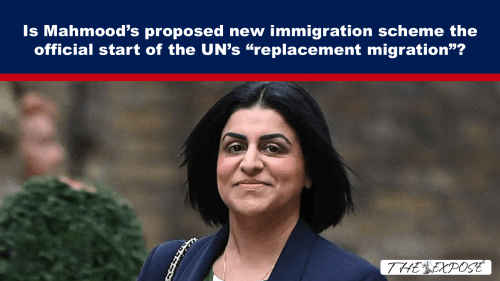
Is Mahmood’s proposed new immigration scheme the official start of the UN’s “replacement migration”?
RHODA WILSON
The UN has long advocated for a system of “replacement migration.” The reasoning the UN uses is to replace the populations where birth rates are low with migrants from countries where the birth rates are high.
At the end of June, Shabana Mahmood, the UK Home Secretary, announced a new refugee sponsorship route for refugees. For refugees to enter the UK, they must be referred by the UNHCR.
In other words, the UN is deciding how many refugees enter the UK and from where. Mahmood is outsourcing control of the UK’s borders to the UN. Worse still, her plan appears to be nothing more than a UN “refugee” quota system or, perhaps more accurately, implementation of the UN’s replacement migration scheme.
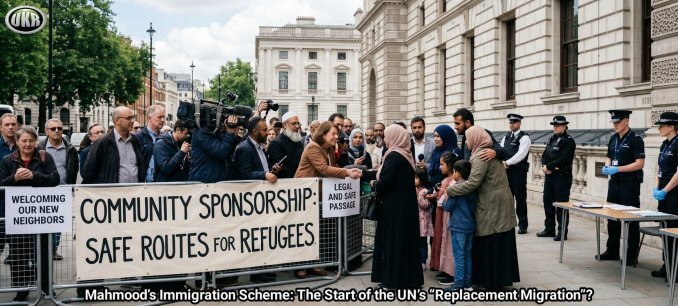
Mahmood’s proposed immigration scheme is designed to mirror Canada’s community sponsorship programme, and will allow communities, trusted universities and community groups to sponsor refugees fleeing conflict, famine or drought, with Sudanese and Eritrean nationals explicitly prioritised under the programme.
Mahmood’s Immigration and Asylum Bill was announced in the King’s Speech and passed its first reading in the House of Commons on 30 June. If Mahmood gets her way, the first arrivals are expected in 2027.
“It is understood that more than 10,000 refugees could be brought to Britain under the programme by 2030, although ministers have not set out a formal target,” GB News said. “Around 200,000 Ukrainians [were] sponsored to come to Britain on temporary visas” under a similar scheme.
“With her new measures accelerating the number of unwanted refugees, the Home Secretary has as good as declared war on the British people,” The Telegraph said.
Related:
Under Mahmood’s proposed sponsorship system, applicants must be referred for importing into the UK by the UN High Commission for Refugees (“UNHCR”). In other words, it is a United Nations (“UN”) quota system for distributing people from non-Western countries to the UK.
Replacement Migration
The UN has long advocated for replacement migration.
Replacement migration is a concept defined by the UN Population Division in a 2000 report titled ‘Replacement Migration: Is It a Solution to Declining and Ageing Populations?’ It refers to the volume of international migration required to offset population decline, working-age population shrinkage and overall population ageing in countries with below-replacement fertility.
As we have noted in a previous article, the claim that “we need immigration to compensate for the low birth rate” is a lie. Instead, mass immigration is destroying the host countries.
We should also recall that the UN has long advocated for population control, i.e. reducing the world’s population and then maintaining the number of people in the world according to their specified number. Keeping the number of humans at a “sustainable” level, as determined and measured by the UN’s metrics, is the basis for the UN’s entire “sustainable development” goals.
The covid “pandemic,” including infertility by vaccination, and the catastrophic climate change and “green” agendas are seen by many as an effort towards the UN’s population control goals. We have published numerous articles on the global oligarchs’ depopulation plan, see HERE, but we draw your attention to a few of them:
The information contained in the last article is particularly important. At the end, it shows images of the instructions to destroy birth rates from three documents:
- Population Planning, United Nations’ World Bank (1972)
- Implications of Worldwide Population Growth (also known as ‘The Kissinger Report’), US National Security Council (1974)
- Activities Relevant to the Study of Population Policy for the US (‘The Jaffe Memo’), Planned Parenthood on behalf of John D. Rockefeller’s Population Council (1969)
Despite the UN’s global aims to reduce the world’s population by whatever means necessary, currently, it is native people or integrated migrants in Western countries who are experiencing below-replacement fertility. So, the UN’s replacement migration is only going to go one way – the movement of people from countries the UN deems as “developing” to those the UN deems as “developed.”
We haven’t read the UN’s 143-page ‘Replacement Migration’ report (see the attached file below). Instead, we have relied on an AI summary generated by the Brave internet browser to get the gist of it:
The UN’s study analysed eight low-fertility countries (France, Germany, Italy, Japan, Republic of Korea, the Russian Federation, the United Kingdom and the United States) and two regions (Europe and the European Union) using three hypothetical scenarios:
- Maintaining total population size at its highest level.
- Maintaining the working-age population (15–64 years) at its highest level.
- Maintaining the potential support ratio (PSR) of workers to those aged 65+.
The findings indicated that while moderate migration could stabilise population size or the labour force, the levels required to halt population ageing were unrealistically high, potentially resulting in 59% to 99% of the 2050 population being post-1995 immigrants and their descendants.
As an indication of the magnitude of migration the UN is proposing under its “replacement migration,” we turn to the abstract of a 2004 paper about its report:
Given the low levels of fertility and mortality now prevailing in the more developed world (and specifically in the eight countries and the two overlapping regions for which the numerical answers to the above questions are presented in the report), and given the expected future evolution of fertility and mortality incorporated in the UN population projections, the results are predictably startling.
The magnitudes of the requisite compensatory migration streams tend to be huge relative both to current net inmigration flows and to the size of the receiving populations … for the US to maintain the support ratio at its highest – year 1995 – level of 5.21 would require increasing net inmigration more than tenfold. The country, the report states, would have to receive 593 million immigrants between 1995 and 2050, or a yearly average of 10.8 million.
The extreme case is the Republic of Korea, where the exercise calls for maintaining a support ratio of 12.6. To satisfy this requirement, Korea, with a current population of some 47 million, would need 5.1 billion immigrants between 1995 and 2050, or an average of 94 million immigrants per year.
Regarding the huge numbers of immigrants countries should accept, the UN’s report stated (page 11), “In many countries, additional large volumes of immigrants are likely to face serious social and political objections, even as a means of slowing population decline and population ageing. Therefore, regulating the level and composition of replacement migration streams to reach a desired population size or population age structure poses enormous challenges for Governments that may wish to do so.” Is public resistance going to stop them?
Unsurprisingly, the abstract for an article published in 2008 indicates there is an issue with the proposals the UN makes in its ‘Replacement Migration’ study:
Unfortunately, the article is behind a paywall and only its abstract is free to read, so we are unable to establish why the author has concluded that the “outlook is not as dire as the UN report insinuates.” Based on other models that the UN uses to push its agenda, we can suspect that both the model and its assumptions are flawed and/or skewed to provide the desired outcome.
(UKR)