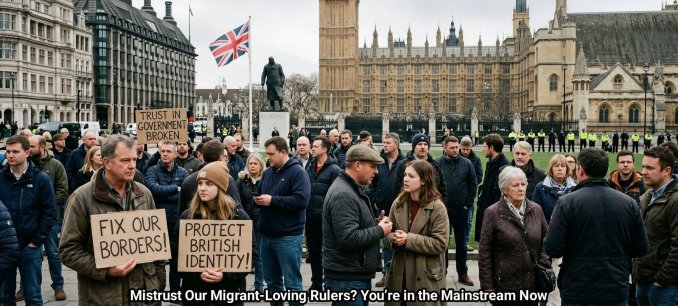
Mistrust our migrant-loving rulers? You’re in the mainstream now
MATT GOODWIN
FOR YEARS now, rebellious voters who oppose what is being inflicted on Western nations have been written off as extremists and weirdos.
Question mass immigration? Complain about open borders? Wonder whether your country is losing its identity? Or whether the deeper social contract that holds a nation together is starting to collapse?
Ask about any of these things and you’ll soon be viewed by the establishment as somebody not voicing legitimate concerns but flirting with extremism, fuelling division, peddling hate, even moving along a pathway towards terrorism.
Which is why I wanted to write about the findings of a major new report, Britain Under Strain, which not only blows apart these establishment narratives but shows how widespread these concerns and anxieties have become in modern Britain.
Despite being produced by the ominous-sounding UK Extremism and Democratic Resilience Centre and shadowy ‘counter-extremism’ industry, which often appears more interested in trying to control what people think than addressing their actual concerns, the report does draw on a wealth of new polling and data and so is forced to acknowledge what millions of ordinary people – including tens of thousands who read my newsletter – have been saying and feeling for many years.
What it finds, in short, is that many of the arguments and views that are held by the silent majority, which we have been tirelessly representing, are not those of some fringe minority but a radicalised majority of people who have simply had enough of what is happening to their country and culture.
The headline finding?
Close to two-thirdsof all British people now think the social contract in their country between the people and the state is completely broken, something we’ve been pointing to for a while.
Nearly two-thirds of the entire country, in other words, rising to more than eight in ten Reform party voters, have now concluded that the unwritten bargain between the people and the state – that the people will obey the law and pay taxes so long as the state keeps them safe and secure – is no longer fit for purpose.
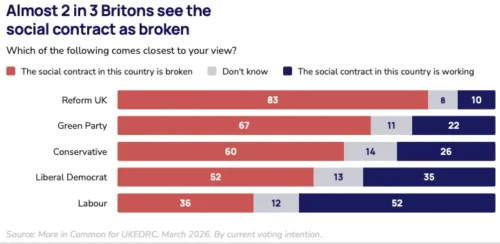
Why do so many people feel this way? It’s not because we have all suddenly morphed into extremists. Far from it. It’s because, as the report makes clear, millions of people have now reached the entirely logical conclusion that our governments, whether Labour or Tory, do not keep their promises, cannot be trusted, do not represent ordinary people, and, perhaps most crucially, cannot even be bothered to perform their most important duty of all: protecting our borders and keeping us safe.
This is exactly what we’ve been warning for years: the longer hapless politicians in Westminster refuse to do whatever is necessary to fix our broken borders, the more likely it is they will destabilise the entire system, tear up the social contract, and push our society further and further into the abyss. And this is no longer just our view: two-thirds of the entire country now agree with it.
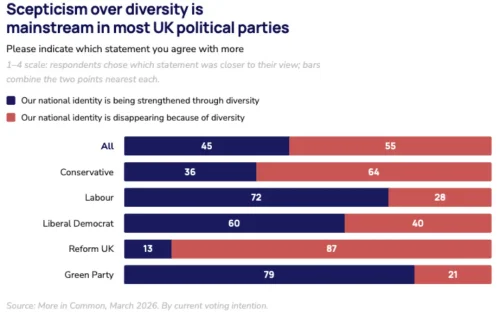
And that’s not the only finding that stands out. A clear majority of British people – some 55 per cent of the entire country – now believe British identity is disappearing because of ‘diversity’. A view that is also held by an even larger majority of 61 per cent among white British people and 90 per cent of Reform party voters.
Let me say that again: more than half of all people in Britain and more than three-fifths of all white Brits have now concluded that diversity is undermining their distinctive sense of British identity, their sense of who we are as a nation.
While this is routinely dismissed in mainstream media, which wants you to think such views are entirely unacceptable, in reality this deep and profound anxiety about what mass immigration and rapid demographic change are doing to British identity has become a fully mainstream view, endorsed by a large majority.
And here’s something else you’ll never hear about on BBC Verify: close to one-quarter of all non-white peoplein Britain hold this view, too.
This is not about whites versus non-whites; it is about a broad, growing coalition of patriotic people who no longer support the establishment’s insistence that diversity is ‘making us stronger’. On the contrary, the silent majority openly disagree with the narrative that the likes of Sadiq Khan, Keir Starmer, Zack Polanski, Carol Vorderman and SW1-BBC Land are constantly ramming down our throats. They think diversity is not making us stronger – it is out of control and eroding who we are.
There are many other findings hidden away in this report that should likewise make the political, media, and university class sit up and take notice.
Because for years now, all we’ve been told is that the ‘mainstream’ of British politics reflects the tastes, priorities, political loyalties and ideological beliefs of liberal progressives: left-learning, urban, financially secure if not affluent graduates who represent only about 12 per cent of the population yet wield enormous power because they dominate all of the major institutions in society.
But as the report makes clear, this could not be further from the truth. The real mainstream lies elsewhere, among a silent majority of people who hold far more traditional views, who reject the woke takeover of our institutions, who have come to the view that mass immigration and rapid demographic change are weakening British identity, and who can see that unless we change course we are heading for disaster.
A large majority of British people, for instance, believe it is patriotic to fight for Britain (81 per cent), to pledge allegiance to the King (68 per cent), to defend British history (76 per cent), and to protect Christian values (52 per cent).
Large majorities reject the assertion that Britain’s foreign policy is driven by ‘racist and colonial attitudes’, as well as the claim that Britain is somehow organised to benefit mainly white people.
Consistently, in other words, most people reject the anti-British, anti-Western, anti-science, and fanatically pro-diversity woke outlook that unites the increasingly extreme and dogmatic ‘progressive’ class that controls the institutions.
While it is true that younger people, Labour voters and Green voters are much more likely to hold these views, the key point is that the silent majority – millions who are dismissed and stigmatised as beyond the pale – do not. Yet too often the establishment acts as though this silent majority does not exist at all.
Belief in the existence of ‘two-tier Britain’ is also becoming far more widespread than the establishment would like us to think. While only one in ten Brits think that white people are more likely than average to get away with breaking the law, close to one in threenow think that migrants and asylum-seekers are able to escape justice.
The establishment routinely suggests that believing in the idea of a two-tier society is a conspiracy theory for cranks, an indicator of far-right extremism. Does this mean that roughly one in every three people in Britain have fallen into the abyss?
Or does it mean they can see something the state refuses to admit – that when you flood our schools, universities, police, health service and civil service with divisive, race-based ideologies such as Critical Race Theory you are indeed setting us up to live in a two-tier society where some identity groups are prioritised over others.
Again, when a large number of people in a society have come to the view that immigrants, asylum-seekers and newcomers are being treated more favourably by the state than its own national citizens, I would suggest the social contract is not just coming apart but is at risk of collapsing altogether.
Lastly, these views and how they are being ignored or mocked by the establishment might also explain something else that comes through in this report: how a large swathe of Britain is now willing to endorse far more radical political options.
Such as the fact that some 40 per cent of people, a minority but still a large number, saw the recent ‘Unite the Kingdom’ rally in London not as a gathering of racists and extremists but as ‘a show of patriotism from people with valid concerns about migration, diversity and the future of the country’.
Or that one-third of all British people, rising to four in ten Tories and six in ten Reform voters, now openly say they would support a policy of ‘remigration’ – the idea that migrants, whether illegal or legal, should be encouraged or forced to return to their countries of origin so as to preserve Britain’s distinctive identity and culture.
Whether you agree with these views or not is beside the point. My point is they are now held by millions of ordinary people who, for years now, have held entirely legitimate worries about the direction of their country yet have been consistently and grossly caricatured as ignorant, extremist or dangerous.
Instead of asking why these views have become far more widespread in modern Britain and then addressing the grievances, the establishment has simply decided to delegitimise the people expressing them. But this is a profound mistake. You cannot rebuild trust in a society by telling your own citizens their concerns are illegitimate.
That’s perhaps why this newsletter of mine has become one of the largest independent, counter-cultural newsletters in Britain, if not Europe. Not because readers always agree with every word I write. But because — long before politicians, journalists and institutions were prepared to admit it — this community of ours recognised that something fundamental has shifted, even if the governing class failed to spot it.
For years now, we’ve argued that Britain’s crisis is not simply about economics and GDP. It’s about something deeper – a broken social contract, collapsing public trust, and a palpable, overwhelming, and unavoidable belief out there among the people that mass immigration, porous borders, and a distant governing class are not just pushing Western nations in the wrong direction – they are actively destroying them.
This report does not endorse every argument I’ve made. But it does do something that is perhaps more significant. It shows that the underlying concerns that people like us share are no longer confined to the fringe – they are now recognised by even parts of the establishment as representing mainstream views.
And that, if nothing else, should give us cause for cautious optimism. Because once the truth starts to come out, and is even being recognised through gritted teeth by those who have been trying to conceal it, then it can no longer be ignored. And once the truth is acknowledged, political change will inevitably follow.

••••
••••
••••
••••
(UKR)