
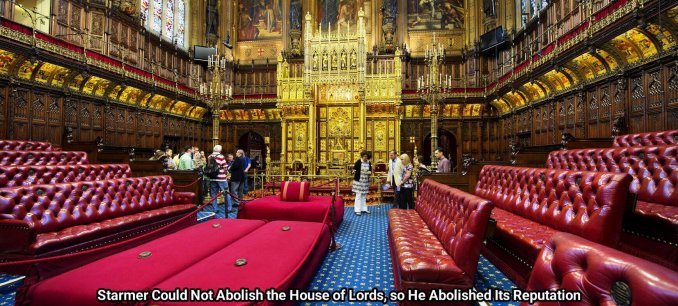
The Quango Chamber
Starmer could not abolish the House of Lords, so he has settled for abolishing its reputation instead
GAWAIN TOWLER
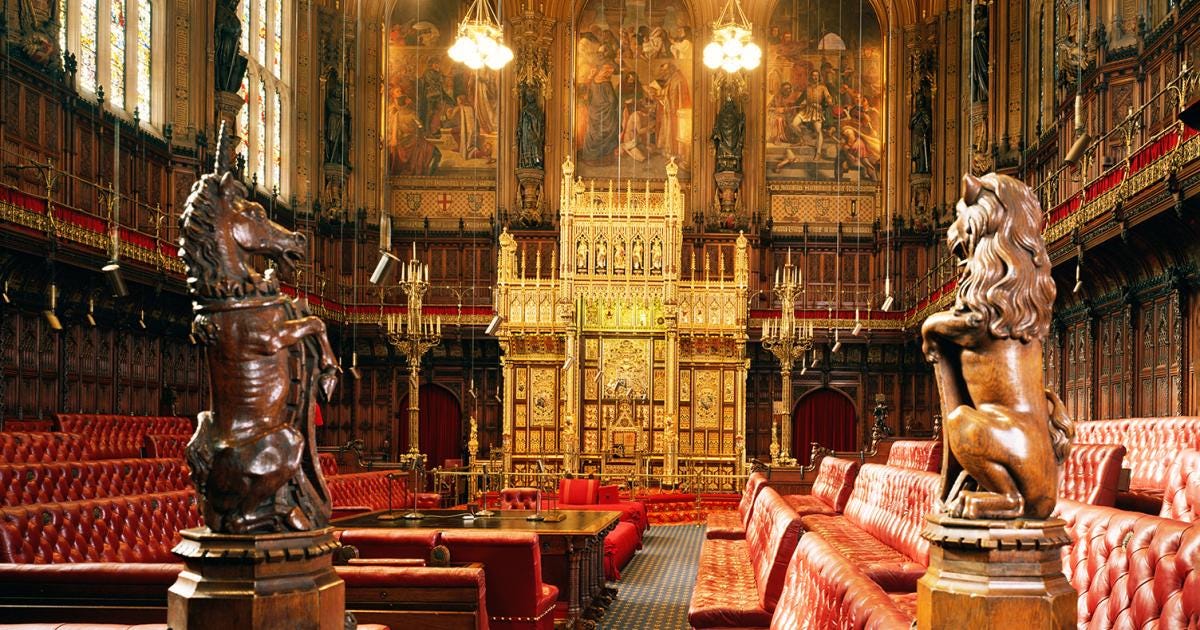
There is more than one way to burn down a house. You can put a torch to it, which takes nerve, or you can let it out to tenants so dreary that the neighbours stop objecting when the demolition men arrive. Keir Starmer, who once called the House of Lords “indefensible” and promised its abolition, has chosen the second method. On Wednesday, in one of his last acts before handing the keys of Downing Street to Andy Burnham, he announced twenty six new peers. It was not an honours list. It was an act of arson by upholstery.
Consider the arithmetic first, because it is genuinely astonishing. By December last year the Electoral Reform Society had counted 96 new peers created since this government took office, which meant Starmer had replaced the 92 hereditaries before the poor devils had even been shown the door. Add the 26 life peerages handed out in May to sweeten the hereditaries’ departure, and now this batch, and the man has created something close to 150 peers in two years and eleven days. Labour spent a decade citing David Cameron’s 122 in two years as the high-water mark of Tory decadence. Starmer has sailed past it without breaking stride, on his way out of the building, having resigned in June because his own MPs could no longer bear him. A prime minister rejected by his party, rejected by the country, and repudiated by every election held since he took office, spends his final week entrenching his friends in the legislature for life. In 2023 he condemned resignation honours as a corruption of public life. He was right. He usually is, about himself, eventually.
But it is the quality that tells the real story. Read the citations and weep. The old Lords, whatever its absurdities, was a chamber of people who had done things. Men who had commanded armies, governed provinces, built industries, judged great causes, or at the very least owned Shropshire. The new intake is a chamber of people who have attended things. Alison Lowe, Deputy Mayor for Policing and Crime in West Yorkshire. Not the Mayor, note. The deputy. Nick Stace, “Chief Global Impact Officer at Howden Group”, a job title that reads like a phishing email. Marcus Davey, formerly of the Roundhouse. Roberto Neri of the Ivors Academy. Tim J Smith, once of the Food Standards Agency, presumably ennobled for services to the traffic-light labelling of sandwiches. Cathy Ashley of the Family Rights Group. Ken Macintosh, who presided over the Scottish Parliament, an achievement roughly equivalent to conducting the band on the Titanic. These are not wicked people. Most of them are doubtless diligent, kindly, and fond of their grandchildren. But they are functionaries. Middle managers of the state and its charitable penumbra, the sort of people who chair the away-day and remember to book the sandwiches, now translated into legislators for life with £371 a day for turning up.
And this, I suspect, is the point. Starmer is a lawyer, and lawyers understand that you do not need to win the argument if you can discredit the witness. The Lords survived Lloyd George, survived Blair, survived even its own hereditary absurdity, because it retained a certain mystique. It contained people the public had heard of, or people whose obscurity concealed genuine distinction. Fill it with the personnel department of quangoland and the mystique evaporates. Nobody will man the barricades for a chamber of Chief Global Impact Officers. When the wreckers come, and under Burnham or whoever follows him they will come, the country will shrug. Starmer has salted the red benches. It is the one genuinely strategic thing he has done in office, and characteristically it is an act of destruction dressed as patronage.
The Labour sixteen also include both co-executive directors of The Death Penalty Project. Both of them. One assumes they can share a Woolsack. There is June Sarpong, broadcaster and “social equity advocate”, there is the general secretary of UNISON, there is the chief executive of the Child Poverty Action Group, and there is Sadiq Khan, elevated for transforming London into whatever it is London has become. It is the guest list of a north London garden party rendered into a branch of the constitution.
Then the Liberal Democrats, who with 72 MPs were invited to add five peers to the eighty odd they already possess. Among them the Town Mayor of Penistone, a former physiotherapist, and the party’s Director of Field Campaigns, ennobled for delivering leaflets at scale. And among them, gloriously, Dr Tim Leunig. Leunig was economic adviser to Chancellor Sunak, the man who, by his own cheerful account, invented the furlough scheme in fifteen minutes on the train from Wimbledon. It ran for eighteen months and cost seventy billion pounds, a sum we borrowed and for which our grandchildren will be paying long after Lord Leunig has taken his last allowance. This is also the adviser who suggested northerners should accept lower wages, and who wrote that fisheries and agriculture were not “critically important” to Britain and could be replaced by imports. A man who would concrete over the shires and import his dinner now sits in the parliament of Elizabeth I’s England, wearing ermine, at the request of his old friend and near neighbour Ed Davey. The party of Gladstone has ennobled the costliest quarter of an hour in British fiscal history.
The Conservatives, offered three nominations, might have used them to signal that they had learned something from the past two years. Kemi Badenoch, scourge of the equalities blob, tribune of the war on woke, chose David Ross, a party donor, General Sir Patrick Sanders, the one serious appointment on the entire list and the exception that convicts the rest, and Professor Swaran Singh, a former Commissioner of the Equality and Human Rights Commission. Let that settle. The Conservative answer to Reform’s insurgency is to install the equalities inspectorate in the legislature. The party spokesman said the three bring experience of “business, defence and healthcare”, which is a delicate way of describing a chequebook and a quangocrat with a general in between.
And Reform? Nothing. Not one peer. Not on this list, not on any list, not ever. The party that came first in the May elections, that runs more than thirty councils, that has led every poll for over a year and holds seven seats in the Commons, has precisely no representation in the upper house at all, having lost its solitary defector when Malcolm Offord left to fight Holyrood. Nigel Farage called the appointments “the uniparty writ large” and observed that “once again, there is nothing for Reform and we get an even more unrepresentative upper house”. He is understating it. UKIP before it was treated the same way, fobbed off with the occasional Tory defector while winning millions of votes. Two crossbenchers complete the picture. Sir Brian Leveson, and Sir Chris Wormald, the Cabinet Secretary whom Starmer’s people briefed against and defenestrated over the Mandelson vetting fiasco, now handed ermine as a severance package. Even the consolation prizes are confessions.
I hold no brief for abolition. The Lords, properly constituted, is one of the last places in our public life where experience outranks ambition and where a man may say an unfashionable thing without checking his mentions. That is precisely why it cannot survive being used as a skip for the political class’s surplus staff. Starmer came to office promising to reform the chamber and leaves having debauched it, which may, in the end, amount to the same thing. The uniparty has looked after its own. The country, as usual, was not consulted. It will remember.

••••
••••
••••
••••
(UKR)