
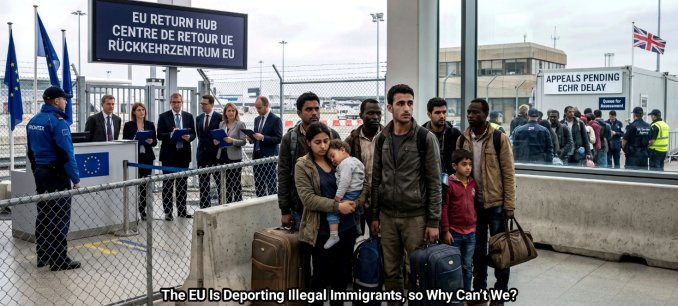
The EU is deporting illegal immigrants, so why can’t we?
NIGEL JACKLIN
THE European Parliament has approved a law aimed at speeding up the return of migrants with no legal right to remain in the EU. This highly significant move, passed by 418 votes to 218, seems to have been missed by the mainstream news here in the UK despite its potentially positive impact on an issue of great importance to many of us. What does this all mean?
Reporting on the vote, the EU broadcaster Euronews made the obligatory reference to ‘far-right’ political groups, describing the return regulation as ‘the bloc’s toughest shift in migration policy in decades’. It called the move to allow European countries to set up return hubs outside the EU ‘controversial’. In contrast, videos of the vote circulating on social media show supporters of the Bill applauding when the results were announced, with MEPs standing and chanting ‘send them back’. Have the EU’s elected representatives finally got it?
The EU law features a host of measures including return hubs, the right to search premises, longer detention periods, tougher entry bans and changes to the appeals process. Commenting on X, Jim Chimirie noted that Britain’s removal rate for illegal arrivals stands at 4 per cent, significantly below the EU’s 20 per cent removal rate that triggered the new legislation. Clearly we have some catching up to do.
The steady stream of illegal arrivals here in the UK has meant this issue has been at the top of the political agenda for some time. Tory Prime Minister Rishi Sunak claimed his plan to ‘stop the boats’ was working in June 2023 just like Starmer did in his farewell monologue. While Home Secretary Shabana Mahmood has repeatedly announced ‘tough’ measures, the boats keep on coming, escorted to ‘safety’ by the RNLI and the UK Border Force. Immigrant accommodation contracts keep getting signed, some lasting over ten years. For some it’s a big earner.
The logistics of illegal immigration are fascinating. The role of international charities and support groups in Calais was well documented by Lee West in his 2018 book Trampface Calais: Undercover in the Jungle. For some time it has felt as if, even when the Government wants to act, lawyers, activists and civil servants are making sure the arrivals continue.
In the EU there has been growing opposition to illegal immigration for some time, as illustrated by the 2023 Polish referendum reported here. Hungary acted and in the US, Trump has acted. Now it’s the EU’s turn.
Someone who sets off from Afghanistan, Eritrea, Iran, Somalia or Sudan will travel through many safe countries to get to the UK. They may apply for asylum in one or more of these countries and have their claim rejected and so move on to the UK, or the UK may be their destination of choice. Their journey may take months. Once they have reached Calais they will be determined to complete it.
Here in the UK we can’t afford them and can’t house them. The issue influences how the electorate votes. Perhaps a new Labour Prime Minister will solve it in time for the general election. If the numbers entering the EU fall, so too will the numbers reaching the UK via the Channel. Labour may well succeed in stopping the boats despite their own best efforts. Legal net migration may fall as many ‘Boriswave’ arrivals go home when their permits expire. This could all play out before 2029.
In March 2023 the Home Office announced proposals to house 1,200 male asylum seekers in Northeye, Bexhill, just under a mile away from where I live. A group of mothers organised the first peaceful gathering to oppose the proposals within weeks. We formed the ‘No To Northeye’ campaign group and residents nominated me to stand as an Independent councillor in the May local elections. As documented here we stopped the Northeye site being used; it will now revert to its original planned use (housing).
During my May 2023 election campaign I spoke to about 200 people. Opposition to the proposals was near-universal. The most striking thing was that people who expressed opposition expected someone standing for election to reprimand them, rather than represent them. I listened and accepted whatever they said. There were only two people I spoke to who wanted them here and one turned out to be a member of the loony-left Stand up to Racism group.
During that first month the town council (of which I am now a member) held the first public meeting at which residents were able to express their views and ask questions. These were sent to the Home Office, which did not answer them. Safety was the chief worry followed by concerns about the burden on infrastructure, which in my mind is just a polite way of saying we don’t want them here.
On the doorstep many people thought illegal immigration was wrong. This wasn’t a Nimby position; they didn’t want them anywhere in the UK. Opposition was particularly strong among people who had moved here legally, and was not divided along racial lines. Very few people believed in open borders. Bexhill locals didn’t see the need for a vast underclass of slave labour to wash their cars, drive taxis and deliver takeaways.
One of the people who helped at a national level was Marianne Overton, leader of the Independent Network and at that time a vice chair of the Local Government Association. She represented councillors on the Home Office Asylum Seeker Accommodation Working Group. Another colleague was an Independent councillor in Braintree, home to the Wethersfield site. Discussing the issue with Marianne I asked whether those people who arrived here were the most deserving or were they simply the most determined? Were there many more people we could be helping to return? Should we be helping them to rebuild their countries? Should we be bombing them to bits in the first place? My conclusion was that the answer to the world’s problems should not be to allow a determined minority to live here in the UK. Marianne voiced the concerns of impacted local communities in her meetings with the Home Office.
As our campaign progressed what was initially a popular but unacceptable view became gradually recognised by the mainstream media. As time progressed even the BBC replayed videos of our protests. Their language changed. So, will the selection of a new Labour leader make any difference? Can we get them to act? Will they be able to get Border Force and the Home Office to do their jobs and stop illegal migrants from coming in? Will the return rate go up? We clearly need to keep up the pressure.
See Related Article Below
Migrants using ECHR to stay in Britain will cost taxpayer £4.9bn
Funding healthcare, education and welfare will add up to £141k for each asylum seeker, Home Office figures show
CHARLES HYMAS
Asylum seekers who invoked the European Convention on Human Rights (ECHR) to stay in the UK last year will cost the taxpayer £4.9bn over their lifetimes, Home Office analysis has found.
In the first calculation of its kind, government statisticians estimated that the cost of granting a migrant the chance to remain because of their right to a family life was £141,000 per individual over their lifetime. The calculation took into account the fact that they would pay taxes.
About 34,400 asylum seekers were granted the right to stay in the UK under Article 8, the right to a family life, of the ECHR last year. The total net cost to the taxpayer to fund their healthcare, education, welfare and pensions will be some £4.9bn until they die, according to the Home Office analysis.
The researchers said that even this was an underestimate as it did not account for family members, writing: “It does not include the fiscal impact of dependents associated with the cohort. It should therefore not be interpreted as the total fiscal cost of all individuals linked to Article 8 grants in 2025.”
On Tuesday, Labour is due to announce new restrictions on foreign criminals’ and failed asylum seekers’ ability to use Article 8 to block their removal from the UK.
Migrants can currently argue that forcing them to leave would be either unduly harsh because it separated them from their family, or that they would suffer by being uprooted and sent to a country that might be alien to their spouse or children.
The Telegraph has revealed many cases of illegal migrants and foreign criminals exploiting Article 8, including an Albanian criminal who won a reprieve from deportation partly because his son would not eat foreign chicken nuggets.
Robert Jenrick, Reform UK’s spokesman on the economy, who served as immigration minister under the Tories, said: “The ECHR allows dangerous foreign criminals to stay in our country – and now it’s clear it’s also costing the country a fortune.
“The Tories refused to leave the ECHR, despite myself and others campaigning to do so. Only a Reform government led by Nigel Farage will do what is required to restore sanity to our immigration system.”
[…]
While the £4.9bn estimate is a cost over the entire lifetimes of the asylum seekers, it applies only to one year’s intake of migrants, and a similar calculation could be made for future intakes.
Migrants who have used Article 8 grounds to remain in the UK include foreign criminals who have successfully appealed their deportations, failed asylum seekers facing removal, visa overstayers and migrants who arrived on a family visa but then no longer met the conditions, including having too low an income.
The Telegraph: continue reading

••••
••••
••••
••••
(UKR)