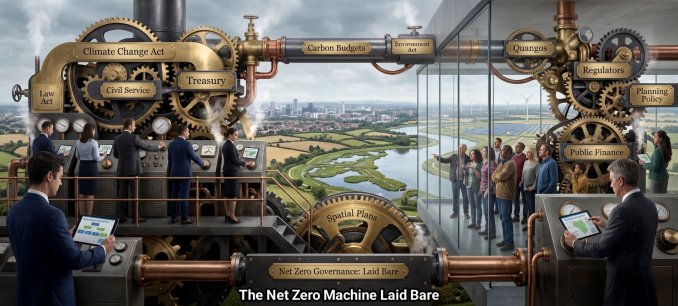
How the Law, Civil Service and quangos work together to enforce Net Zero.
DAVID TURVER
So far 258 articles have been published on Eigen Values. Almost all the articles have been written from scratch by yours truly. However, I do have to acknowledge that sometimes readers send me material that inspires an article. This week though, we are trying something different. Reader Shane Oxer sent me a paper he had written, and I thought it was so good it should be published. What follows is the lightly edited Executive Summary and the full version of the paper is offered as a download at the end. Please share with your family and friends.
The United Kingdom is constructing a permanent system of carbon, environmental and spatial governance. It does not operate through one law or one central office. Its power lies in the sequence connecting multiple institutions working together as a single machine
The Climate Change Act fixes the emissions destination. Carbon budgets set the permitted pathway. The Carbon Budget and Growth Delivery Plan divides the burden between sectors. The Environment Act creates parallel duties for biodiversity, water and environmental recovery. The Environmental Improvement Plan converts those duties into programmes. The Farming Roadmap transmits them into agriculture. The Land Use Framework begins to reconcile them spatially. Strategic Spatial Energy Plan (SSEP) determines the broad energy geography. Centralised Strategic Network Plan (CSNP) identifies the network backbone. Regional Energy Strategic Plans (RESPs) influence regional distribution investment. Water plans allocate another essential resource. Spatial Development Strategies place strategic decisions above the local plan. The Local Nature Recovery Strategy (LNRS) maps environmental priorities. Biodiversity Net Gain (BNG) creates financial demand for habitat. The Nature Restoration Fund centralises environmental mitigation. National Policy Statements establish overriding infrastructure need. Planning and compulsory powers convert that need into rights over land.
So we are not being transformed by one statute, one ministry or one published master directive. The governing direction is distributed across law, carbon budgets, environmental targets, civil-service delivery plans, Treasury appraisal rules, regulators, spatial strategies, planning policy, public finance and legally enforceable agreements over land.
The central argument of this paper is constitutional and administrative. Parliament has enacted broad outcomes, but the cumulative programme created by those outcomes has never been presented to the public as one complete decision. Instead, the system is divided into separate instruments, each with its own consultation, regulator, department and limited legal question.
The effect is alignment. Climate law fixes the destination. Environmental law creates a parallel set of land and biodiversity duties. Civil servants translate those duties into departmental pathways. Treasury appraisal embeds carbon values into spending decisions. Energy, farming, water, housing and nature strategies then divide the burden between sectors. Spatial plans allocate the geography. Regulators authorise investment. Planning policy gives national need substantial weight. Contracts, covenants, conditions, levies, easements and compulsory powers secure delivery on the ground.
Formal challenge has not been abolished. Citizens can object, vote, petition, seek judicial review, respond to consultations and challenge individual planning decisions. The stronger and more accurate claim is that challenge is structurally compartmentalised. Each forum is generally permitted to examine only its own part of the chain, while the assumptions created at earlier stages are treated as legally or politically settled.
The carbon target is not normally reconsidered in a local planning inquiry. The national need for infrastructure is not reopened during a network price control. A regional allocation is not reconsidered when an individual site is examined. Biodiversity law is not reopened when a landowner signs a habitat agreement. The public may challenge the implementation, but it rarely receives an effective opportunity to challenge the cumulative system as a whole.
This is why consultation can exist without amounting to democratic consent. The public is invited to comment on routes, sites, mitigation, methodology and delivery after law, policy, finance and spatial assumptions have substantially narrowed the available choices.
Law fixes the destination. Targets determine the pace. Delivery plans divide the burden. Spatial plans allocate the geography. Regulators authorise the infrastructure and expenditure.
Full download here:

(UKR)