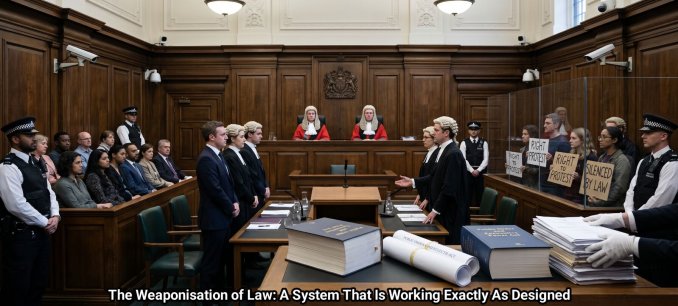
The Weaponisation of Law: A System That Isn’t Broken, But Working Exactly as Designed
How modern governance survives by turning law into a tool of control, coercion, and obedience
CONSCIENTIOUS CURRENCY
This is Part 4 of my series The Weaponisation of Law. In my last article, I showed how the Rule of Law and the Separation of Powers function not as safeguards but as constitutional propaganda – doctrines that reassure the public while protecting the architecture of rule‑over.
This 4th article moves from structure to practice: from the myths that legitimise power to the concrete ways in which law is weaponised in everyday governance. I include framework legislation in this piece, because it is one of the most potent tools the executive uses to bypass scrutiny and expand its reach.
Before diving in I want to enforce a deeper point that is perhaps not evident in this article – weaponised law only works because people have been conditioned to accept immoral state actions as legitimate. Through education, propaganda, bureaucratic culture, and Western exceptionalism, the public has been engineered to see obedience as virtue and state authority as moral by default. Bad law becomes “good”, harmful policy becomes “necessary”, and unlawful state actions are carried out willingly by ordinary people who believe they are doing the right thing. This is why:
- police enforce immoral laws
- regulators apply unlawful policies
- civil servants carry out harmful instructions
- juries convict people for political protest
- the public cheers for punishment
- people defend the system that harms them
The system has not only weaponised law; it has weaponised people’s moral instincts. Therefore it does not survive on legal mechanisms alone. It survives because people whose moral frameworks have been engineered by the system end up working within and upholding the very structures that harm them.
Below I expose how law is used in practice to discipline the public, protect the powerful, and maintain the machinery of rule‑over. But my deeper message is this: none of these mechanisms would work if people refused to enforce them. As I have always said, real change will not come from reforming the system. It will come only when people fundamentally change – when they stop mistaking engineered obedience for morality, stop treating state power as the arbiter of right and wrong and stop working to facilitate the very system that is hurting them.
Framework Legislation: The Executive’s Most Powerful Weapon
The first and most important mechanism of practical weaponisation of the law is framework legislation. Unlike ordinary statutes, framework laws do not set clear rules, limits, or duties. They create vast zones of executive discretion. They hand ministers the power to legislate by regulation, to redefine legality without parliamentary debate, and to expand their own authority whenever politically convenient. Framework legislation is not accidental. It is a central pillar of the legal architecture of rule‑over.
As an example, the Coronavirus Act 2020 allowed ministers to suspend rights, restrict movement, close businesses, and impose criminal penalties through secondary instruments that received almost no scrutiny. Likewise, the Public Order Act 2023 created sweeping powers to restrict protest based on highly subjective and elastic concepts as “noise” and “serious disruption”. The Police, Crime, Sentencing and Courts Act 2022 expanded executive control over assemblies, marches, and public space. One of the most damning outcomes of this is that an individual can be convicted of breaching protest conditions if they “ought to have known” about them, effectively removing the requirement for prosecutors to prove a person had actual knowledge of the restrictions. The Investigatory Powers Act (IPA) 2016 notoriously legalised bulk surveillance through broad executive enabling powers, granting intelligence and law enforcement agencies broad powers to intercept, hack, and retain the communications and internet browsing data of millions of innocent citizens, whether or not they are suspected of any wrongdoing. The EU Withdrawal Act 2018 granted ministers Henry VIII powers to amend primary legislation without parliamentary approval.
These laws share the same structural DNA: they are drafted broadly, interpreted expansively, and applied selectively.
They allow ministers to:
- create criminal offences without primary legislation
- rewrite statutory duties through guidance
- bypass parliamentary scrutiny
- expand executive power through regulation
- shield decisions behind “national security” or “public order” language
Framework legislation is the legal equivalent of a blank cheque. It is designed to be used, stretched, and repurposed. It gives the executive the tools it needs to weaponise law in practice, because it removes the need for “democratic control” and consent and replaces it with administrative fiat. And once such powers exist, they are never surrendered. They become part of the permanent machinery of rule‑over.
This is why framework legislation must come first in any analysis of practical weaponisation. It is the foundation upon which all other mechanisms rest. Without it, the executive would be constrained. With it, the executive becomes the primary law‑maker and the public becomes the governed, not the protected.
In practice, framework legislation is easy to recognise once you know what to look for. Open almost any modern Act of Parliament and you will find page after page of clauses stating that “the Secretary of State may by regulations…”, “provision may be made by order…”, or “the Minister may determine…”. These are not minor administrative details. They are the core of the statute and mean that instead of Parliament setting out clear rules, duties, limits, or rights, the Act delegates those decisions to ministers to fill in later through secondary legislation. This means the real substance of the law – the part that affects people’s lives – is never debated in Parliament at all. It is created afterwards, behind closed doors, through regulations that receive little scrutiny and cannot be meaningfully amended. In effect, Parliament passes the shell of a law, and the executive writes the law itself.
This is not a marginal phenomenon. It is now the dominant form of legislation in the UK. The majority of modern Acts are framework statutes, and the majority of legal rules that govern daily life are made through secondary legislation. This shift has been building for decades, accelerating sharply from the 1990s onwards and exploding after 2010. The Coronavirus Act 2020 made the trend undeniable, but it did not create it. What we are seeing is the culmination of a long transition from parliamentary law‑making to executive law‑making – a quiet revolution that has transferred power from so called elected representatives to ministers and civil servants. Once you see it, you cannot unsee it. And once you understand it, you realise that the weaponisation of law is not an aberration. It is the predictable outcome of a system that always wanted to hand the executive the tools to legislate at will.
This shift matters because once Parliament delegated law‑making power to the executive, the content of the law became, and remains, far more susceptible to influence from unelected interests. Regulations are drafted inside departments, often in consultation with corporations, industry lobbyists, security agencies, and international partners. They are shaped by commercial priorities, geopolitical alliances, and foreign policy pressures long before the public ever sees them. This is why so much UK law now aligns with the interests of powerful private actors and with the strategic priorities of the current hegemon, the United States. Framework legislation creates the legal environment in which these external pressures can be translated directly into domestic law without parliamentary debate, democratic scrutiny, or public consent. It is not simply a mechanism of executive convenience. It is the structural doorway through which corporate power, bureaucratic interests, and geopolitical agendas entered the legal system, took control over it, and overrode any sort of public interest, in a self-serving heist.
Jury Erosion: Removing the Last Public Safeguard
The second mechanism of practical weaponisation of the law is the erosion of jury independence. This is not a mere procedural issue. It is a shift of enormous significance. For centuries, juries were the public’s final protection against state power, the one place where ordinary people could refuse to enforce an immoral law, an unjust prosecution, or a politically motivated charge. Jury nullification, rooted in Bushel’s Case (1670), was the principle that no judge, minister, or monarch could force a jury to convict against conscience. It ensured that law could not be used as a weapon without public consent, because a jury could choose not to convict from their conscience and morals.
This safeguard has been under attack for nearly a century. The first step was the abolition of grand juries in 1933, bringing to an end 750 years of their use as the public’s initial check on prosecutorial power. Grand juries decided whether a case should proceed at all and their removal transferred that power entirely to the state. From that moment, the public no longer had any role in determining who would be prosecuted. The erosion of trial juries is simply the continuation of the same trajectory: the steady removal of public oversight from the justice system.
Modern judges now prohibit any mention of jury nullification. Defence counsel who remind jurors of their right to acquit on conscience are threatened with contempt, removed from courtrooms, or disciplined. In one recent case, a barrister was physically removed and threatened with imprisonment simply for telling a jury the truth: that they may acquit if they believe the prosecution is unjust. The message is therefore clear – juries must apply the law mechanically, not morally. This shift is profoundly dangerous because it asks ordinary people to abandon their own moral reasoning and apply the law without nuance, conscience, or judgment. It demands that jurors treat legality as morality, even when the law itself is unjust, politically motivated, or weaponised against dissent. In philosophical terms, it replaces ethical deliberation with mechanical obedience and trains people to believe that their role is not to evaluate right and wrong, but to enforce whatever the state places before them.
This is the exact inversion of what juries were created for. Juries were meant to be the moral circuit‑breaker, the place where the public could refuse to enforce an immoral law. Removing morality from jury deliberation does not make justice more objective. It makes injustice easier to carry out, because it ensures that laws shaped by unelected interests, corporate power, security agencies, or foreign policy priorities can be enforced without the risk of public conscience disrupting the process.
The Filton 4 case shows how far this erosion has gone. Four activists were sentenced under terrorism legislation, yet the jury did not know this would happen and did not convict them of any terror offence, instead finding them guilty under criminal damage charges. The state used counter‑terror powers behind the scenes for sentencing purposes and for the first time in British legal history protestors convicted of property damage faced a terrorism designation. This clearly shows that when juries are denied full information, they cannot act as a check on power and instead they merely become instruments of it, wielded to enforce what the state wants. Simply put, once juries are neutralised, the last democratic barrier between the public and the state disappears, and the executive becomes free to enforce policies, prosecutions, and foreign‑aligned agendas without public interference.
Jury erosion is not accidental. It is necessary for a system that increasingly relies on framework legislation, executive discretion, and geopolitical alignment. Juries are unpredictable as they can refuse to enforce laws that serve corporate interests, security agencies, or foreign policy priorities. They can acquit protesters, whistleblowers, dissidents, and those targeted for political reasons. They can disrupt prosecutions that align with the strategic aims of the current hegemon, and they can refuse to convict under laws designed to suppress dissent or protect powerful actors. A system whose very existence depends on obedience CANNOT tolerate or allow that kind of public autonomy.
The removal of jury independence ensures that prosecutions aligned with corporate, bureaucratic, or geopolitical interests proceed without resistance. It ensures that laws created through framework legislation and shaped by unelected actors can be enforced without moral interference from the public. It ensures that dissent can be criminalised, that political prosecutions can succeed, and that foreign‑aligned security agendas can be implemented domestically without democratic friction. The erosion of jury independence is therefore not simply a legal development. It is the removal of the last democratic safeguard against the weaponisation of law. Once juries are controlled, censored, or bypassed, the public loses its only direct power within the justice system. The state gains the ability to enforce any law it creates, however immoral, unjust, or politically motivated, without the risk of public refusal.
This trajectory becomes even more dangerous when viewed alongside the growing push to integrate AI into the justice system. AI does not apply conscience. It cannot engage in moral reasoning, weigh nuance, or refuse to enforce an immoral law. It simply executes instructions and this is precisely why it is attractive to governments, corporations, and security agencies. An AI‑driven justice system will eliminate the last vestige of public moral oversight and replace it with automated obedience to enforce laws shaped by unelected interests. It will complete the transformation of justice from a human moral process into a mechanised system of state enforcement. Therefore, once juries are fully neutralised and AI is introduced, the public loses not only its power to judge, but its power to refuse.
People should be very aware that a system that fears juries is a system that fears the people. And a system that fears the people is a system that has already abandoned the idea of consent.
Conflicting Law: The Power to Choose the Interpretation That Serves Power
The third mechanism of practical weaponisation is the proliferation of conflicting laws within our system. This is not legislative incompetence, but is, in fact, a necessary feature of a coercive and controlling structure. Hypocrisy is at the heart of the same, because it is fundamental to the system’s survival.
When statutes contradict one another, overlap, or impose mutually incompatible duties, the state gains the ability to choose whichever interpretation best serves its interests. Conflicting law therefore creates a legal environment where power is exercised not through clear rules, but through selective interpretation to suit agendas and so called “elite” interests.
This is one of the most dangerous forms of weaponisation because it is almost invisible. People assume that contradictions in law are mistakes. They are not. They are opportunities. They allow ministers, regulators, civil servants, police officers and prosecutors to decide which version of the law applies in any given situation, and therefore who is protected, who is punished, and which interests prevail.
The examples are everywhere. The Mental Health Act and the Mental Capacity Act impose overlapping and contradictory duties, allowing authorities to justify detention or intervention under whichever statute is more convenient. The Care Act and NHS Continuing Healthcare guidance conflict so profoundly that lawful entitlements are routinely denied, as exposed in the Coughlan case. Universities are caught between the Equality Act and the Prevent Duty, leading them to suppress lawful speech to avoid Prevent sanctions. Equality law itself often places public bodies in impossible positions where two protected rights conflict, forcing officials to choose which interpretation to enforce. During Covid, guidance was enforced as if it were law, while regulations contradicted one another and changed weekly, enabling arbitrary enforcement and selective prosecution.
This interpretive flexibility is also useful for enforcing foreign‑aligned agendas. When domestic law conflicts, the executive can select the interpretation that aligns with the strategic priorities of the current hegemon. This is visible in areas such as counter‑terror policy, surveillance powers, sanctions regimes, and protest policing. Conflicting law allows the UK state to implement foreign policy preferences through domestic enforcement without having to change the law. It is therefore a permanently open doorway through which external agendas can enter the justice system.
International law is also riddled with such contradictions. Western states frequently invoke “self‑defence” under a pre‑emptive model even when no attack has occurred, while states that respond to Western military action are labelled unlawful or terrorist. The same legal principle is applied in opposite ways depending on who holds power. This hypocrisy is accepted by Western publics because they have been conditioned through propaganda, education, and exceptionalist narratives to see their own state’s actions as inherently moral, even when they contradict the very legal standards they claim to uphold.
Conflicting law is therefore not simply a bureaucratic problem, but a relied upon mechanism of control. When the law contradicts itself, the public cannot rely on it, but the state can. It can choose the interpretation that expands its power, protects its allies, or aligns with external pressures. This is why conflicting law is so valuable to unelected interests. Corporations, security agencies, and geopolitical partners do not need to change the law – they only need to influence which interpretation is chosen. A contradictory legal landscape is far easier to manipulate than a clear one.
Philosophically, conflicting law destroys the idea of legality as a stable moral framework. It replaces certainty with discretion, and discretion with power. It means that the public cannot know in advance what the law requires, but the state can always find a justification for whatever action it wishes to take. It turns law from a shield into a weapon – a tool that can be pointed in any direction depending on who is interpreting it.
Once you understand this, you see the pattern clearly. Framework legislation gives the executive sweeping powers. Jury erosion removes the public’s ability to resist. Conflicting law gives the state the ability to choose the interpretation that serves its interests. Together, these mechanisms create a justice system where legality is not a constraint on power, but a resource that power can deploy selectively.
Policy Superseding Law: The Shadow Legal System
The fourth mechanism of practical weaponisation is the routine elevation of policy over law. This phenomenon is closely connected to conflicting law and, in many ways, is its operational extension. When statutes are vague, contradictory, or drafted as frameworks, the real substance of governance is not found in legislation at all but instead in internal policy. Policy therefore becomes the de facto law for the public, even though it has no democratic legitimacy, no parliamentary scrutiny, and no lawful authority to override statute.
This is one of the most pervasive and least understood forms of weaponisation. Most people assume that regulators, departments, and agencies apply the law. In reality, they apply policy. They follow internal guidance, operational manuals, departmental instructions, and bureaucratic “mandates” that frequently contradict the law they are supposed to, and claim to, uphold. Policy then becomes the rulebook, and law becomes the justification.
The examples are everywhere. The DWP routinely applies internal guidance that contradicts statutory tests for disability benefits, as exposed in the MM and DM cases. Ofsted has repeatedly used unlawful inspection frameworks. The Home Office’s “hostile environment” was built almost entirely on policy that contradicted statutory rights, culminating in the Windrush scandal. Safeguarding guidance is treated as if it were law in schools and social services, even though it has no statutory force. NHS Continuing Healthcare decisions are made according to policy that contradicts the Coughlan judgment and the Care Act. In every one of these cases, policy is treated as superior to law.
This is not accidental and is, in fact, structurally incentivised. Policy allows bureaucracies to control outcomes. It allows departments to standardise decisions, reduce discretion, and ensure compliance with political priorities. It allows regulators to enforce interpretations of the law that suit their institutional interests. It allows agencies to avoid the constraints of statute by creating their own rules. And it allows the executive to implement agendas, whether domestic, corporate, or foreign‑aligned, without the inconvenience of parliamentary debate.
Arms‑export licensing is one of the clearest examples of policy superseding law. The UK’s arms‑export regime is governed not by strict statutory prohibitions but by “policy criteria” that can be interpreted elastically to suit geopolitical priorities. Even when credible evidence shows that weapons are being supplied to states accused of atrocities, the government routinely concludes that there is “no clear risk” of misuse – a phrase so vague that it can justify almost any decision. This allows the executive to align arms‑export decisions with foreign policy interests rather than legal obligations, with policy becoming the operative rulebook, enabling the UK to supply weapons to states engaged in unlawful conduct while maintaining the appearance of legality. Arms‑export licensing demonstrates how policy can override statute, how corporate and foreign interests shape enforcement, and how the system uses interpretive flexibility to pursue outcomes that would be unlawful under a genuine legal framework.
Policy superseding law is also immensely valuable to private corporations. Businesses routinely rely on regulatory guidance rather than statute because guidance is easier to influence, easier to shape, and easier to comply with. Corporations lobby for changes in policy, not law, because policy can be rewritten quietly, quickly, and without democratic oversight. In sectors such as healthcare, finance, energy, and social care, policy determines outcomes far more than legislation ever does. This creates a shadow legal system where unelected interests shape the rules that govern the public without ever entering Parliament.
This mechanism is equally useful for enforcing foreign‑aligned agendas. When policy becomes the operative rulebook, external pressures, such as from security agencies, international partners, or geopolitical allies, can be translated directly into domestic practice. Counter‑terror guidance, surveillance protocols, sanctions enforcement manuals, and protest‑policing frameworks are all shaped by international cooperation and foreign policy priorities. Policy becomes the conduit through which external agendas enter domestic governance, bypassing the constraints of statute and the consent of the public.
Policy superseding law is the final erosion of legality as a public safeguard. It means that the rules governing people’s lives are not made with their consent through elected representatives, but instead made by bureaucrats, regulators, and private actors. It means that the public is governed by documents they cannot see, cannot challenge, and cannot vote on. It means that law is no longer the framework within which power operates, but the veneer that conceals the real machinery of control.
This is what I call the shadow legal system. It is where weaponisation is routine and the structural operating system of those in power.
Public Order & Terrorism Laws: Criminalising Dissent and Expanding State Power
The fifth mechanism of practical weaponisation is the use of public order and terrorism laws to suppress dissent, control protest, and expand state power under the guise of security. This is where the structural mechanisms described earlier become visible in everyday life. Framework legislation provides the powers. Jury erosion removes public oversight. Conflicting law allows selective interpretation. Policy superseding law operationalises those interpretations. Public order and terrorism laws are then used to enforce them against the population.
These laws rely on concepts so elastic – “serious disruption”, “public nuisance”, “risk”, “extremism”, “harm”, “national security” – that they can be stretched to cover almost any behaviour the state wishes to control. The result is a legal environment where protest, journalism, political expression, and even ordinary civic participation can be treated as threats.
Recent cases show how far this has gone. Journalist Kit Klarenberg was detained under Schedule 7 of the Terrorism Act 2000 at Luton Airport, interrogated about his reporting on intelligence agencies, and had his devices seized, all without suspicion. Chris Medhurst was charged with “public nuisance” for peaceful protest, subjected to extreme bail conditions, and surveilled under pre‑emptive policing powers. Journalist Richard Medhurst has faced repeated targeting for reporting on foreign policy, demonstrating how dissenting geopolitical narratives are treated as security risks. Journalist Asa Winstanley had his home raided and devices seized over his Israel Palestine reporting, with bail conditions designed to suppress his reporting and limit his ability to comment further. Civil injunctions are now routinely used against protesters, particularly when their actions threaten corporate interests such as arms manufacturers, fossil‑fuel companies, or infrastructure contractors. Breach of the injunctions leads to prison time, with cases decided without the involvement of a jury.
None of the above is accidental. Public order and terrorism powers are structurally aligned with the priorities of security agencies and foreign policy partners. Counter‑terror frameworks, surveillance protocols, and protest‑policing strategies are shaped through international cooperation and geopolitical alignment. Domestic dissent becomes entangled with foreign policy narratives, and protest is reframed as a security threat rather than a democratic right. The UK’s coercive powers increasingly reflect the strategic priorities of the current hegemon, whose security doctrines emphasise pre‑emptive action, expanded surveillance, and the suppression of political movements deemed destabilising.
The public has been conditioned to accept this through fear. Decades of propaganda, media narratives, and exceptionalist framing have taught people to equate dissent with danger, protest with disorder, and criticism of the state with extremism. This moral conditioning ensures that the expansion of coercive power is not only tolerated but often supported. People who would never accept such powers if applied to themselves endorse them when applied to others, believing that the state’s actions are inherently justified.
This dynamic is reinforced by a deeper psychological mechanism: people are conditioned to accept coercive powers when they believe those powers will be used only against an “out‑group”. Public order and terrorism legislation rely heavily on this phenomenon. The public is encouraged to see certain groups such as protesters, migrants, minority communities, foreign nationals, political dissidents, alternative journalists, or those with dissenting geopolitical views, as dangerous, disruptive, or morally suspect. Once such a group is framed as a threat, the public becomes willing to endorse powers that they would never accept if applied to themselves.
This is why division is so valuable to those in power. If the population can be split into competing groups – by race, faith, class, ideology, or political identity etc – each group can be persuaded to support coercive laws against the others. People then go on to endorse bad laws because they believe those laws target “them”, not “us”. But the distinction is an illusion. Once coercive powers exist, they expand. Powers created to target one group are inevitably used against others. Eventually, they are used against everyone.
The divide and conquer phenomenon is cultivated largely through media framing, fear narratives, and propaganda. The media repeatedly presents certain groups as dangerous, unstable, extremist, or foreign. Politicians reinforce these narratives by invoking security, disorder, and risk. Bureaucracies operationalise them through policy. The result is a population that has been taught to see coercion as protection, surveillance as safety, and repression as necessary. People internalise the belief that the state’s actions are inherently justified, (as long as they are directed at someone else), “for their safety”.
This is then the moment where legality has become indistinguishable from coercion. Public order and terrorism laws have cemented the relationship between the state and the public as one of control and subjugation. These laws have allowed the state to decide which voices may be heard, which movements may exist, and which forms of dissent are permissible. They have turned so called democratic participation into a regulated activity and political expression into a conditional privilege. And this is, of course, because no real participation or expression is allowed within a system that is nothing other than hierarchical, top down, control.
The structural mechanisms described earlier – framework legislation, jury erosion, conflicting law, and policy superseding law – are the foundation upon which coercive power is built and which our constitution encourages and upholds. Public order and terrorism laws are one of the tools through which that power is exercised. Together, they have created a system where dissent against it can be criminalised, protest can be suppressed, and political movements can be neutralised – all under the veneer of legality.
Free Speech Criminalisation: Silencing Awareness to Preserve Power
The sixth mechanism of practical weaponisation is the criminalisation of speech. This is not a peripheral issue. It is, in fact, central to maintaining the system’s stability. A hierarchical, top‑down, coercive structure cannot survive if people are free to describe what it is, how it operates, and whom it serves. Free speech is therefore not merely inconvenient to power; it is existentially dangerous. If people can articulate the system’s contradictions, abuses, and coercive nature, they can recognise it for what it is. And once they recognise it, they may refuse to comply en-masse. This is why speech must be controlled.
The criminalisation of expression functions exactly like the behaviour of an abusive partner who isolates their victim, prevents them from speaking, and punishes disclosure. The goal is the same: to stop the victim from telling others what is happening, because outside perspectives might reveal the truth and threaten the abuser’s control. A coercive political system behaves no differently. It cannot allow people to speak openly about its structure, its contradictions, or its abuses, because widespread awareness would destabilise the architecture of power.
Modern speech laws are therefore drafted very broadly to offer maximum protection to the system and include such vague terms as “harm”, “distress”, “offence”, “alarm”, “misinformation”, “extremism”, “hate”, “hostility”, so that almost any expression of anything can be reframed as criminal. And the police, of course, routinely arrest people for victimless speech offences as a result of this, often based on subjective interpretations of online social media posts and articles. Thousands of people have been questioned, cautioned, or arrested for social media content that caused no harm, involved no victim, and posed no threat. Meanwhile, serious crimes with devastating social consequences go un-investigated due to lack of resources. The message here is unmistakable: policing dissent is a higher priority than policing real harm. This is not by chance. The system is concerned with protecting only itself, not you or me.
A system built on obedience cannot tolerate speech that exposes its coercive nature. It cannot allow people to articulate the fact that the system is hierarchical, top‑down, and designed for control. It cannot allow people to describe how law is weaponised, how policy supersedes statute, how public order powers suppress dissent, or how foreign‑aligned agendas shape domestic enforcement. Speech that reveals these truths is treated as destabilising, dangerous, or extremist – not because it is harmful, but because it is accurate.
The public is conditioned to accept this as perfectly normal, and this is achieved through fear and division. Just as with public order “offences” media framing encourages people to see the same groups – protesters, migrants, minority communities, foreign nationals, political dissidents, journalists, or those with dissenting geopolitical views – as dangerous or morally suspect. Once a group is framed as a threat, the public becomes willing to endorse speech restrictions against them, supporting laws they would never accept if applied to themselves.
This conditioning is reinforced by propaganda that equates criticism of the state with extremism, dissent with danger, and political expression with instability. People internalise the belief that speech must be controlled for safety, even when the speech being suppressed is simply the articulation of political reality. The result is a population that has been taught to fear words more than power, and to see censorship as protection rather than control.
The criminalisation of speech is the final barrier preventing people from recognising the system’s true nature. It ensures that the public cannot collectively articulate the fact that the system is not malfunctioning, but rather that it is functioning exactly as designed and not for their benefit. It ensures that people cannot describe the architecture of control, the mechanisms of weaponisation, or the absence of genuine democratic participation. It ensures that the truth remains fragmented, isolated, and unspoken.
Once you understand this, you see the pattern of it throughout the control structure. Free speech criminalisation ensures that people cannot speak openly about any of the abuses that we and others are living under.
Speech is not suppressed for our safety. Speech is suppressed because it is true and dangerous to the very existence of the control structure.
In closing
The mechanisms described above in this article – framework legislation, jury erosion, conflicting law, policy superseding law, public order powers, and the criminalisation of speech – are only part of the architecture of control wielded by those working for the system we live under. They show how power is accumulated, insulated, and enforced. But they do not yet explain how the system protects itself from challenge, avoids accountability, and ensures that coercion continues unchecked. To understand the full structure of weaponisation, we must therefore examine the mechanisms that prevent redress, shield the state from liability, and make it impossible for the public to correct or resist the system. These mechanisms are less visible, but they are foundational. They are the internal circuitry that keeps the system functioning exactly as designed.
They are administrative law, immunity, the illusion of oversight, bureaucratic delay, economic coercion, surveillance, and the fusion of corporate and state power. Together they form the second half of the practical application of the weaponisation structure. I will examine these in my next article, because together they complete the picture: a system that is not malfunctioning, but functioning exactly as intended and not for our benefit. And this is something I want readers to understand – especially those who may still believe the system is broken and can be reformed. It is crucial not to fall into that trap. The system is not designed for reform and does not see itself as broken. It is performing its purpose. Much like an abuser who sees nothing wrong with their behaviour, the system does not recognise any fault because it is operating according to its own logic: top‑down control, coercion, and subjugation. It exists only to pursue these outcomes, and it defends its own existence with increasing zeal.
The system was never built for ordinary people to succeed or flourish within, because that would defeat the purpose of a structure designed to benefit only the select few. Therefore, the system cannot change – only the people who live under it can. We can refuse to be fooled, propagandised, or engineered into believing that morality is selective or conditional. We can reject the idea that it is acceptable to kill some but not others, to silence one group but not another, or to imprison journalists whose views do not align with our preferred narratives while proclaiming free speech for those who do. We can refuse to endorse coercion simply because it is applied to an “out‑group”. Tools of the executive can choose not to blindly follow orders that are immoral or unjust. If we see ourselves as one body suffering under the same coercive structure, we can choose to work together to stop it.
This is where the final part of my series will turn – toward natural law. What natural law is, how it works, where morality fits within it, and why a fundamental change in our attitude towards one another is essential if a system based on consent, equality, and moral universality is ever to take root.
Part 5 of this series will be published shortly with a link back to this article. In the meantime, thank you for taking the time to read this article. This is a complex subject and I have done my best to simplify it and present it in plain English so that readers can better understand matters and come to their own conclusions
If you found this article valuable or learned something new, you can support my work by buying me a coffee – if you wish to and can afford it. The link is Buy Me a Coffee, or you can copy and paste the URL directly:
https://buymeacoffee.com/claredwillb
You can also subscribe to this Substack for free to access all my previous and future work.
See you all again soon!

••••
••••
••••
••••
(UKR)