…Inside NAFDAC, Customs’ battle against drug trade
“Trade in counterfeit medicines is organised murder. The importers and manufacturers are worse than armed robbers because they kill citizens silently through poison disguised as healing”.
That was how the late Prof. Dora Akunyili, former Director-General, National Agency for Food and Drug Administration and Control (NAFDAC), justified her fierce battle against the merchants of death who traded poison for profit.

According to her, there was no need to soften the grip on unscrupulous importers and manufacturers who, driven by greed, were ready to wipe out millions of Nigerians to pocket billions of dollars.
Today, Nigeria still battles a growing poisoning crisis as fake drugs and foods continue to flood various markets. The worrisome situation, aside from putting unsuspecting citizens at risk, is still killing many.
An official of the National Agency for Food and Drug Administration and Control (NAFDAC), Dr. Martins Iluyomade, stated that fake drugs have killed more Nigerians than Boko Haram insurgents.
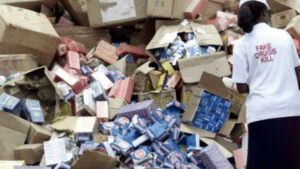
Iluyomade, Director of Investigation and Enforcement at NAFDAC, made the claim in August 2025 after the agency’s five-day enforcement operation at the Lagos Trade Fair Market, where more than 10,000 cartons of unregistered tomato paste and cosmetic products were seized.
“I can say authoritatively that deaths from substandard medicines, cosmetics and unsafe foods exceed the number of people killed by Boko Haram.
“This is why the agency remains committed to ensuring Nigerians use only products that have passed regulatory processes, assuring safety and effectiveness”, he told journalists.
Social scientists point to an entrenched network within the medicine importation chain, allegedly involving wealthy and well-connected players, as key drivers of the illicit trade.
Worse, many insist there is not sufficient deterrence on ground to discourage the blood-stained business.
Those caught somehow get off the hook and return to the nefarious trade soon after.
The social media is awash with calls from consumers to tighten the noose on all culprits, including life sentences.
According to the Director-General of NAFDAC, Prof. Mojisola Adeyeye, the battle against fake drugs is a relentless one.
She has repeatedly stressed that medicines should be obtained from authorised and licensed suppliers, while suspected falsified products should be reported to NAFDAC.
In June this year, NAFDAC launched an improved Med Safety App specifically to strengthen reporting of substandard and falsified medical products and adverse drug reactions.
The war against fake drugs starts from the borders.
A container arrives at a Nigerian port, declared as something innocent. On examination, however, Customs officers discover that its contents are not what the paperwork says.
Instead of legitimate goods, they find cartons of unregistered medicines, expired pharmaceuticals, products bearing questionable registration numbers and other substances that should never find their way into the Nigerian medicine market.
That is where Nigeria’s long-running battle against fake and substandard drugs begins.
For the National Agency for Food and Drug Administration and Control and the Nigeria Customs Service (NCS), the fight has moved beyond simply confiscating suspicious medicines. It now involves intelligence gathering, surveillance, raids, arrests, laboratory analysis, seizures, destruction of products and, in some cases, prosecution.
But the size of the seizures also reveals the scale of the challenge.
In July 2026, Customs handed over nine containers containing narcotics, fake medicines and unregistered pharmaceutical products to NAFDAC and the National Drug Law Enforcement Agency (NDLEA).
The seized consignments had a combined duty paid value of N53.39 billion. They included 339,800 bottles of codeine syrup, expired pharmaceutical products and fake or unregistered medicines.
Days earlier, Customs in Port Harcourt handed over expired medicines with a cost, insurance and freight value of more than N59 million to NAFDAC. The agency said the intervention prevented the products from reaching unsuspecting Nigerians.
These are not isolated incidents.
In February 2026, NAFDAC raided locations in Lagos and seized about N3 billion worth of suspected fake malaria medicines and cosmetics. Eight truckloads of products were removed during the operation, while four people were arrested. Investigations were launched into the activities of those allegedly connected with the products.
The operations illustrate the different roles played by the two agencies.
Customs is positioned at Nigeria’s ports, airports and borders, where it can intercept illicit pharmaceutical consignments before they enter the domestic market.
NAFDAC, on the other hand, is responsible for determining whether medicines are registered and compliant with regulatory requirements and for pursuing enforcement action against manufacturers, importers, distributors and sellers of offending products.
The relationship becomes particularly important when Customs discovers pharmaceutical products.
In July 2025, for example, the Apapa Area Command of Nigeria Customs handed over 25 containers containing counterfeit medications, unregistered pharmaceutical products and prohibited substances to NAFDAC. The consignments had a combined duty-paid value of N9.2 billion.
The seizure included unregistered medicines, codeine-containing cough syrups, antibiotic injections and tablets bearing fake NAFDAC registration numbers. Customs described the operation as exposing a sophisticated network attempting to circumvent Nigeria’s import regulations.
Another Customs operation in Port Harcourt exposed the lengths to which smugglers can go to bring illegal pharmaceuticals into Nigeria.
A 40-foot container declared as motorcycle spare parts was examined and found to contain 2,455 cartons of unregistered pharmaceutical products.
The discovery showed that the battle against fake drugs is also a battle against deliberate concealment and false declarations.
On July 2, 2026 during the handover of N53.39bn worth of seized narcotics, counterfeit medicines and expired pharmaceuticals to NAFDAC and NDLEA.
The Nigeria Customs Service Comptroller General, Adewale Adeniyi said the seizures resulted from intelligence gathering, non-intrusive inspection, physical examination and inter-agency collaboration.
International connections.
“These seizures represent far more than monetary value. They represent lives protected, families preserved, communities secured and countless young Nigerians shielded from the devastating consequences of drug abuse and unsafe medicines”, he said.
NAFDAC documented an intelligence-led investigation involving 31 containers of unregistered pharmaceutical products, including high-dose tramadol, allegedly shipped from India to Nigeria. The containers were reportedly disguised as building materials and intended for bonded terminals. NAFDAC tracked the containers across sea routes in cooperation with the Nigeria Customs Service. 21 were eventually intercepted at Apapa Port.
NAFDAC also issued an alert on falsified ZACEF-TZ injection identified in Nigeria. The product claimed to have been manufactured for JioPharm International in India, while the Nigerian marketer was identified as JAC Pharmaceuticals. NAFDAC said the registration number printed on the product was fake and did not exist in its database.
Fake drugs war hits markets
The ports are only the first line of defence.
Once illicit medicines enter the country, they can move through wholesalers, warehouses, open drug markets, pharmacies, patent medicine shops and informal distribution networks.
That explains why NAFDAC has increasingly taken enforcement operations directly into major drug markets.
In 2025, the agency conducted extensive raids across some of Nigeria’s biggest pharmaceutical trading centres, including Idumota in Lagos, Bridge Head Market in Onitsha and Eziukwu Market in Aba.
The operations resulted in the closure of thousands of premises and the evacuation of truckloads of suspected counterfeit, expired, unregistered and improperly stored medicines.
An analysis of NAFDAC enforcement records shows that the agency’s seizures and enforcement activities involved products valued at more than N1.1 trillion during the period examined.
At Idumota alone, more than 3,000 shops, warehouses and packing stores were screened and sealed during the operation.
The message from the agency was that fake drugs are not simply imported through ports; they are also stored, distributed and sold through domestic networks.
Arrests follow seizures
In 2025, NAFDAC arrested about 114 suspects during major enforcement raids, according to analysis of agency records.
However, only 16 cases proceeded to prosecution.
That gap between arrests and prosecution raises an important question of what happens after the cameras leave and the seized products are taken away?
The answer is crucial because seizure alone does not dismantle the business.
The people moving counterfeit medicines through Nigeria’s supply chain are not necessarily the same people whose names appear on shipping documents. Some may be distributors, warehouse owners or retailers, while the financiers and organisers operate further up the chain.
Consequently, investigators need to establish who imported the products, who financed the transaction, where the medicines were headed and who was responsible for distributing them.
That process can be lengthy and legally complicated.
Prosecution, the weak link?
The most difficult part of the battle may therefore not be discovering fake drugs but securing convictions.
Examination of NAFDAC enforcement records showed that the agency conducted 1,724 investigations and 19,204 surveillance operations in 2024. Yet, only 20 court cases were filed and six convictions were secured that year.
The previous year, NAFDAC conducted 3,486 investigations and 26,453 surveillance operations, while four court cases were filed.
The figures point to a disparity between enforcement activity and judicial outcomes.
Thousands of inspections and investigations can produce mountains of seized medicines, but if relatively few cases reach court or end in convictions, the deterrent effect may remain limited.
NAFDAC’s own enforcement records, however, show that prosecution is possible.
The agency has documented cases involving suspects accused of distributing counterfeit medicines, including cases involving Tramadol and other prescription medicines. Some suspects have been prosecuted at the Federal High Court in Lagos.
The challenge is to ensure that such cases do not remain isolated successes.
Why the trade persists
According to NAFDAC, the counterfeit-drug business survives because there is money to be made.
Fake medicines can be produced or acquired at much lower cost than genuine products and then sold through legitimate-looking channels.
For consumers struggling with the rising cost of living, the cheaper product can appear attractive.
That creates an especially dangerous environment: the consumer may not know that the medicine is fake, while the seller may deliberately exploit the buyer’s ignorance.
There is also the problem of sophisticated packaging.
Some counterfeit products carry registration numbers, brand names and packaging designed to resemble genuine medicines. In some cases, counterfeiters have even attempted to use fake NAFDAC registration numbers.
This makes enforcement and consumer awareness equally important.
NAFDAC has consequently continued to issue public alerts on falsified and substandard medicines and to warn Nigerians against purchasing medicines from unapproved sources.
Battle cannot end at the warehouse
According to experts, the partnership between Customs and NAFDAC is very important.
Customs can stop suspicious consignments at the border, while NAFDAC can authenticate medicines and pursue regulatory action. When necessary, other agencies become involved in investigation and prosecution.
They also believe the success of the war should not be measured only by the number of containers seized or trucks evacuated.
The real test should be whether the enforcement chain can move from detection to arrest, from arrest to prosecution and from prosecution to conviction.
A N53 billion seizure makes headlines. So does the seizure of N3 billion worth of fake medicines.
But the long-term victory will come when those who finance and organise the trade begin to regard it as a business with a high probability of detection and serious legal consequences.
Until then, the cycle can continue where a container is intercepted, a warehouse is raided, suspects are arrested, products are destroyed and another shipment begins its journey.
For NAFDAC and Customs, therefore, the war against fake drugs is no longer simply about finding the medicines.
It is about finding the people behind them.
And, more importantly, ensuring that the journey from seizure to courtroom to conviction is completed.
(The Sun)