
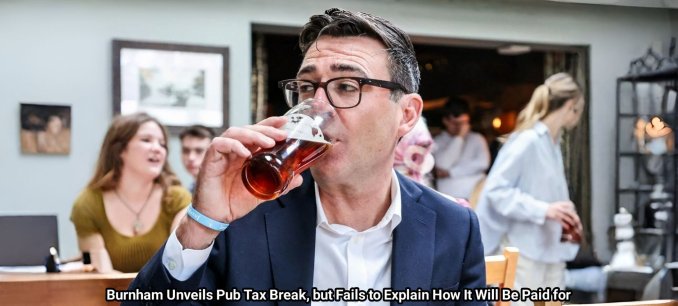
Burnham unveils pub tax break, but questions remain over how it will be paid for
CP

.
Prime Minister Andy Burnham has announced a 20 per cent cut to business rates for pubs, clubs and live music venues from April 2027, but ministers have struggled to explain, in full, how the £100 million policy will be funded.
Downing Street said the cut would save the average pub around £1,100 in the next financial year and benefit close to 32,000 hospitality venues across England. Announcing the move on Thursday, Burnham said his government would “back the businesses that people want to see in their communities,” and described pubs and high streets as “the beating heart” of local life.
Chancellor John Healey backed the announcement, saying pubs, clubs and live music venues “are at the heart of communities across the UK” and help keep town centres busy.
Government guidance published on GOV.UK said the changes would be fully funded, in part by reviewing rate reliefs for businesses judged not to make a positive contribution to their local area, such as vape shops, alongside a crackdown on online marketplaces that do not meet their tax obligations.
How ministers say it will be paid for
The government’s own explanation, repeated across several outlets, rests on two main measures: withdrawing rate reliefs from vape shops, on the grounds that they do not benefit their local areas, and tightening tax compliance among sellers on online marketplaces. Burnham had previously pledged to raise taxes on out-of-town warehouses used by online retailers such as Amazon to help pay for the cuts. No 10 also said it was consulting on ways to make online marketplaces more responsible for stopping non-compliant sellers avoiding tax.
Why the funding is being questioned
Despite that framing, senior figures in Burnham’s own government have been reluctant to confirm the money is actually secured. Emma Reynolds, the Chief Secretary to the Treasury, told broadcasters on Thursday that ministers were still “looking at” both the online retail tax rise and the vape shop crackdown, and that full details would only be set out at the autumn Budget. Pressed on whether she could say the pub policy was fully funded, she conceded the wording would only be accurate in future tense, saying it “will be” fully funded, rather than that it already was.
This is not the first Burnham policy to run into funding scrutiny. An £850 million cut to VAT on electricity bills, announced earlier in the week, had been linked by Number 10 to savings from Sir Keir Starmer’s scrapped digital ID scheme, but Darren Jones, who oversaw that scheme before being removed from Cabinet, said no money had ever actually been allocated to it. A separate pledge to cap single bus fares outside London at £2 was said to be funded by repayments from developing nations on climate loans, though Transport Secretary Heidi Alexander was unable to confirm whether any interest would be generated by those loans.
Matt Vickers, chairman of the Conservative Party, described the pub rates policy as the government’s “third unfunded spending commitment in three days,” and argued ministers had removed a larger, pandemic-era rates discount before offering back a smaller one.
Reaction from the hospitality sector
Industry reaction has been mixed. Iain Hoskins, who owns the Ma Pub Group in Liverpool, said a previous 15 per cent discount had ended up applying to only one of his five venues, because the rest did not have “pub” in their business name, and questioned how many venues would actually benefit this time.
Hotelier Steve Perez, whose venues include pubs and restaurants, argued the saving would make little practical difference given that his own business rates bill had risen by around 130 per cent, and noted the new discount does not extend to restaurants or hotels, even though many pubs now also serve food and offer accommodation.
The wider picture
The announcement follows a period of pressure on the hospitality sector after business rate reliefs introduced during the Covid pandemic were gradually withdrawn. A 15 per cent discount for 2026/27 was announced by the previous chancellor in January, with rates due to rise in line with inflation from 2027 to 2029; Burnham’s 20 per cent discount from 2027/28 builds on that. The rates-free threshold for small businesses, currently £12,000, has been frozen since 2017; Burnham has previously said he wants to raise it to £18,000.
With the detailed costings for all three of this week’s announcements (pubs, energy VAT and bus fares) now pushed back to the Budget, opposition parties and some in the hospitality industry say they will be watching closely to see whether the funding commitments hold up to scrutiny.
Image: https://creativecommons.org/licenses/by-nc-nd/4.0/
See Related Article Below
Burnham’s help for pubs is all froth, no beer
Save your cheering and whooping – the new PM’s business rates cut will make little difference to the hospitality industry
WILLIAM SITWELL
But such details are all tiresome froth for good times guy Andy Burnham, who is yet to offer serious ideas for turbo-charging the economy. Will he cancel what is actually crippling hospitality and small business – Starmer’s rise in National Insurance contributions for employers and the minimum wage – or reduce VAT to 10 per cent?
The Telegraph: continue reading
(UKR)





Taking a break from his modus operandi as a teenage influencer who finds himself UK Prime Minister, Andy Burnham has dished out another pretence of good will.
Today it’s a reduction in business rates for pubs, clubs and music venues, the sorts of places where you might hear his beloved band, The Smiths, via a jukebox or a tribute act. Or in the words of the official government press release: “Burnham means business: PM slashes business rates bills.”
This in the week that the new Prime Minister told the BBC: “I will always be honest with the public.” Words which came in the same breath as his utterance that this week’s new policies (ending rough sleeping, caps on bus prices and the removal of VAT in electricity costs) are “fully funded”. Good joke, mate, they’re decidedly unfunded.
They are all acts of sleight of hand by a magician, except that we can see through the apparent magic and Burnham is fast becoming a Tommy Cooper-type illusionist whose tricks go wrong, except with him it’s not funny.
We are indeed living in 1972 in that, for example, the temporary cut to VAT costs will save a family some 80p a week. Great for the early 1970s when that got you a whole chicken, an OK bottle of wine or four tickets to the cinema. But we’re in 2026, so it means one banana for the week, cut into pieces for a family of four.
Now I have a pub, The White Hart in Wiveliscombe, West Somerset, but you’ll need to save the cheering and whooping as we beckon in an era of triumph and success in hospitality. Because the heralded business rates cut turns to dust on just a scratch of analysis.
It’s a 20 per cent reduction from next April, which won’t save the two pubs a day which are currently closing (I make that 504 by April 1 2027). And remember that in last November’s budget, then chancellor Rachel Reeves increased business rates by an average of 79 per cent across the UK. So that crippling increase is merely reduced to 59 per cent.
As the chef Tom Kerridge, who is campaigning for a reduction in VAT, explains, it will save a typical pub £1,000 a year which, “on a yearly revenue doesn’t really make a difference”.
And why on earth does it exclude restaurants? Are they not also “the beating heart of our communities”, as the PM describes pubs? And of course the £100m it will cost is yet to be funded.