In the City of London the foreign share of sex crime arrests reached 66.9 per cent; in Derbyshire it hit 44.8 per cent. Nationalities with the highest rates included Afghans, Iraqis, Algerians and Somalis.
The two-tier reality of enforcement has also become impossible to ignore. An Ethiopian small-boat arrival housed in an Epping asylum hotel sexually assaulted a 14-year-old girl and a woman who tried to help him.
He received a 12-month sentence. Local residents who protested the hotel and the offender later received longer jail terms.
One father of two was given two years and nine months for violent disorder after adopting what a judge called a “fighting or boxing stance.”
Police Scotland has gone further, refusing FOI requests for aggregated data on call-outs, crimes and arrests at five asylum hotels.
Officers cited fears that releasing the figures would heighten community tensions and put people at risk of physical harm. The force acknowledged the hotels house asylum seekers and refugees yet argued that numbers could change over time and that incidents might be linked to protests rather than residents.
Scottish Conservative shadow justice secretary Liam Kerr called the refusal another example of public bodies following an SNP culture of secrecy.
The same pattern repeats across Europe. In Spain a CEU-CEFAS study found foreigners commit five times more rapes and four times more murders per capita than Spanish citizens.
They make up 31 per cent of the prison population. In Catalonia 91 per cent of convicted rapists are migrants, who form only 17 per cent of the population.
Penetrative rape cases rose 143 per cent between 2019 and 2024. Attempted murders nearly doubled over a similar period. Illegal property occupations saw foreigners accounting for 51.8 per cent of arrests.
Official Spanish figures show rape crimes tripled from 1,878 cases in 2019 to 5,206 in 2024 — an average of 14 rapes per day. Catalonia, Madrid and Andalusia led the surge. Sixty-four per cent of sexual assault and rape inmates are foreign nationals.
Eurostat data confirmed the continental scale: rape reports in Spain surged 322 per cent over the last decade, against an EU average rise of 150 per cent.
EU-wide sexual violence cases exceeded 250,000 in 2024, with nearly 100,000 rapes. Foreigners in Spain remain over-represented in serious crime even as the native population ages.
In France left-wing MPs, including Greens, tabled an amendment demanding public media reduce coverage of crime stories. They cited the murders of 13-year-old Lola and of Thomas in Crépol as examples of “political exploitation” by the right.
Marine Le Pen called the move a hallmark of totalitarian ideology that threatens the public’s right to know. French statistics already show foreigners responsible for 69 per cent of violence and sexual crimes on public transport, half of all crimes in Paris and 55 per cent in Marseille.
Germany’s 2025 police crime statistics show foreigners, 15 per cent of the population, responsible for 41 per cent of violent crimes and 38 per cent of murders.
They account for 39.1 per cent of serious sexual offences. Rape has risen 72 per cent since 2018. Afghans are 14 times more likely than Germans to commit sexual offences; Syrians are 11 times more likely to commit violence.
Knife crime runs at 29,000 incidents a year. In North Rhine-Westphalia foreigners commit 48 per cent of robberies.
Reported rapes in Germany reached nearly 14,000 in 2025, a 9 per cent rise on the previous year and a 72 per cent jump since 2018. Non-German nationals formed around 41 per cent of suspects for crimes against sexual self-determination.
In some states the over-representation reaches three to four times their population share. Hesse’s Interior Minister Roman Poseck noted that perpetrators with a migration background are overrepresented and that some arrive with “a completely wrong understanding of roles” regarding women’s rights.
Sweden Democrats MEP Charlie Weimers forced the European Parliament to confront the pattern after a Swedish police officer was beaten to death at a Copenhagen fan zone and a Gambian migrant in Milan stabbed a man 20 times “for fun.”
Weimers described the attacks as part of a broader wave undermining ordinary Europeans’ safety. Swedish Social Democrats voted against even holding the debate.
The refusal to publish the data sits against a starker warning delivered inside the same parliament.
At a conference titled “Civil War: Europe at Risk?”, Professor David Betz of King’s College London told MEPs that “Europe is on track for civil war.”
Marion Maréchal warned that cultural homogeneity — the main basis of trust between citizens — is eroding, producing societies of violence and mistrust.
A report mapped up to a thousand no-go zones across the continent. Betz described the trajectory as Balkanisation that could extinguish coherent national identities and lead to large-scale conflict resembling the Troubles or the Years of Lead, only on a continental scale.
British officials still claim the full nationality breakdown is too expensive or too risky to release. The Information Commissioner already rejected those arguments.
Campaigners note that partial data and FOI-driven releases have already painted a consistent picture: certain nationalities drive disproportionate shares of theft, violence and sexual crime, while native protesters face longer sentences than the offenders who provoked them.
Across Spain, France and Germany the same disparities appear, often followed by official efforts to limit public discussion rather than confront the numbers.
The legal battle is therefore not about administrative cost. It is about whether British voters are allowed to see the consequences of the migration policies successive governments have pursued.
Reform UK has pledged to publish the data and begin deportations. Until then, the Ministry of Justice will keep fighting in the courts to keep the full ledger closed.
Your support is crucial in helping us defeat mass censorship. Please consider donating via Locals or check out our unique merch. Follow us on X @ModernityNews.
See Related Article Below
It’s Not Your Imagination: Media Sanitizes Migrant-Islamic Identity in Violent Crime – Orders Come From the Top
RAIR FOUNDATION USA
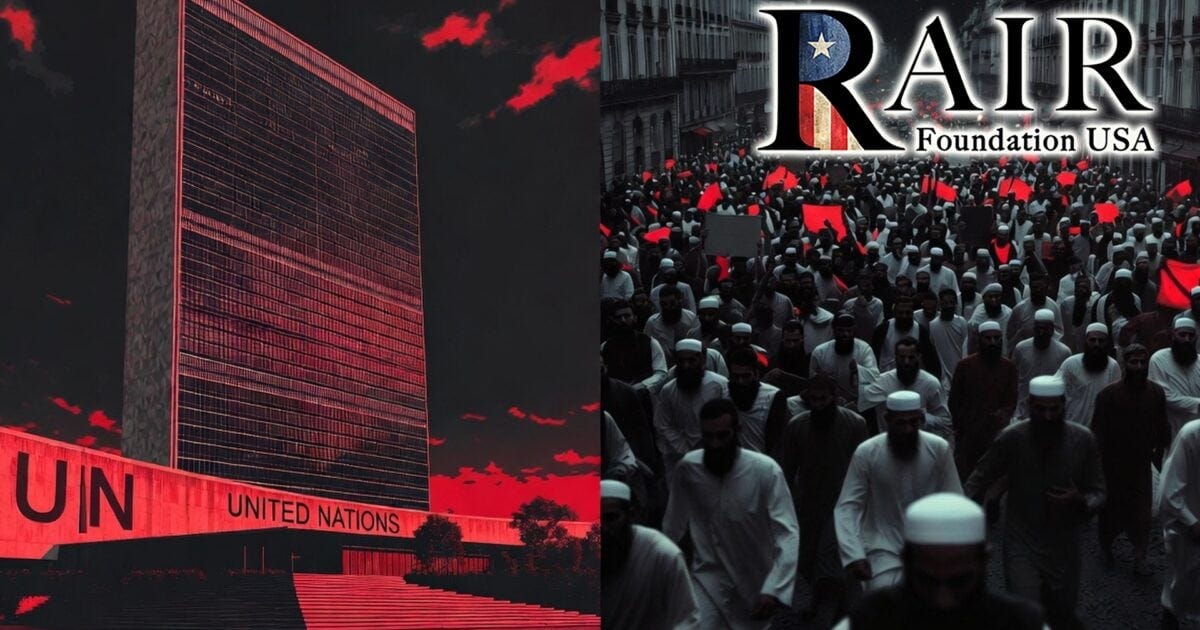
Mainstream European media, guided by the UN Global Compact for Migration and hate-speech policies, systematically conceals or downplays the migrant (often Muslim or African) backgrounds of violent perpetrators while freely detailing the identities of native European offenders.
By Vlad Tepes
European media’s consistent refusal to report the full identity, religion, and immigration status of perpetrators in horrific crimes is not incompetence. It is policy.
In case after case, the pattern is unmistakable: when the attacker is a migrant (often Muslim or African), mainstream outlets default to vague descriptions such as “a man,” “youths,” “locals,” or even misleading nationality labels, while the victim’s background is sometimes highlighted. When the perpetrator is a native European, details flow freely.
This is not random. It follows a clear set of guidelines established at the highest institutional levels.
In a Strasbourg press conference ahead of the Marrakesh conference, MEP Marcel de Graaff and colleagues warned exactly what the UN Global Compact for Safe, Orderly and Regular Migration would bring.
Though sold to the public as technically non-binding, it was designed to become the framework for national legislation and media behavior. And clearly that is exactly what it became.
De Graaff stated: “Criticism of migration will become a criminal offense… media outlets that give room to criticism of migration can be shut down… it will become impossible to mention that mass migration leads to explosive surge of rape and murder.”
Another MEP highlighted the UN’s earlier demographic replacement goals and the push to make migration a “human right.”
A German reporter covering the Compact at the time noted its cramped language but clear core message: Migration is good, always and without restrictions. He observed that while officially non-binding, it is politically and morally obligatory, with calls for media to be involved in “guiding” migration and financial consequences for those who do not comply.
The Compact was led by Louise Arbour, then UN Special Representative for International Migration. Today she is Canada’s Governor General, hand-picked by Canada’s Prime Minister, Mark Carney.
In 2016, she debated Mark Steyn at the Munk Debates, strongly defending large-scale refugee intake.
Below, Steyn refutes Arbour’s stance on Western acceptance of any and all migration.
Overseeing it all was UN Secretary-General António Guterres, a longtime socialist leader and former head of the Socialist International.
In a 2019 UN briefing on the “Strategy and Plan of Action on Hate Speech,” Guterres and colleagues launched a system-wide effort to combat “hate speech”, framing it as a precursor to violence while insisting it does not limit free speech.
Critics saw it as the perfect tool to police criticism of migration.
- In Milan, Gambian national Lamin Saidilly (with a prior UK stabbing conviction) stabbed a 55-year-old Italian man 20 times from behind. After the attack, he told police: “I had fun. As soon as I’m out, I’ll do it again.”
- In the Netherlands, 13-year-old Joni was stabbed in the back by a 14-year-old Turkish classmate for refusing to help in a robbery. The Turkish boy had previously stabbed a 65-year-old Dutch woman. After serving the maximum one-year juvenile sentence, he is free.
Time and again, when the perpetrator fits the “wrong” profile, key details disappear or are delayed.
The UN Global Compact and Hate Speech strategy, combined with EU-level pressure and national journalistic guidelines that discourage mentioning ethnicity/religion “unless relevant,” have created a de facto system of narrative control.
The result is exactly what the 2018 MEPs predicted: sanitization of migrant crime, protection of the open-borders project, and marginalization of criticism.
Europeans are not imagining the pattern. They are living it and paying for it with their safety and their children’s lives.
The media’s job is to inform the public so that citizens can make the best decisions for their own security, wealth, and well-being.
When the media instead becomes stenographers for a political project, and one clearly designed to dismantle the high trust society Western Civilization has enjoyed for centuries, security of the legacy population, continuation of the culture, and anything that Europeans would consider to be an aspect of their identity, public trust doesn’t just collapse. The people are rightly beginning to see their own governments as their enemies.
It is long past time to name the pattern, hold the institutions accountable, and demand honest reporting.
(UKR)