
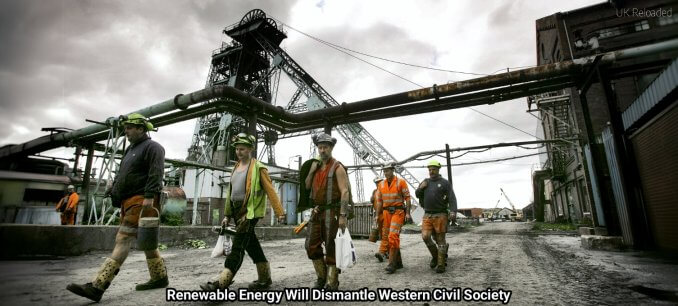
Renewable Energy Will Impoverish Humanity
Human prosperity is founded on the physics of dense energy sources like fossil fuels, says Dr John Constable
THE CLIMATE SKEPTIC
This is the eighth in a series of 13 articles challenging climate change orthodoxy commissioned by Professor Gwythian Prins. We will be publishing the articles at a rate of one a week (read the first article here, the second here, the third here, the fourth here, the fifth here, the sixth here and the seventh here). The hope is that they can be collected into a book for Sixth Formers and university students.
The modern world and the rich, free lives it brought are both dying in Britain. Energy consumption has fallen by about 30% since 2005 and electricity consumption by about 23%, both due to climate policy costs, and particularly that of renewable energy, subsidies to which amount to £25 billion a year, 40% of the total cost of electricity supply. Insofar as we are maintaining our standard of living, we do so by borrowing and importing the goods of fossil- and nuclear-fuelled Asia. That borrowing cannot continue indefinitely, and an abrupt reversal in distressed circumstances is all but certain, with the consequence that wind and solar are not only a threat to British prosperity, but to any realistic hope of reducing emissions.
To get out of this mess we must remind ourselves of the relationship between fuel quality and wealth, and act in accordance with those realities.
Stand anywhere in the world and starting from your skin look out and around you. Even in the remotest wildlands the environment will have been modified to suit your interests. Layers of intricate textile shield you against weather. In your backpack you have a container with pure water, clean and concentrated food, and in your pocket an electronic device that can send and receive signals as part of a worldwide network. The hills may be bathed in brilliant sunshine and clear air but also in manmade electromagnetic fields permitting you to establish your location, to summon help, to interrogate databases to identify any unusual flower or bird, to call your friends to let them know of your discovery or distribute photographs.
And this is human life at the simpler end of the spectrum. At the extreme of complexity, in an urban area, you will probably be within a fabricated structure with temperature and humidity regulation, controllable lighting, running water hot and cold, and a system to safely carry away your wastes. Controllable heat is available at whim to prepare food, and a low temperature food storage cabinet inhibits the growth of bacteria and moulds. The pantry will contain many other foods in airtight, pathogen proof membranes offering convenient, low risk nourishment. To an astonishing degree this whole space is free of hostile organisms and substances. And none of this will seem remarkable to you.
Around you there is an interconnected pattern of smooth roads with swift vehicles carrying family to visit, or goods to your door, or taking produce and things to shops not because you ordered them but just in case you might happen to want them.
And beyond that there is a spider’s web of things and services available or in preparation. Here, a theatre rehearsing a drama that you may choose to attend in a month, there a hospital training the surgeon whose lifesaving attentions you may require quite unexpectedly next year. Guided by computer analysis, factories in places over the horizon are anticipating a demand that you have yet to express, and power stations are planning to generate electricity precisely when you tend to turn on your kettle and make tea. Overhead pass sophisticated and safe aircraft that are nevertheless so cheap to run that they can import fresh vegetables from another continent and passengers who have no more urgent purpose for visiting the other side of the world than that they want to have a look at Uluru before they die.
And operating all this is an information system distributed over human minds and computers, a bio-electronic network mediated by cables, satellites and written and spoken communication between several billion human beings.
This is an improbable state of physics. In the jargon of science, it is distant from thermodynamic equilibrium and of low entropy, meaning that such a situation is vanishingly unlikely to come about by chance. And we have been in this fortunate position for a large part of human history and even prehistory. Our situation is comparatively extreme, but a hunter-gatherer band of a few dozen individuals is also in an improbable state. They may lack engines, but they can carry fire from place to place. They have only a few tools, yet these are exquisitely well-designed; and though illiterate they possess a detailed orally transmitted knowledge of territory, weather, animals and plants, enabling their families to prosper. Such human populations may seem to us simple, primitive even, but they too are impressively distant from equilibrium, and in an important sense they are rich, for wealth is an improbable state of the physics in relation to a human desire.
And, from that definition it follows that wealth is the result of changes to the world. To make such changes we must overcome one or more of the forces of nature, namely gravity, the electromagnetic force, or the strong or the weak nuclear forces. In physics this is called work, with the capacity to do work termed energy.
Energy is therefore by definition an indispensable requirement for the creation of wealth. Suggestions that economic growth can be decoupled from the consumption of energy are simply illogical in the technical sense and cannot be taken seriously. The creation and maintenance of wealth is proportional to energy consumption. Improvements are certainly possible in the efficiency of conversion, but, as W. S. Jevons pointed out in 1865 with his famous ‘paradox’, this increases the potential for wealth creation, and since there is no limit to our desires, energy consumption will always rise not fall. No candid person will ever say, for example, that child mortality is low enough. Energy, like cash, is never left on the table.
We derive energy from fuels, which are bits of physics that have the property of doing work. In this general sense all physical states are fuels, from the dried leaf that blew into my study through an open skylight, to the breeze that brought the leaf to me, as well as the solar radiation that allowed me to see it drifting down onto my desk.
But fuels vary greatly in their potential to cause change and in their ease of use. Generally, the more accessible the energy the less useful the fuel. The energy state of the leaf is of a moderate level and easily reached through combustion. The wind energy is ubiquitous and available at a temperature that does not threaten organic tissue, but is of a low quality, close to random heat, and almost incapable of work. Consequently, living organisms use winds only adventitiously, for seed dispersal say, not for fundamental metabolic energy. The fuel quality is simply too low, the entropy too high, to support life.
Solar radiation is better, and outside the earth’s atmosphere is of high quality. But on the surface of the earth, and as seen by a point receptor, a leaf say or a solar photovoltaic cell, it is degraded, being subject to a continuously varying angle of incidence, total occlusion at night, Rayleigh scattering, clouds and shadows. Plants do derive their metabolic energy from sunlight, but almost their entire structure is devoted to overcoming the disadvantages of the fuel. Those parts of plants which are not its reproductive organs are devoted to energy collection and storage. There is little or no sensory equipment, and they lack nervous systems capable of integrating information to support rapid movement.
By comparison even with the solar flux, fossil fuels have an elevated energy state. The reasons for this are curious. While we often say that coal is fossilised sunshine this is only part of the story. Plants are certainly superior fuels to the radiation which produced them, but if coal were just the sunshine collected by plants it would be no better than timber, which it demonstrably is. The reason for this difference is that the dead plant material was subjected to hundreds of millions of years of gravitational compression, increasing its energy density (and reducing its entropy), but also raising its temperature and resulting in chemical transformations driving its molecules into higher energy states. Bizarre though it may sound, coal’s energy can in part be described as ancient gravity. This makes fossil fuels exceptional pieces of physics and there is nothing to compete with them as fuels other than sub-atomic structures.
But fossil fuels, and nuclear fuels too, are difficult to use, requiring sophisticated conversion devices to resist high temperatures and pressures. Bootstrapping this took time. Indeed, human history can be read as the progressive adoption of better but more demanding fuels. Our hunter gatherers, for example, live in an improbable state because fire enables effective tool manufacture and extends the range of usable foods. But such a society is still fuelled by organic materials and thus limited. Contemporary populations, even those we call poor, inhabit a world many orders of magnitude more unlikely in its close correspondence to human wishes.
To achieve this, we certainly use a great quantity of energy, but the difference between the hunter gatherer and ourselves is not explained only in terms of quantity, but also and critically by the quality of our fuels. Coal, oil, and gas are more difficult to employ, but when converted they deliver energy not only plentifully from a relatively small volume, but at a remarkable rate of joules per second, enabling the achievement of very high temperatures.
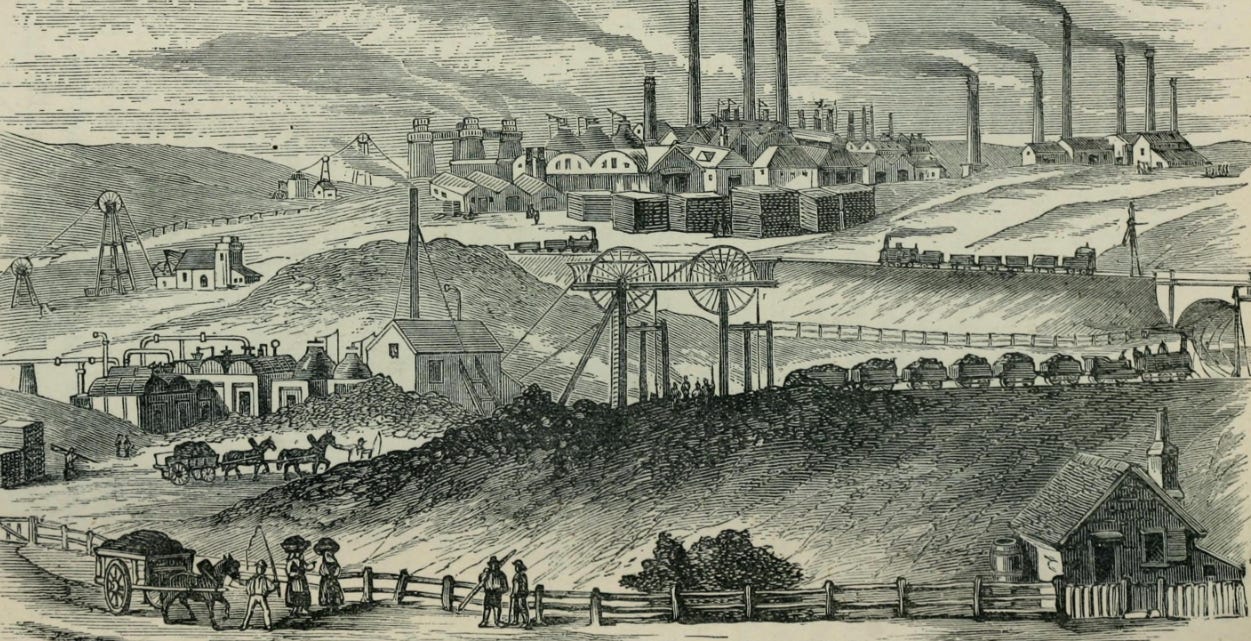
The high energy return on the energy invested in the collection and conversion of fossil fuels thus delivers a large surplus for other purposes, a fact which has consequences for the structure of society. The economies of the past were based on low return fuels, and, like plants, they were almost entirely devoted to energy collection and storage. Societies that adopted high return fuels had a greater surplus, and the high temperatures possible meant that many transformations previously so difficult as to be rarely or never produced, such as airflight, became commonplace. That is the story of Europe and then the entire world from the later medieval period to the present, and it first became evident in Britain, which by 1700 was 50% driven by the competent physics of coal. By 1850 our energy consumption had increased tenfold, and over 90% of that consumption was of coal.
The changes in British society during that period were staggering. Household wealth, houses and chattels combined, quadrupled in the first 50 years of the 19th century, growing faster even than population which itself grew fourfold from the 1700s to the 1800s. And employment was much more diverse in character. In 1600 about 80% of the male population worked in the primary sector, mostly agriculture. By the early and middle 19th century the workforce was some four times larger, and those in the secondary and tertiary sectors, manufacturing, dealing and services, comprised about 70% of the workforce. And this large and variously busy population could travel. In the 1840s British railways were already carrying 20 million passengers a year; but by the 1880s this had risen to nearly 800 million. It was a different kind of world. A child born in the 1600s would almost certainly work on or around a farm and rarely leave it, while someone born in the 1800s could increasingly go where they wished and do as they wished. To an unprecedented degree the mass of the people had become free.
Forcing the use of physically inferior fuels, such as wind and solar, will reverse this process. Renewable energy is intrinsically costly, requiring extensive resources to correct its entropic defects, and these resources, from wind turbines to batteries, are currently all derived from fossil wealth. A wholly or predominantly wind and solar fuelled economy will not be able to sustain those corrective technologies and at the same time provide a generous margin for other uses. So the system will shrink, energy consumption itself will fall and the human niche will narrow. General health will decline, rates of mortality will rise, household wealth will fall, travel will be restricted, and there will be little work outside the energy sector.
Our whole societal structure will move back towards the pre-coal past, when the energy sector and its owners were socio-politically dominant. Such a society will be internally miserable and externally vulnerable to enemies who have not neglected thermodynamic realities. Could any sane person want such a future for their descendants?
Dr John Constable is Director of the UK charity Renewable Energy Foundation and author of Europe’s Green Experiment (2022) and Powering Freedom: The Thermodynamic Roots of Modernity (2025), amongst other studies. He also holds joint positions as Davis Family Professor of Energy, Economics and Civilisation and Director of the Future of Energy Institute at the University of Austin, Texas (UATX).
See Related Article Below
Remove Crude Oil, and You Don’t Merely Dim the Lights. You Dismantle Western Civil Society, Which Is Whole Point for Radicals!
RONALD STEIN
Guest Post from Ronald Stein, P.E., Yoshihiro Muronaka
Can a zero-emissions world survive without crude oil?
That is the wrong question.
The zero-emissions debate asks when we can stop burning crude oil. The harder question — one that remains largely unasked — is what do we propose to make things from once we do.
Electricity generated by wind and solar cannot be poured into a mold to produce a medical device, spread on a field as fertilizer, or refined into the lubricant that keeps the wind turbine itself from seizing.
More than 6,000 products and transportation fuels that underpin modern civilization are derived from crude oil as raw materials. Remove the crude oil, and you do not merely dim the lights. You dismantle the material foundation of industrial society.

Wind turbines and solar panels generate electricity — but electricity alone cannot sustain modern civilization. Energy leaders rarely acknowledge what crude oil uniquely provides. Consider what it alone supplies:
- Jet fuel for military and commercial aviation — approximately 100,000 flights daily worldwide.
- Diesel for trucks, trains, ships, and construction equipment.
- Gasoline for approximately 1.6 billion vehicles on this planet.
- Bunker fuel for the roughly 100,000 merchant vessels that carry 90 percent of world trade.
- Feedstocks for fertilizers, pharmaceuticals, plastics, and synthetic fibers.
- Lubricants and hydraulic fluids for every category of machinery — including wind turbines and solar panel manufacturing equipment.
Planes, ships, trucks, and factories run on products manufactured from crude oil by multi-billion-dollar refineries. These are not legacy inconveniences to be engineered away. They are the material foundation of modern life, and no amount of electricity from wind or solar can substitute for them.
Every Nation Runs on a Different Clock
Discussions of crude oil dependency are often built around American conditions, but the reality differs sharply by country. What a sudden supply disruption would mean depends on each nation’s combination of four distinct capabilities: domestic reserves, extraction capacity, refining infrastructure, and petrochemical manufacturing. No two countries share the same profile.
The United States holds domestic production and refining capacity, yet even there, the ongoing closure of California refineries illustrates how quickly regional infrastructure gaps translate into transportation fuel shortages. A state with abundant sunshine and aggressive renewable targets still depends entirely on petroleum-derived products for the functioning of its economy and the materials of daily life.
Today, with Hormuz transit severely disrupted by the Iran conflict, Japan is reportedly drawing down those reserves while simultaneously securing alternative supplies for crude oil from producers outside the Middle East. No renewable electricity target can substitute for this scramble to secure the physical availability of crude oil and its derivatives.
Meanwhile, roughly 60 percent of the world’s population — about five billion people — lives on less than ten dollars a day. These are not yet heavy consumers of petroleum products, but they aspire, as all people do, to reliable food, clean water, modern medicine, and durable shelter. At an industrial scale, every one of those aspirations depends on petrochemical inputs. The developing world has not fully joined the petroleum economy, and the answer to that fact cannot be to deny them the materials that already-industrialized nations used freely in building their own prosperity.
Each country runs on a different clock. Some would feel a supply shock within days; others have buffers measured in months. But all clocks, without crude oil, eventually stop at the same place.
The Horizon That Keeps Moving
For half a century, the world has been told that oil will run out in roughly forty years. That warning was issued during the 1970s oil shocks. It was repeated throughout the 1990s and 2000s. It is still being issued today, and the number has barely moved.
The world currently holds approximately 1.77 trillion barrels of proved reserves, a reserves-to-production ratio of about 47 years at current consumption levels. Yet this ratio has remained near 40 to 50 years for decades, even as the world consumed tens of billions of barrels annually. Proved reserves are not a fixed inventory. They are a running calculation: as technology advances and economics shift, resources once considered unextractable migrate into the proved category. Shale oil, deepwater fields, and enhanced recovery techniques have each added decades to the count. The horizon keeps moving because human ingenuity keeps moving it.
This does not mean oil is infinite. It means that treating the reserves-to-production ratio as a countdown timer misreads how resource development works. The evidence points to a simpler conclusion: the world has consistently found ways to extend access to this resource — and there is no sign this process has ended.
The Refinery: Civilization’s Conversion Point
One element is consistently overlooked in the rush to count barrels: crude oil in its raw form is useless. No one fuels an aircraft with unprocessed crude. The black liquid from oil fields only becomes the fuels and feedstocks civilization depends on after passing through a petroleum refinery — one of the most capital-intensive and technically sophisticated facilities ever built, representing investments of several billion dollars and years of permitting and construction.
This is why the question of crude oil cannot be reduced to a question of emissions. The refinery is not merely a source of carbon dioxide. It is the conversion point between a raw natural resource and the material requirements of modern life. Policies that accelerate refinery closures — without any credible alternative for producing the same spectrum of products — are not cleaning the air. They are removing a linchpin.
Learning to Live with It Wisely
None of this is an argument for recklessness. Efficiency, cleaner processes, and reduced waste are goals entirely consistent with acknowledging crude oil’s irreplaceable role as a raw material. What the evidence does not support is the proposition that oil can be eliminated from the human economy through mandates and deadlines without catastrophic disruption to the material foundations of civilization.
This 4-billion-year-old planet has provided humanity with an extraordinary endowment of resources. The appropriate response is not to declare that endowment a crisis and race to abandon it, but to use it responsibly, innovate continuously toward cleaner processes, and extend its benefits to the billions who have not yet had full access to them. The future will not be secured by banning carbon. It will be secured by learning to live with it wisely.
Ronald Stein, P.E. is an engineer, energy consultant, speaker, author of books and articles on energy, environmental policy, and human rights, and Founder of PTS Advance, a California based company.
Yoshihiro Muronaka, P.E., JP is a chemical engineer who currently focuses on evaluating net-zero and decarbonization policies, advocating alternative energy concepts such as “carbon symbiosis,” and promoting balanced international energy cooperation.Please share this information with teachers, students, and friends to encourage Energy Literacy conversations at the family dinner table.
Click this Link to Sign up for Energy Literacy from Ronald Stein.
(UKR)