The Met Office has warned that “intense” rain is set to fall with “a vengeance” on Britain this week. Laura Dodsworth spies the insidious role of ‘nudge’ and behavioural science in trying to manipulate the public.
A tweet from the Mayor of London stopped my thumb today.
From 3am, London is at risk of severe flash floods. Intense downpours could see up to 50mm of rainfall arrive in the space of just a few hours – almost the total average rainfall for August. Don’t be caught out – check your insurance covers flooding and see what more you can do to prepare.
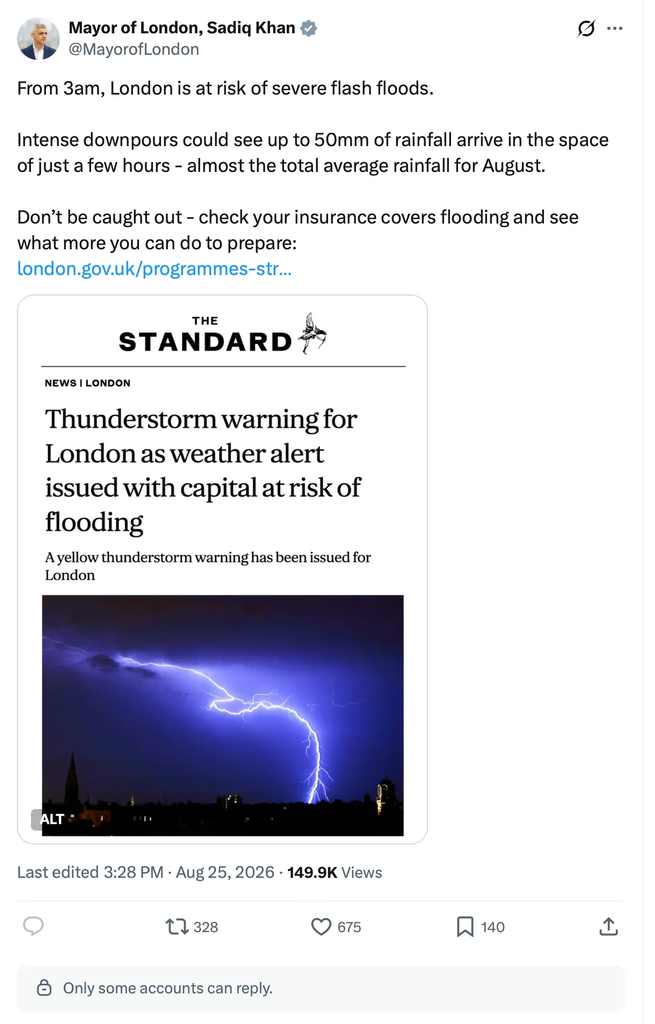
It’s disappointing to hear that the best summer of my entire life might be over. But 50 millimetres? A whole month’s rain in a just few hours. This got my attention with a jolt, just as it was supposed to.
The Met Office also warns:
The rain returns with a vengeance this week. Whilst rain is welcome for many, for others it brings the risk of torrential downpours, flash flooding, lightning and hail. How has the atmosphere switched so dramatically? Watch this week’s Deep Dive with Aidan
Vengeance, you say? This sounds bad. It also sounds like personification. The rain returning with a vengeance uses narrative language rather than dry meteorological terms, providing emotional and vivid framing. And this is processed faster and remembered better than neutral language, which increases perceived threat.
The clauses are out of balance too. The rain is welcome for many on one hand, but on the other brings four very unwelcome consequences: “torrential downpours, flash flooding, lightning and hail.”
Luckily, a first-name presenter is waiting behind a link, ready to be your friend. He’s also prepared to take you on a Deep Dive. And what do you dive into? That’s right, deep water.
I have written before, in ‘The forecast is… nudging to Net Zero‘, about the way the weather forecast has become one of the more reliable temperature checks we have for the state of nudge in British public life and I must inform you that the mercury has not come down since.
Finding myself more curious about where the behavioural science trail would lead, rather than the weather tonight, I found the Met Office’s ‘WeatherReady’ campaign, which is worth reading in full because it is rather unguarded about its own method.
It tells you, more or less in as many words, that its job is not simply to forecast the weather but to change what you do about it, and it backs this up with compliance statistics lifted straight from the nudge unit playbook: 99% of people in the red warning area for Storm Éowyn were aware of the warning, it says, and 95% of them “took action”. For Storm Amy, 92% were aware and 90% took action. I don’t doubt the numbers. (Well, maybe I do.) But I do doubt what they’re doing there — they are dressed up as evidence, rather than what they actually are, which is a description of a population that has been successfully trained to comply.
None of what follows requires you to take a view on whether the forecast is accurate, whether man-made climate change is real, or whether Net Zero is a sensible policy, nor whether complying with storm warnings is sensible. This piece is only interested in the mechanism: how a public body gets you to feel something and then do something
Think of this Substack as an umbrella, shielding you from a torrent of nudges dropping on your head from on high.
The techniques
Loss aversion framing
“Don’t be caught out” and “check your insurance covers flooding” are both built around the prospect of losing something you already have, rather than gaining something new. Decades of behavioural economics tell us we are more strongly motivated by the fear of loss than by an equivalent promise of gain, so official messaging defaults to it almost as a reflex.
Vivid, specific numbers deployed for effect rather than context
“Up to 50mm of rainfall” sounds authoritative and precise. It is also, notice, an upper-tail figure presented without the central estimate or the probability attached to it, which is precisely what makes it so useful rhetorically: a specific number reads as more credible than a vague adjective like ‘heavy’, whether or not it is the number you are actually likely to experience. (Remind you of Covid modelling?)
Comparative anchoring
“Almost the total average rainfall for August” takes an unfamiliar figure and anchors it against something the reader already has a rough feel for: a month’s worth of rain. This is how you make 50 millimetres feel dramatic to someone who has no intuitive sense of what 50 millimetres means.
Manufactured urgency
“From 3am” gives the warning a hard deadline within hours. Urgency is one of the most reliable levers in the nudge toolkit precisely because it short-circuits the part of us that would otherwise simply wait and see.
Authority
Both tweets lean on the borrowed credibility of office, the Mayor of London and the Met Office. We are conditioned to extend trust to recognised institutions without doing the work of independently verifying every claim they make, which is precisely what makes institutional messaging so much more efficient than persuading you would otherwise be.
A small, specific, low-effort ask
“Check your insurance covers flooding” is one concrete task that takes very little time. Vague appeals to caution rarely convert into behaviour.
Personification
Rain does not “return with a vengeance” it simply falls, lightly or heavily. Vengeance is a human motive, borrowed here to cast the weather as an adversary with intent and increase the feeling of threat.
The curiosity gap
“How has the atmosphere switched so dramatically?” is not a genuine question. The Met Office ‘knows’ the answer and is choosing to withhold it, in order to create the small unresolved itch that only clicking through will scratch.
Two-sided framing used to build trust rather than balance
“Whilst rain is welcome for many, for others it brings the risk of…” performs even-handedness while actually according the threat a four-item list. Sounding balanced is not the same as being balanced, but the appearance of fairness is persuasive which increases certainty.
Social proof
The Storm Éowyn and Storm Amy figures are there to tell you what ‘normal’ behaviour looks like, so that not complying feels like the deviant choice. This is descriptive norm-setting, the same device behind “eight out of 10 cats prefer Whiskas”.
Halo effect by association
The WeatherReady article name-checks the NHS, the RAC, the British Red Cross, the RNLI, Age UK and the British Veterinary Association, without drawing substantively on any of their specific expertise. It is authority laundering, and is a well known technique in campaigns that want to look more authoritative than any one voice within them actually is.
Civic duty and guilt framing
“Reduce the load on emergency services” and “look out for your neighbours” reframe an individual safety instruction as a moral obligation to the collective. Of course, these are good things, but declining to comply is no longer simply your own business, it is mildly antisocial, which raises the cost of saying no. (Again, remind you of Covid?)
Pre-emptive credibility
The WeatherReady article opens by telling you that “weather in the UK is famously difficult to forecast” — a very useful disclaimer, so that if this week’s forecast overshoots or undershoots, the miss has already been pre-forgiven. (Once more, if you were paying attention during Covid, you know this already.)
I’m afraid my conclusion is rather dry. We do not know what the weather will do tonight. Nobody does, reliably.
What we do know, and what the Mayor of London’s X feed won’t tell us with the same urgency, is that the UK’s national terror threat level is at Severe, and that London’s own Metropolitan Police force area still has the highest per-capita knife crime rate of any police force in England and Wales, even without Deep Dive with Aidan to explain it.
By all means take out contents insurance and keep a brolly by the door. That is just good sense, forecast or no forecast. But it might be worth keeping your wits about you a little more broadly than the Mayor of London’s timeline would suggest, because the risks that don’t come with a panoply of behavioural science tactics are still risks.
(UKR)