
PAUL BIRCH
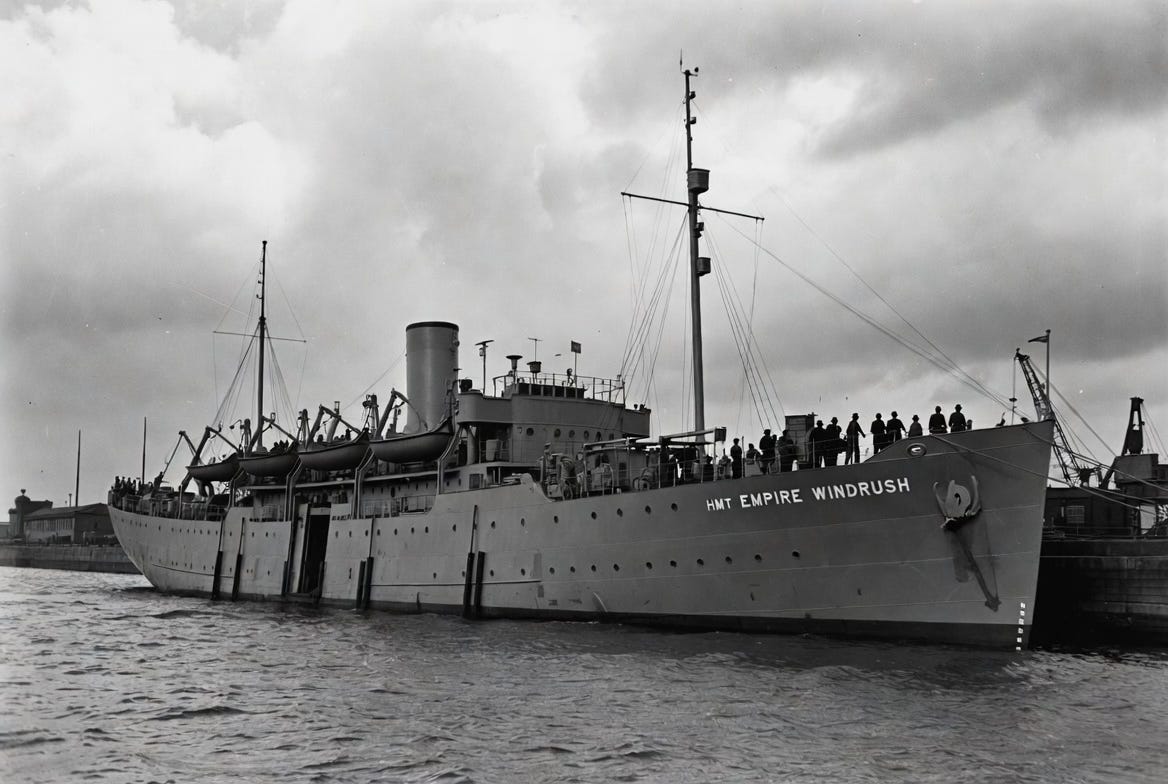
June 2026 marked 78 years since the nondescript ship ‘HMT Empire Windrush’ docked at Tilbury, England. Few ships have been exploited so relentlessly by the British state and its cultural outriders. In today’s Yookay, Windrush is no longer merely a vessel; it has been repurposed as a creation myth, the authorised foundation story of modern, vibrant, multicultural Britain.
Its voyage is minted on coins, sanctified by museums and drilled into schoolchildren as a moral lesson. The Imperial War Museum, stepping wildly outside its remit, called it ‘one of the most foundational moments in British history’. Across the country, the same mantra is recited with official piety: Britain called, and the Caribbean answered.
Unfortunately, this intonation just isn’t true. The Windrush left Kingston, Jamaica, on the 24th May 1948 carrying several hundred West Indian men. The ship’s operator expected to sail below capacity, so offered cheap berths at short notice. Local men in the Caribbean, unsurprisingly, seized the chance.
Far from summoning them, the British government flinched. A Privy Council memo sent to the Colonial Office on the 15th June warned that helping the new arrivals might ‘encourage a further influx’. Colonial Secretary Arthur Creech Jones predicted: “They won’t last one winter in England.” (The year prior to the Windrush voyage saw one of the most severe British winters on record). These are not the voices of a grateful nation welcoming invited workers. It is the voice of a nervous government praying the whole thing would go away.
Labour Minister George Isaacs warned that men arriving “under no organised arrangement” would cause “considerable difficulty and disappointment”. He hoped “no encouragement” would be given to others. Then, on the very day the Windrush arrived, eleven Labour MPs wrote to Prime Minister Clement Attlee urging controls on immigration “in the political, social, economic and fiscal interests of our people”.
Attlee tried to play the episode down, writing on the 5th July that it would be ‘a great mistake’ to take the arrival too seriously. At most, he expected a ‘steady trickle’ – very much like Tony Blair disingenuously stated in the early noughties regarding the influx of Eastern European migrants.
The key was the 1948 British Nationality Act. Canada’s 1946 citizenship law had forced Britain to clarify the status of Commonwealth subjects. The answer it produced turned out to be truly pivotal: those holding UK-issued passports could enter the mainland. But it was never intended to allow the mass migration of new Commonwealth subjects to Britain. The possibility was barely discussed in Parliament, the press or administrative documents.
In short, Britain did not fling open the doors out of enlightened design. It stumbled into a liberal immigration regime through sloppy drafting, imperial self-deception and official complacency. Then it spent the next twenty years trying to regain control of a system its own political class had failed to understand.
The numbers began slowly, but the surge really came in the mid-1950s. Caribbean migrants were soon joined, and then outnumbered, by arrivals from South Asia. In the late 1960s and early 1970s, more people of South Asian origin fled ethno-nationalist prejudice in Kenya and Uganda and came to Britain. By then, successive governments had legislated to close the route but, in reality, it was too late for anyone wishing to turn the clock back.
The ‘call’ narrative also performs a useful trick. It collapses wartime service, later recruitment schemes and spontaneous migration into one morally convenient blob. There were wartime labour shortages, and some colonial volunteers helped fill them. But this has been lazily folded into the quite different story of post-war economic migration, because complexity is fatal to slogans.
Direct recruitment did exist, but later and on a much smaller scale. In 1955, Barbados developed a scheme through which London Transport and other bodies could recruit workers directly from the island. Jamaica and Trinidad later joined. The NHS also trained young women from the Commonwealth as nurses. These initiatives mattered, but they accounted for only a minority of Caribbean immigration. So why has Windrush been inflated into the master-symbol of modern Britain?
Because nations need stories, and ruling classes need alibis. The Windrush story is emotionally and politically convenient. It offers descendants of Caribbean migrants a dignified account of arrival, contribution and belonging. But it also offers the modern establishment something even more useful: a founding scene for multicultural Britain, a cleansing ritual in which old imperial Britain is theatrically denounced while today’s institutions present themselves as redeemed, enlightened and morally superior. The fact that the National Health Service was also founded in 1948 gives the establishment of the Yookay a definitive cross in the calendar. And in the previous year, India and Pakistan were given their independence, one of the most significant moments in the dismantling of the British Empire.
Yet Windrush wasn’t treated as sacred scripture at the time. It barely featured in early accounts of Caribbean migration. But, as with many of the progressive falsehoods, the story hardened into civic theology under Tony Blair’s Labour government in the nineties and noughties. The effusive documentaries, the renaming of streets, official speeches, monuments and school lessons all helped turn one unremarkable ship into a national parable – and then into a loyalty test for anyone unwilling to confuse commemoration with historical submission.
The state-sponsored version amputates the awkward limbs of the story: bureaucratic confusion, official anxiety, political resistance and sheer historical accident. The passengers came not because Britain issued a grand summons, but because they were British subjects exercising rights ministers hadn’t thought through.
That distinction matters. A country which can’t (or won’t) tell the difference between history and civic fable can’t understand itself. Windrush has become a state-sponsored fairy tale. The migrants were not extras in a government recruitment campaign or symbolic props in a late twentieth-century morality play. They were people acting on opportunity and legal status, quite understandably. They stepped into a country whose rulers couldn’t have begun to grasp what their arrival would mean.
Only one, Enoch Powell, had the foresight to understand the potential ramifications of unfettered immigration. His long public career is overshadowed by a single, explosive moment: his 20th April 1968 so-called ‘Rivers of Blood’ speech attacking the race relations legislation of the time. Powell’s speech unleashed decades of accusations that he was racist, although Powell insisted he had condemned immigration policy, not race. And the speech didn’t contain the phrase ‘rivers of blood,’ rather this specific reference to the Greek epic poem, the Aeneid: “As I look ahead, I am filled with foreboding; like the Roman, I seem to see ‘the River Tiber foaming with much blood’.”
Looking at the subsequent history of migrant origin populations in Britain, and the way our cities, in particular, have changed forever, it is hard to disagree with Powell’s prescience, despite the Commentariat saying the whole thing was worth it because we’ve got some good footballers.
The honest slogan of the Windrush tale is not “you called and we came”. It is harsher, truer and far less useful to the liberal myth-makers: “they came, we panicked, and then we built a monument to our own folly”.
(UKR)