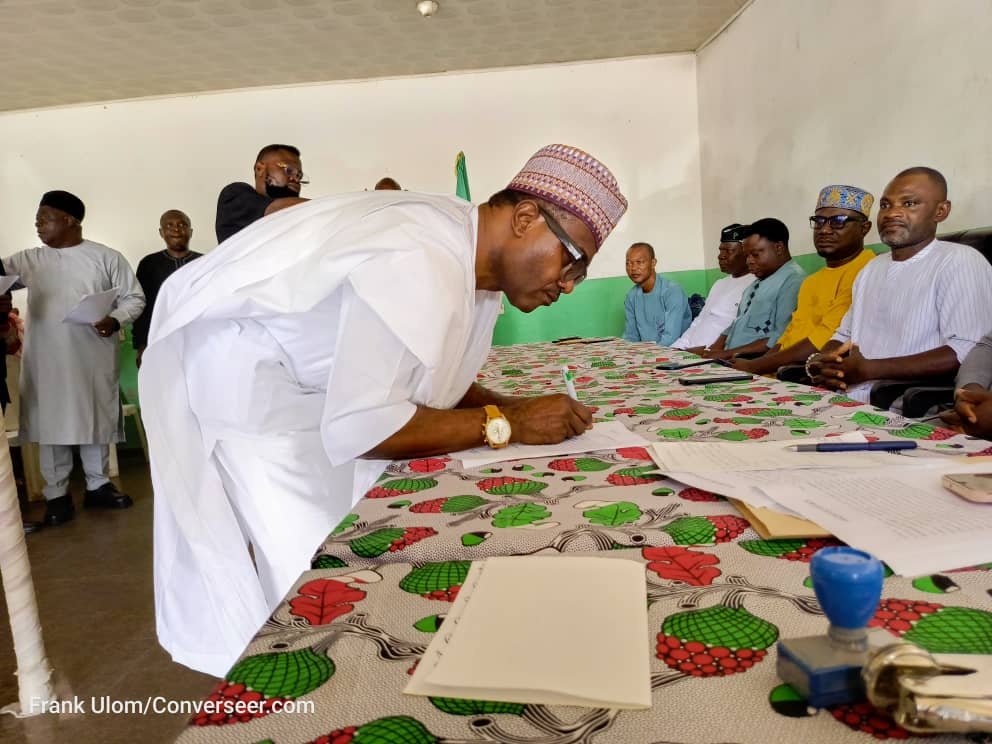
The Abia State Governor, Dr Alex Otti, has assured residents that communities yet to benefit significantly from his administration’s development projects will not be left behind, saying government interventions will eventually reach every part of the state.
Otti gave the assurance on Saturday while speaking at Amaku Nvosi, Isiala Ngwa South Local Government Area, during the traditional marriage ceremony of Oluomachi Nwaobia, daughter of the Archbishop of Aba Ngwa Province of the Anglican Church, Most Rev Isaac Nwaobia, and Jude Emeanaa.
The governor said the pace of development recorded in Abia since his assumption of office should be regarded as the foundation of a broader transformation that would ultimately extend across the state.
He acknowledged that some communities were yet to experience the full impact of his administration’s projects, but urged residents to remain optimistic as the government continues with its development plans.
According to Otti, the administration has been in office for only three years and a few months, leaving considerable time to consolidate and expand the ongoing transformation.
“This is just the beginning. This place has to be a different place and the dignity of our people will be restored.
“We are in the process. We are not there yet. But we’ve just done three years and a few months,” he said.
The governor expressed confidence that Abia would witness a more significant transformation if the current development trajectory was sustained throughout an eight-year tenure.
“By the time we do eight years and then bring someone who is better than us, because anybody succeeding me must be better,” Otti added.
He consequently appealed to residents not to be discouraged by the fact that some areas were yet to receive major government projects, stressing that the administration was working towards achieving statewide coverage.
“So, you can imagine what Abia will look like, and it is possible, let us not lose hope. We’ve not touched everywhere, but we are in the process,” the governor assured.
Otti congratulated the couple and advised them to handle disagreements with patience and mutual understanding, rather than allowing conflicts to weaken their union.
He also acknowledged Archbishop Nwaobia’s support for his political journey, describing the cleric as a principled individual who stood by him and his political aspirations even when such support was not convenient.
Otti said the Archbishop’s prayers and encouragement, alongside those of others who supported his political journey, contributed to his emergence and the progress his administration is currently recording in Abia.
Earlier, Archbishop Nwaobia expressed appreciation to the governor for attending the wedding ceremony despite his official engagements.
The cleric recalled his first encounter with Otti in 2012 during the opening of the Owerrinta branch of Diamond Bank, saying their relationship continued to grow after another meeting at a presentation focused on repositioning Abia State.
Nwaobia said Otti’s vision for the state impressed him and motivated him to lend his support to the governor’s political ambition.
He expressed gratitude to God for giving Otti the opportunity to implement his vision for Abia, noting that the policies and programmes of the present administration were already producing changes in the state.
The Archbishop prayed for continued divine wisdom, good health and strength for the governor, asking God to enable him to successfully fulfil his mandate to the people of Abia.
(The Whistler)